Autonomous Time Lapse With A Video Camera Throwie

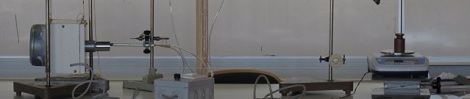
When [Matt] came across a small video camera made to fit onto a keychain, the first thing that came to mind is a time-lapse video throwie. Like the LED + coin cell battery + magnet we’ve seen we’ve seen before (and deployed…), [Matt]’s video throwie would be deployed in interesting spots for a few days and shoot a time-lapse video until the battery ran out.

The camera [Matt] picked up has the capability of shooting video or still pictures and writing them to a microSD card. To make his camera film a time-lapse video, [Matt] connected an ATtiny45 to the camera shutter and power buttons and uploaded a short bit of code that would snap a picture ever 15 seconds.

Right now, [Matt] is having a few problems with his video throwie. When the camera is turned on, it iterates through the SD card to find the next unused file name. This eats up a few seconds, so the current setup will slowly speed up the time-lapse video. This isn’t an insurmountable problem, so we’re looking forward to the very interesting videos these tough little cameras will film.

Check out [Matt]’s video of ice melting after the break.

Continue reading “Autonomous Time Lapse With A Video Camera Throwie”

Putting QR Codes In Copper

Former Hackaday contributor [mikeysklar] has been trying to etch a QR code into a sheet of copper. Although his phone can’t read the CuR codes he’s made so far, he’s still made an impressive piece of milled copper.

The biggest problem [mikey] ran into is getting Inkscape to generate proper cnc tool paths instead of just tracing a bitmap image. He’s got the CNC part of his build under control, but he still can’t find a QR code reader that will register his work.

We’re no stranger to QR codes here at Hack a Day, and it’s very possible the only thing that could be stopping [mikey]’s QR code from being read by a phone is the contrast of the image. We’re thinking a little bit of printer’s ink forced into the non-copper part of the PCB would make the QR code register. Since [mikey] already has a very nice negative etching of his QR code, he could easily use his new board as a printing plate, making infinite paper copies of his copper-based QR code.

If you’ve got any ideas on how [mikey] can get his QR code working, post them in the comments.

Hackaday Links: April 11, 2012

This hurts our head

You know you can ‘freeze’ drops of water in mid-air by flashing a LED at the right time, right? Well, according to this video you don’t even need a strobing light; just use the frame rate of the camera. Much cooler if you don’t know how it works, in our humble opinion.

Now do Junkyard Wars!

[James Cameron] and [Mark Burnett] (the guy who created Survivor) are bringing Battlebots back to the Discovery Channel. The new show is called Robogeddon and calls upon the current talent in the fighting robot world. Our prediction? Someone is going to build an amazing piece of art that will be completely destroyed in the first round; a wedge with wheels will take the championship.

A steam engine made out of rocks

[Hansmeevis] just spent 230 hours hand carving a steam engine out of gems. It’s called “Dragon’s Breath” and it’s an amazing piece of work: the cylinder is carved out of quartz, while the flywheel, mount, and base are carved out of jasper, onyx, zugalite, and other semi precious gems. Amazing artistry and it works.

Don’t lose a finger on all that science over there

[Dr. W] is a science teacher in Saint-Louis, France. Next year, his students will be learning about reaction propulsion and impulse conservation. To demonstrate these properties, [Dr. W] hacked up an old vacuum cleaner in to a jet engine and built a Pitot tube to measure the 140 km/h wind speed. Google translation.

Circuit bending a Sega Saturn

Making cool glitched-up graphics from Ataris and Nintendos is old hat, but not much has been done with circuit bending slightly more modern consoles. [big pauper] found his old Sega Saturn in his grandma’s attic and wondered what secrets this forgotten box held. It turns out he can make some pretty cool sounds and even cooler glitched out graphics. The pic above is from Virtua Fighter; done correctly these glitched low-polygon graphics could easily find themselves in a very stylistic indie game.

A Six-year Adventure Into The World Of CNC Fabrication

Hackaday doesn’t always get the entire back story of a build. The usual assumption is that someone decided to build something, and with just a little bit of effort the project makes it into the Hackaday tip line. This doesn’t do justice to the builder, with skills honed after years of practice and experience. A 200-word summary is deceiving, and makes everything look almost too easy. [Michal] decided to buck that trend and sent in his half-decade long adventure of becoming one of the best micro-scale machinists we’ve ever seen.

In 2006, with years of robots made out of hot glue and cardboard behind him, and the quality of 3D printers not up to his exacting specifications, [Michal] snapped. He sunk the better part of $3000 into a Roland MDX-15 desktop mill. After several months of futzing about with acrylic sheet, [Michal] came across the wonderful machining properties of modeling board.

Determined to do something useful with this modeling board, [Michal] started looking into resin casting. Casting in resin is a common technique in the artist and model maker communities to mass produce small plastic parts. After getting his hands on eight liters of polyurethane resin, [Michal] made a useful part guiding the direction his skill set would grow in the coming years.

After years of experimenting with techniques, materials, and mediums, [Michal] eventually honed his craft and was able to finally start building real robots. These projects were a far cry from the cardboard and milk jug contraptions made earlier in his career. [Michal] was now producing incredibly precise gear assemblies with accuracies within 0.002 mm.

You may remember [Michal] from his robot with pivoting wheels we showcased last week. He got a lot of email from people wanting to know how to start delving into his unique blend of artistry, engineering, and craftsmanship. The good news is you can now learn from his mistakes, so a planetary gearbox shouldn’t take more than a few months to finish.

Building A Word Clock With Genetic Algorithms

Maybe it was a language barrier he ran into, or possibly an inclination to do things the hard and smart way, but we really like [Alessio]’s take on building the display for his word clock. Instead of relying on a pre-designed word layout, he made his own word pattern with a genetic algorithm.

While looking at other word clock builds on the Internet, [Alessio] noticed all the DIY copies used the same pattern of letters as the original QLOCKTWO word clock. There are obvious reasons for this, laziness chief among them, but [Alessio] decided to do one better. Armed with JGAP, he made a 10×10 German language word clock and a 11×11 English language word clock.

[Alessio]’s algorithm takes a list of regular expressions – ‘five past four’ and ‘four five’ are both valid expressions for 4:05 – and combines solutions together for a hopefully optimal solution. One added bonus of [Alessio]’s method is the ability to generate non-square word clocks. On his project page, [Alessio] put up examples for round, triangular, and diamond-shaped word clocks.

[Alessio] ended up building a 10×10 square German language word clock with an Arduino Nano, DS1307 real-time clock, RGB LEDs, and a few shift registers. Very nice work for a custom-designed word clock.

Print In Chocolate, Sugar, And Clay With A Universal Paste Extruder

With a glut of Easter candy acquired over the last week, you might be thinking what to do with mountains of chocolate and other sugary delights. How about sending them through a 3D printer with [RichRap]’s universal paste extruder?

[RichRap]’s extruder uses a common 10cc syringes slowly squeezed by an off-the-shelf stepper motor. Chocolate wasn’t the only goal for this build;  [RichRap] also tested out cake icing, corn chip dough, muffin and sponge cake batter with his new toy. The most interesting paste in our humble opinion is porcelain ceramic clay. [RichRap] was able to make some very nice 3D printed greenware, but we’ll withhold our judgement until the ceramic parts are fired later this week.

After the break you can check out the introduction video for the Universal Paste Extruder, as well as a quick glimpse of [RichRap]’s very cool porcelain clay prints. We’re very interested in the ceramics printed with this extruder, if only for printing reprap parts that will be exposed to plastic-melting temperatures.  Of course, all the files to build your own paste extruder are up on Thingiverse.

Tip ‘o the hat to [Josef Prusa] for sending this one in.

Continue reading “Print In Chocolate, Sugar, And Clay With A Universal Paste Extruder”

Playing Chiptunes With A YM2149 And Optimizing An Arduino

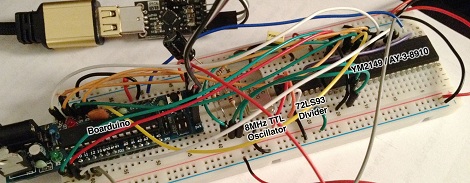
[Oryx] grew up with the bleeps and bloops of an Atari ST, so it comes as no surprise he would want to relish in his nostalgia by playing with the YM2149 sound generator he recently picked up on eBay. Like most of us, [Oryx] went to his old standby, the Arduino, when it came to connect this bare chip to his computer. The first circuit didn’t work, so after a lot of poking around the firmware, [Oryx] discovered the benefits of hand-optimizing software.

There are a lot of sound files available for the YM2149 floating around on the Internet. These files are just dumps of the 16 registers at 50Hz, so it’s very easy to send these from a computer to an Arduino over a serial connection. Unfortunately, when [Oryx] got his breadboard set up nothing happened. After breaking out the ‘scope, he discovered the Arduino was switching pins 100 times slower than the YM2149 data sheet called for.

[Oryx] remembered seeing a great blog post going over the speed at which the digitalWrite() function changes pin states. We’ve seen this before, and the fastest way to change pin states on the Arduino is with the ugly bitwise manipulation. After changing a few lines of code, [Oryx] was switching two pins nearly simultaneously.

Now that the YM2149 chip is working correctly, [Oryx] is planning to make a MIDI synth out of his project. You can get an idea of how that will sound with the demo video he put up after the break.

Continue reading “Playing Chiptunes With A YM2149 And Optimizing An Arduino”