Putting Laptop LCDs To Use With An FPGA

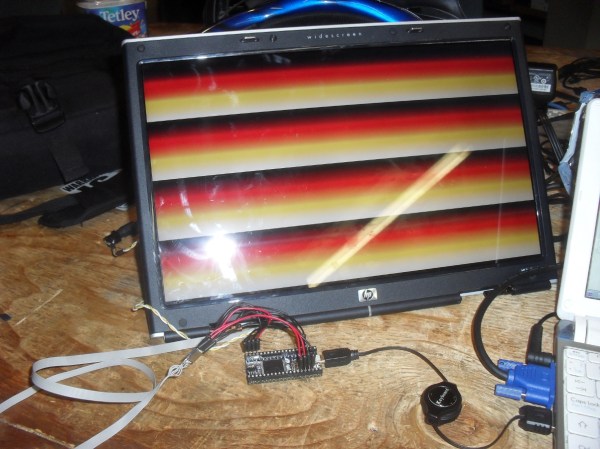
We’re always impressed with the number of laptop displays we’re able to pick out of the trash. Most of the time the computer is borked beyond repair so we end up with a lot of functional but unusable LCD panels. As a service to us all, [EiNSTeiN_] figured out how to control an LCD panel using a cheap homebrew FPGA board.

LCD panels don’t use a simple protocol like VGA for turning pixels on and off. Instead, the very high-speed LVDS is used. LVDS is beyond the capabilities of simple microprocessors, so [EiNSTeiN_] built himself a clone of an XuLA FPGA prototyping board and set to work. After figuring out the signal lines to the panel, [EiNSTeiN_] pored over the timing diagrams for the LVDS controller and the LCD panel. From the data sheets, he figured out data is usually sent to the panel at about 500 MHz. The homebrew FPGA board couldn’t manage that speed so [EiNSTeiN_] cut the FPGA clock in half.

While LCD’s 60 fps refresh rate was reduced to 30 fps, [EiNSTeiN_] says there’s only a little flicker. Not bad for something that could have easily been trashed.


Engine Hacks: Riquimbilis, Or: What We’d Do If We Couldn’t Buy A Car

Engine Hacks Theme banner

After the United States enacted a near-total economic embargo against Cuba in 1962, American export of Detroit Iron came to a halt. Since then, some Cubans have been lucky enough to own a classic Chevy or Buick. Soviet imports of Volgas stopped in the 1990s. With a dearth of any sort of motorized transport (and a public transport system that’s even worse than America’s), some Cubans went with the only reasonable solution: they built Rikimbilis, bicycles and engines hacked together into a moped.

Most rikimbilis are based around Chinese bicycles with a motor ‘obtained’ through ‘non-conventional means’. The exhaust can be fabricated from just about any metal tube available, and a plastic soda bottle is the gas tank of choice. Everything on these bikes is done for reasons of economy and availability, and the fuel efficiency is unbeatable with some rikinbilis getting 120 mpg.

Because they’re not especially safe, Riquimbilis are illegal in Cuba, but the police generally turn a blind eye to their use. Lately the Cuban government has begun cracking down on riquimbilis, but with not many cars to go around these machines of necessity will most likely continue plying Havana boulevards.

Recovering Data For A Homemade Cray

In our hubris, we pat ourselves on the back when we’re able to pull data off our old SCSI drives. [Chris Fenton]’s attempt to get an OS for a homebrew Cray-1 puts us rightfully to shame.

Last year we saw [Chris]’ fully functional 1/10th scale Cray-1 supercomputer built around FPGA. While the reproduction was nearly cycle-accurate, [Chris] hasn’t had an opportunity to test out his system because of the lack of available Cray software. A former Cray employee heard of his plight and loaned an 80 Megabyte CDC 9877 disk pack to in the hope of getting some system software.

[Chris] acquired a monstrous 100 pound disk drive to read the disk pack, but after 30 years in storage a lot of electrical problems cropped up. Since reading the drive digitally proved to be an exercise in futility, [Chris] hit upon the idea of taking analog data straight from the read head. This left him with a magnetic image of the disk pack that was ready for some data analysis.

After the disk image was put up on the Internet, the very talented [Yngve AAdlandsvik] figured out the data, header, and error correction formats and sent [Chris] a Python script to tease bits from the analog image. While no one is quite sure what is on the disk pack provided by the Cray employee, [Chris] is remarkably close to bringing the Cray-1 OS back from the dead. There’s also a great research report [Chris] wrote as penance for access to the CDC disk drive. Any Hack A Day readers feel like looking over the data and possibly giving [Chris] a hand?

Engine Hacks: Electric Drill Made Into A Trolling Motor

We knew our engine hacks theme would come down to an argument over the difference between “a motor” and “an engine” so after much deliberation, name calling, restraining orders, and a duel we’re happy to put up [Berto]’s DIY trolling motor made out of an electric drill. The project is probably inspired by [Berto]’s collapsible amphibious e-scooter that used the same electric drill propulsion setup.

The build is just a few pieces of wood, drill rod, some hardware and a prop. Definitely not the most complicated build. This isn’t the speediest motor ever when attached to a canoe, and isn’t meant to be a primary means of propulsion. That’s not a problem for this build – trolling motors aren’t designed to be fast or powerful. There’s no word on how much thrust [Berto]’s motor can put out, but it is a nice bit of MacGyverism to build a boat motor out of spare parts.

Check out the build walk though video after the break to see the motor in action.

Continue reading “Engine Hacks: Electric Drill Made Into A Trolling Motor”

GPS Audio Tour Brought To You By Surface Speakers

The team at Eschelle Inconnue wanted to “trace a sound cartography of Islam” in Marseilles, France, so they came up with a clever little GPS walking tour powered by an Arduino, MP3 playback module, and a surface transducer speaker.

The team used a Processing app to define geographic areas where each MP3 file would play. An Arduino on the build queries a GPS module and selects the audio file from an MP3 playback module. This isn’t uncommon, and a lot of large outdoor museums (think battlefields) have similar setups.

Determining which audio to play at what location is fairly easy, but that’s not what makes this build special. Instead of simply hooking up a pair of headphones to the build, the team decided to use a surface speaker that turns just about any solid material into a speaker. From the writeup, this is supposed to, “diffuse sounds by giving the illusion to collect them, to listen to the words of the walls, the whisperings through the materials” but we think it’s just a great way to have several people listen to the same audio file at the same time.

Controlling Samplers And Sequencers With Multitouch

When we see artists like Daft Punk or Madeon working their magic in a live setting, we’re always impressed with their controllers. Sample-based artist use controllers like the Monome and Kaoss Pad a lot, but these devices are fairly expensive. Thankfully, we live in an age of multitouch displays, so [Graham Comerford] came up with his own multitouch controller that does just about anything.

The build is based on the Kivy framework and includes a Monome emulator, MIDI drum pads, mixer, and a whole bunch of other sliders and buttons. There’s no word on how [Graham]’s multitouch display was constructed, but if you’re looking to build your own gigantic audio control setup there’s a lot of info on building Microsoft Surface clones, adapting computer monitors, and spherical multitouch rigs.

We’re not sure if [Graham]’s virtual drum kit is velocity sensitive but even if it’s not, it’s an interesting bit of kit. Check out an earlier version of his setup after the break.

Continue reading “Controlling Samplers And Sequencers With Multitouch”

Playing Snake With A TV Remote

[vinod] sent in his replica of a Snake game, the game to play on old Nokia dumb phones.

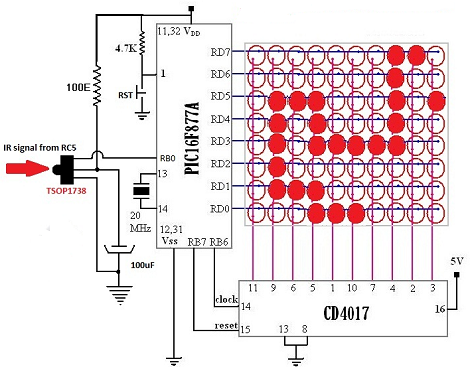
The build is based on a PIC16F877 microcontroller just like previous Snake builds we’ve seen, but [vinod] didn’t use physical buttons in his build. Instead, he used a Philips infrared TV remote to control the game. The infrared controller only takes up one pin on the microcontroller, as opposed to the 4 pins of the easiest four button setup. [vinod] also threw in a simple one-transistor level converter so Snake can be played with a PC via RS-232. With the PIC code included in the build, it’s a great build that reminds us of a more civilized age.

The video of [vinod]’s snake game in action is posted after the break, but we noticed that the snake is allowed to ‘warp around’ the sides of the LED matrix. Some people might consider that cheating but that can be fixed by changing a few lines of code.

Continue reading “Playing Snake With A TV Remote”