Modeling Home Heating Systems With Circuit Simulation Software

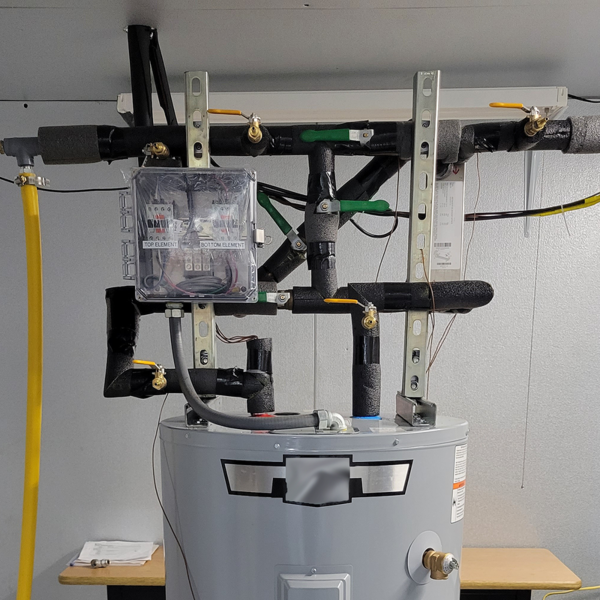
Electricity flow is generally invisible, silent, and not something that most humans want to touch, so understanding how charge moves around can be fairly unintuitive at first. There are plenty of analogies to help understand its behavior, such as imagining a circuit as a pipe of water, with pressure standing in for voltage and flow standing in for current. But you can flip this idea in reverse and use electric circuits to model other complex phenomena instead. [Oxx], for example, is using circuit theory to model his home’s heating systems.

To build his model, he’s using LTSpice, a free circuit simulation program. Using voltage to model temperature and current to model heat flow, he’s set up a model for his home to compare the behavior of a heat pump and a propane furnace. A switch model already in LTSpice with built-in hysteresis takes the place of the thermostat. Using temperature data for a single day in January [Oxx] can see how each of his two heating systems might behave, and the model for the heat pump is incredibly close to how the heat pump behaved in real life.

The model includes all kinds of data about the system, including the coefficient of performance of the heat pump and its backup electric resistive heater, and the model is fairly accurate at predicting behavior. Of course, it takes a good bit of work to set up the parameters for all of the components since our homes and heating systems won’t be included in LTSpice by default, but it does show how powerful an electric circuit analog can be when building models of other systems. If you’ve never used this program before, we’ve featured a few guides to getting started that you can take a look at.

Thanks to [Jarvis] for the tip!

Continue reading “Modeling Home Heating Systems With Circuit Simulation Software”

Swapping Vinyl For Cardboard With This ESP32 Turntable

Cardboard is a surprisingly durable material, especially in its corrugated form. It’s extremely lightweight for its strength, is easy to work, can be folded and formed into almost any shape, is incredibly inexpensive, and when it has done its duty it can be recycled back into more paper. For these reasons, it’s often used in packaging material but it can be used to build all kinds of things outside of ensuring that products arrive at their locations safely. This working cardboard record player is one example.

While the turntable doesn’t have working records in the sense that the music is etched into them like vinyl, each has its own RFID chip embedded that allows the ESP32 in the turntable’s body to identify them. Each record corresponds to a song stored on an SD card that instructs the ESP32 to play the appropriate song. It also takes care of spinning the record itself with a small stepper motor. There are a few other details on this build that tie it together too, including a movable needle arm held on with a magnet and a volume slider.

As far as a building material goes, cardboard is fairly underrated in our opinion. Besides small projects like this turntable, we’ve also seen it work as the foundation for a computer, and it even has the strength and durability to be built into a wall or even used as shelving material. And, of course, it’s a great material to use when prototyping new designs.

Continue reading “Swapping Vinyl For Cardboard With This ESP32 Turntable”

Go Forth With This Portable Programmer

When choosing a low-level language, it’s hard to beat the efficiency of Forth while also maintaining some amount of readability. There are open source options for the language which makes it accessible, and it maintains its prevalence in astronomical and other embedded systems for its direct hardware control and streamlined use of limited resources even though the language started over 50 years ago. Unlike 50 years ago, though, you can now take your own self-contained Forth programmer on the go with you.

The small computer is built on a design that [Dennis] built a while back called my4TH which has its own dedicated 8-bit CPU and can store data in a 256 kB EEPROM chip. Everything else needed for the computer is built in as well but that original design didn’t include a few features that this one adds, most notably a small 40×4 character LCD and a keyboard. The build also adds a case to tie everything together, with ports on the back for I2C and power plus an RS232 port. An optional battery circuit lets the computer power up without an external power supply as well.

Continue reading “Go Forth With This Portable Programmer”

Portable, Full-Size Arcade Cabinets

Believe it or not, there was a time when the only way for many of us to play video games was to grab a roll of quarters and head to the mall. Even though there’s a working computer or video game console in essentially every house now doesn’t mean we don’t look back with a certain nostalgia on those times, though. Some have turned to restoring vintage arcade cabinets and others build their own. This hackerspace got a unique request for a full-sized arcade cabinet that was also easily portable as well.

The original request was for a portable arcade cabinet, and the original designs were for a laptop-like tabletop arcade. But further back-and-forth made it clear they wanted full-size cabinets that just happened to also be portable. So with that criteria in mind the group started building the units. The updated design is modular, allowing the controls, monitor, and Raspberry Pi running the machines to be in self-contained units, with the cabinets in two parts that can quickly be assembled on-site. The base is separate and optional, with the top section capable of being assembled on the base or on something like a tabletop or bar, and the electronics section quickly drops in.

While the idea of a Pi-powered arcade cabinet is certainly nothing new, the quick build, prototyping, design, and final product that’s mobile and quickly assembled are all worth checking out. There is even more information on the build at the project’s GitHub page including Fusion 360 models. If you need your cabinets to be even more portable, this tabletop MAME cabinet is a great place to start.

Learning Morse Code With A DIY Trainer

Morse code, often referred to as continuous wave (CW) in radio circles, has been gradually falling out of use for a long time now. At least in the United States, ham radio licensees don’t have to learn it anymore, and the US Coast Guard stopped using it even for emergencies in 1999. It does have few niche use cases, though, as it requires an extremely narrow bandwidth and a low amount of power to get a signal out and a human operator can usually distinguish it even if the signal is very close to the noise floor. So if you want to try and learn it, you might want to try something like this Morse trainer from [mircemk].

While learning CW can be quite tedious, as [mircemk] puts it, it’s actually fairly easy for a computer to understand and translate so not a lot of specialized equipment is needed. This build is based around the Arduino Nano which is more than up for the job. It can accept input from any audio source, allowing it to translate radio transmissions in real time, and can also be connected to a paddle or key to be used as a trainer for learning the code. It’s also able to count the words-per-minute rate of whatever it hears and display it on a small LCD at the front of the unit which also handles displaying the translations of the Morse code.

If you need a trainer that’s more compact for on-the-go CW, though, take a look at this wearable Morse code device based on the M5StickC Plus instead.

Continue reading “Learning Morse Code With A DIY Trainer”

The ’80s Multi-Processor System That Never Was

Until the early 2000s, the computer processors available on the market were essentially all single-core chips. There were some niche layouts that used multiple processors on the same board for improved parallel operation, and it wasn’t until the POWER4 processor from IBM in 2001 and later things like the AMD Opteron and Intel Pentium D that we got multi-core processors. If things had gone just slightly differently with this experimental platform, though, we might have had multi-processor systems available for general use as early as the 80s instead of two decades later.

The team behind this chip were from the University of Califorina, Berkeley, a place known for such other innovations as RAID, BSD, SPICE, and some of the first RISC processors. This processor architecture would be based on RISC as well, and would be known as Symbolic Processing Using RISC. It was specially designed to integrate with the Lisp programming language but its major feature was a set of parallel processors with a common bus that allowed for parallel operations to be computed at a much greater speed than comparable systems at the time. The use of RISC also allowed a smaller group to develop something like this, and although more instructions need to be executed they can often be done faster than other architectures.

The linked article from [Babbage] goes into much more detail about the architecture of the system as well as some of the things about UC Berkeley that made projects like this possible in the first place. It’s a fantastic deep-dive into a piece of somewhat obscure computing history that, had it been more commercially viable, could have changed the course of computing. Berkeley RISC did go on to have major impacts in other areas of computing and was a significant influence on the SPARC system as well.

Harmonic Table Keyboard Brings Old Idea Back To Life

If you missed the introduction of the Axis-49 and Axis-64 keyboards by C-Thru Music, you’re definitely not alone. At the time it was a new musical instrument that was based on the harmonic table, but it launched during the Great Recession and due to its nontraditional nature and poor timing, the company went out of business. But the harmonic table layout has a number advantages for musicians over other keyboard layouts, so [Ben] has brought his own version of the unique instrument to life in his latest project.

Called the Midihex, the keyboard has a number of improvements over the version from C-Thru Music, most obviously its much larger 98 playable keys and five function keys. The keys themselves are similar to Cherry MX keys but which use Hall-effect sensors. This style of key allows the device to send continuous key position information to the host computer, and since this is a MIDI instrument, this capability allows it to support a MIDI protocol called MIDI Polyphonic Expression (MPE) which allows each note to be more finely controlled by the musician than a standard MIDI instrument. The PCB is powered by a Teensy 4.1 at the core.

For any musicians that haven’t tried out a harmonic table before, an instrument like this might be worth trying out. The layout provides easier chord and scale patterns, and for beginner musicians it can have a much shallower learning curve than other types of instruments. If you can’t find an original Axis-49 or Axis-64 anywhere to try out, though, we actually posted a teardown of one way back in 2009 when the company was still producing instruments.

Continue reading “Harmonic Table Keyboard Brings Old Idea Back To Life”