
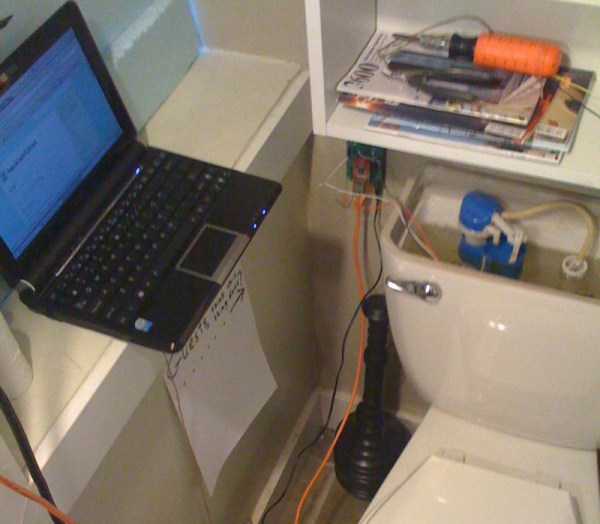
Twittering Toilet

We wouldn’t want to let a week slip by without something new being made to twitter would we?  This time it is a toilet. Don’t worry, they are sparing us the graphic details, it pretty much tweets every time it is flushed. As you can see in the picture above, they’re using an Arduino for the toilet/PC connection. If you really want to make something twitter, this might be a good starting point. It’s basically twittering every time a button is pushed. You can download the source code on the site as well as find a tutorial on Arduino basics.

[via astera]

Weather Monitoring

weather

This weather monitor can track pressure, temperature, and humidity and last several months on a pack of AA batteries. It has a PIC18f452 to control all the bits, as well as some fancy power management to get the most out of the batteries as possible. The screen displays the highest and lowest temperatures of the last 42 hours as well as having options to display all other sensor input, updated every minute or so. You can get the full schematic and parts list on the project site.

[via YourITronics]

APRS Tracking

aprs

We really wish we had a little more information on the construction of this, but [Jeff] made this APRS tracker several years ago. APRS, or Automatic Packet Reporting System is a system where shortwave radios put out small packets of data that are uploaded to a database available via the web. This specific one is relaying GPS data so his family can see where they are located. With current phones, you might think this is antiquated, but he notes that he took this through New Mexico and was able to transmit his position even when there was zero cell phone coverage.

Robotic Sheep Shearing

[youtube=http://www.youtube.com/watch?v=6ZAh2zv7TMM]

This contraption was made in the late 80’s, expressly for shearing sheep. For some reason, it never really took off. We’re guessing because it takes forever and still requires a person to wrangle the sheep on to the holding rack. Having that person just shear the sheep themselves might be much quicker. We think they need to refine it a bit. It should be fast, and not require a person to load it. Maybe something like a modified version of this.

LED Buttons

led_buttons

For their final project in ECE 4760 at Cornell, [Christina] and [Joe] made a small single octave keyboard using LEDs as the input. They used a total of 63 LEDs to make the keys. Each key consists of 9 LEDs, with the center one acting as a sensor. When you lay your finger on it, the light reflects off of your finger and is picked up by the center LED. An ATMega 664 runs custom code to play a sound. You can find out more details about the construction as well as download the source code on the site. You can also download an example movie of it in action ( 7MB .mp4)

WaitLess Bus Tracking System

waitless

Bus systems on campus can often be frustrating. You’re standing at the stop waiting and you don’t know if it would just be faster to walk. If you have a WaitLess tracking system at your stop, you can see exactly where the bus is and make that decision much easier. The unit is self contained, solar, and equipped with wireless internet. With an Arduino at it’s core, it displays the current location of the bus by lighting an LED on a map. You can see a video of it in action after the break.

Continue reading “WaitLess Bus Tracking System”

WikiBrowser

[youtube=http://www.youtube.com/watch?v=H1TelXmRQs0]

This project is particularly amusing. It doesn’t have a whole lot of practical use, but it makes up for it in style. They have an SD card with Wikipedia from 2003 downloaded to it. This is accessed with a Parallax propeller microcontroller based system and displayed on a small retro looking screen. We like it. We don’t think we would ever actually use it, but we would definitely keep it around.









