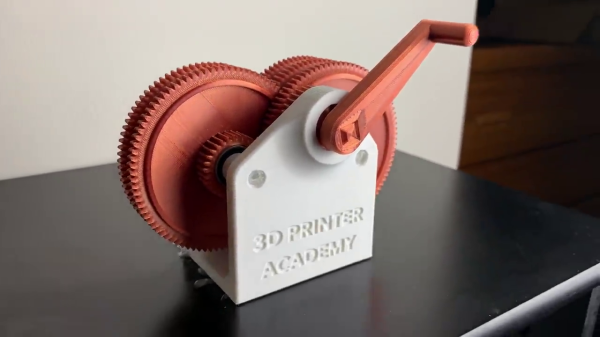
7000 RPM On A 3D-Printed Gearbox

[Steven] at the 3D Printer Academy has been working on a variety of different gear designs. He recently embarked on a series of experiments to see how fast he can spin a 3D-printed gearbox.

After testing several kinds of gear teeth, gear diameters, and gear spacing, he finally struck upon an 81:1 ratio gearbox. It has six gears: five stepped gears and one drive gear on the input shaft. First tests are accomplished with a 3D-printed handle, similar to a hand crank used to start really old cars. But unlike those cranks, [Steven]’s doesn’t have any release provision. While the handle can be removed, it can’t be removed while spinning.

We think it would be helpful to revise the drive shaft coupling method, allowing the handle or drill to be easily removed from the gearbox once it’s attained speed. This would be more convenient, and it seems prudent from the workbench safety point of view as well.
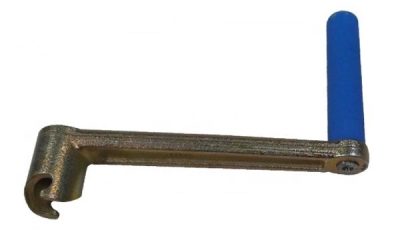
Example of a crank quick release mechanism

[Steven] manages to get the final gear spinning at 7000 RPM in video #2 of the series by hand cranking it “as fast as he can”, a speed measured by using the metronome app on his smartphone. He begins driving the gearbox with an electric drill in video #3, with some mixed but promising results. We think he will ultimately succeed in his goal of a high-speed, electric-drill-driven gearbox after a few more tests. If you want to have a go at this yourself, the design files are posted online.

How fast do you think he can eventually get this gearbox spinning? Are there any physical limitations of the assembly or due to the 3D printing materials/process? We certainly know that high torque can tear 3D-printed gearboxes apart, but how does the speed affect things? Let us know in the comments below.
Continue reading “7000 RPM On A 3D-Printed Gearbox”

No-Nixie Nixie Clock

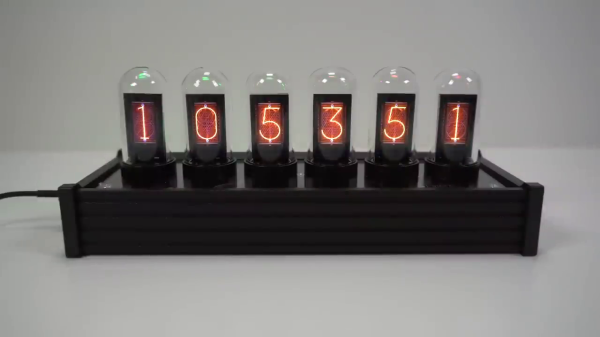
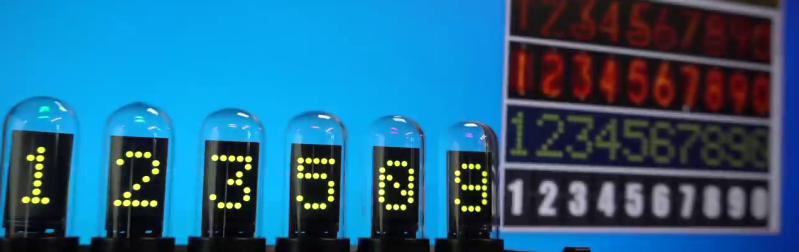
Over on [Techmoan]’s YouTube channel he’s excited about a new gadget that finally arrived after months of waiting — the EleksTube IPS fake Nixie tube clock. This is a re-imagining of a Nixie tube clock using six 135×240 pixel IPS display panels. They are mounted like tiny billboards, each one inside glass bulbs to mimic that retro look. Based on [Techmoan]’s measurement of these displays, it appears they are the same 16:9 IPS displays used in the TTGO ESP32 modules. The effect is quite impressive, and the fact that each digit is a complete display leads to quite a bit of flexibility. For example, if you don’t like the Nixie look, you can select from a suite of styles or make your own set of custom digits.

Additional digit styles are provided

Continue reading “No-Nixie Nixie Clock”

Programming PALs In 2021

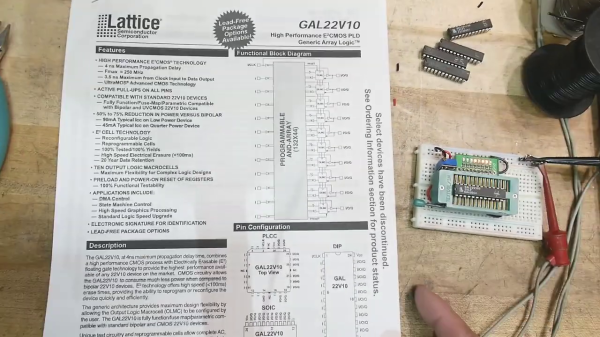
The [IMSAI Guy] has posted a follow-up video with all the details of how he programs GAL22V10 chips in the modern era. We noted that this was missing from his stepper motor project a few days ago, and before we could even ask him, he answered. And no, you won’t have to dig that old Intel 486 DX2-66 out of the closet and search eBay for working floppy drives. It turns out the answer is easier than you’d think.

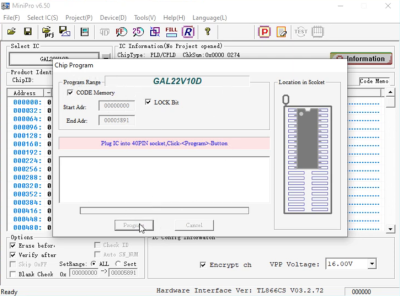
Microchip now owns WinCUPL through its acquisition of Atmel in 2016, and offers WinCUPL as a free download from the Microchip website. This runs only in Windows, although some users report success running under Wine on Linux. This tool will compile the design, but you still need to program the chip. If you’ve done any EEPROM programming lately, chances are you have one of the TL866A MiniPros laying around — this programmer can handle CPLDs, PALs, and GALS as well as EEPROMS. [IMSAI Guy] walks you through the programming procedure, and if you’ve programmed EEPROMs before, the process will be familiar.

For those who prefer the Linux or Mac environment, there are some alternatives. We’ve seen GALasm used on several projects such as [Ken Yap]’s 8085 Minimax. The GitHub repository for GALasm states that commercial use is strictly prohibited, so take note if this applies to your project. As for controlling the TL866A, there is a Linux port called minipro available on GitLab. The remaining hurdle if you want to experiment with these programmable logic chips it to actually get them — many are now obsolete. But it looks like you can still buy Lattice and Microchip (Atmel) ones from various sources. Happy Programming.

Continue reading “Programming PALs In 2021”

History Of Closed Captions: The Analog Era

Closed captioning on television and subtitles on DVD, Blu-ray, and streaming media are taken for granted today. But it wasn’t always so. In fact, it was quite a struggle for captioning to become commonplace. Back in the early 2000s, I unexpectedly found myself involved in a variety of closed captioning projects, both designing hardware and consulting with engineering teams at various consumer electronics manufacturers. I may have been the last engineer working with analog captioning as everyone else moved on to digital.

But before digging in, there is a lot of confusing and imprecise language floating around on this topic. Let’s establish some definitions. I often use the word captioning which encompasses both closed captions and subtitles:

Closed Captions: Transmitted in a non-visible manner as textual data. Usually they can be enabled or disabled by the user. In the NTSC system, it’s often referred to as Line 21, since it was transmitted on video line number 21 in the Vertical Blanking Interval (VBI).
Subtitles: Rendered in a graphical format and overlaid onto the video / film. Usually they cannot be turned off. Also called open or hard captions.

The text contained in captions generally falls into one of three categories. Pure dialogue (nothing more) is often the style of captioning you see in subtitles on a DVD or Blu-ray. Ordinary captioning includes the dialogue, but with the addition of occasional cues for music or a non-visible event (a doorbell ringing, for example). Finally, “Subtitles for the Deaf or Hard-of-hearing” (SDH) is a more verbose style that adds even more descriptive information about the program, including the speaker’s name, off-camera events, etc.

Roughly speaking, closed captions are targeting the deaf and hard of hearing audience. Subtitles are targeting an audience who can hear the program but want to view the dialogue for some reason, like understanding a foreign movie or learning a new language.

Continue reading “History Of Closed Captions: The Analog Era”

Stepper Motors Quick And Simple

If you want a simple and easy introduction to stepper motors, check out the [IMSAI Guy]’s short video where he designs a very basic stepper motor controller and packs in a lot of quick lessons along the way. (Embedded below.)

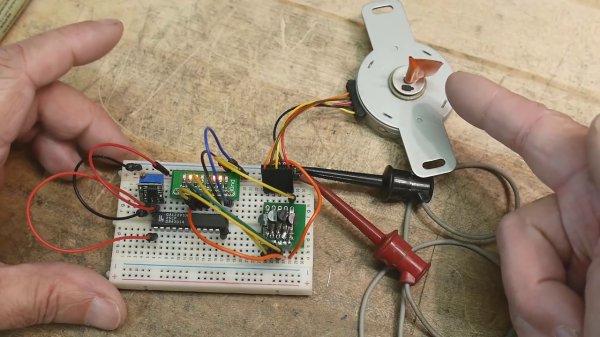
He first goes over the fundamentals of a stepper motor in a practical, hands-on approach, and also shows us how to ring out the connections if the pinout is unknown. Next he demonstrates stepping the motor manually and then makes a simple FET driver circuit. Just when you’re expecting a small microcontroller to appear, the [IMSAI Guy] instead digs deep into his junk box and explains how to drive the motor with a 22V10 GAL (an electrically erasable PAL) and a 555 timer module. Based on a clearly-explained logic table for driving the coils, a sneaky way to introduce Karnaugh maps, he proceeds to write the output equations in WinCUPL.

Mature Readers will recall the “Happy PAL” Character

WinCUPL is the modern version of CUPL (Compiler for Universal Programmable Logic) originally written by a company called Assisted Technology, now owned by Altium. CUPL and peers like PALASM from Monolithic Memories, Inc. (MMI) and ABEL from Data I/O Corporation were basic Hardware Description Languages specifically designed for PALs, GALs, and CPLDs. PALs were small arrays of logic gates with fusible interconnections, and your design is “burned” into the fuses much like a (EE)PROM. When designing with PALs, you could clearly visualize the connections in your mind, something that has since been remedied by the advent of modern FPGAs.

Alas, he cuts out the part where the source code is compiled and the 22V10 is programmed, and jumps directly into testing the circuit on a breadboard. Spoiler alert — it does work. Zooming in close and squinting, the nifty 555 timer breadboard module that he points out is called a TP353, which you can find from your favorite online supplier.

There is a lot to learn in this tutorial, and the [IMSAI Guy] does a great job at making the subject approachable to hobbyists and novices. We also covered another of his tutorials a couple of weeks ago on image sensors. Thanks to [itsevilbert] for the tip.

Continue reading “Stepper Motors Quick And Simple”

Big Clive Hacks LED Bulbs With OpenSCAD

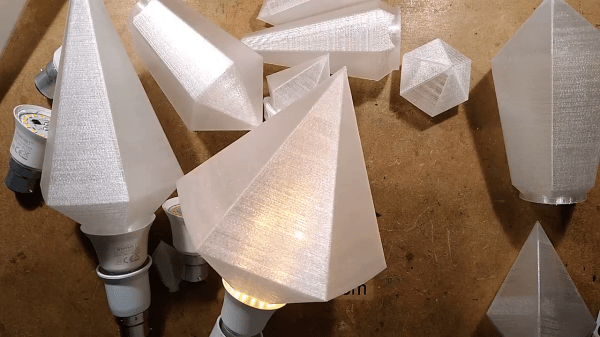
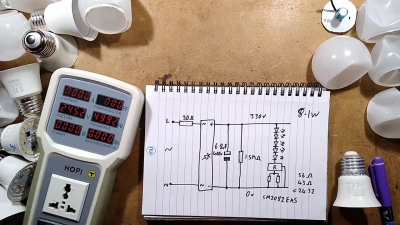
After accidentally crushing the plastic envelope on a cheap LED light bulb, [bigclivedotcom] figured out he could make custom ones using OpenSCAD in any shape he wants. He previously hacked a bunch of these inexpensive LED bulbs last month, discovering they all shared a similar circuit topology. All the ones he experimented with drove the LEDs hard, something that’s bound to reduce bulb lifetime. By reverse engineering the current control regulator, it turns out it is easy to adjust the drive current by changing a resistor or two. Reducing the current should not only increase lifetime, but could allow repurposing the bulb for other uses, such as decorative lighting.

Tweaking the LED Current

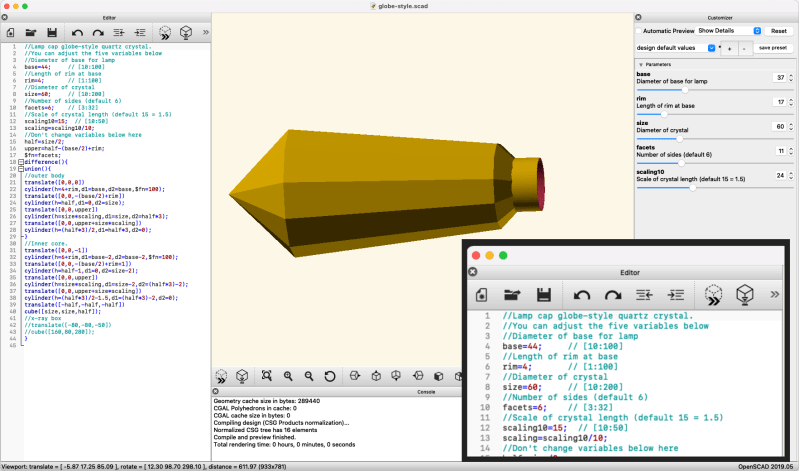
Three OpenSCAD scripts are provided which generate what he calls diamond, obelisk, and globe styles. Basic parameters for each style can be tweaked by the user, such as feature sizes and number of facets. He mentions the lack of OpenSCAD customizers in his script — this can easily be added as shown in the following example (this section of the User Manual on customizers explains the syntax). Note that you can’t make the slider generate real numbers, only whole numbers, which is why the scaling factor is multiplied by 10.

Adding Parameter Customization Sliders is Easy

These fancy globes can be used as night lights and possibly outdoor lighting, if you can make a good seal with the base. Custom chandeliers, anyone? Indicator lamps for very large panels? Any other ideas? If you want to explore the LED lifetime issue further, inveterate tinkerer Ted Yapo wrote a deep dive into the mythical 100,000 hour LED bulb. Thanks to [Cliff Claven] for the tip.

Continue reading “Big Clive Hacks LED Bulbs With OpenSCAD”

Forgotten Tech — Self Driving Cars

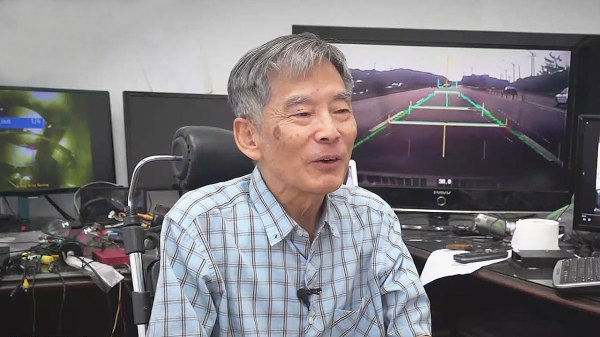
The notion of self driving cars isn’t new. You might be surprised at the number of such projects dating back to the 1920s. Many of these systems relied on external aids built into the roadways. It’s only recently that self driving cars on existing roadways are becoming closer to reality than fiction — increased computer processing power, smaller and power-efficient computers, compact Lidar and millimeter-wave Radar sensors are but a few enabling technologies. In South Korea, [Prof Min-hong Han] and his team of students took advantage of these technological advances and built an autonomous car which successfully navigated the streets of Seoul in several field trials. A second version subsequently drove itself along the 300 km journey from Seoul to the southern port city Busan. You might think this is boring news, until you realize this was accomplished back in the early 1990s using an Intel 386-powered desktop computer.

The project created a lot of buzz at the time, and was shown at the Daejeon Expo ’93 international exposition. Alas, the government eventually decided to cancel the research program, as it didn’t fit into their focus on heavy industries like ship building and steel production. Given the tremendous focus on self-driving and autonomous vehicles today, and with the benefit of hindsight, we wonder if that was the best choice. This isn’t the only decision from Seoul that seems questionable when viewed from the present — Samsung executives famously declined to buy Andy Rubin’s new operating system for digital cameras and handsets back in late 2004, and a few weeks later Android was purchased by Google.

You should check out [Prof Han]’s YouTube channel showing videos of the car’s camera while operating in various conditions and overlaid with the lane recognition markers and other information. I’ve driven the streets of Seoul, and that alone can be a frightening experience. But [Han] manages to stretch out in the back seat, so confident in his system that he doesn’t even wear a seatbelt.

Continue reading “Forgotten Tech — Self Driving Cars”