Making Printed Food More Palatable For Those Who Need It

Most foods when pureed become pretty unappetizing to look at. For that reason, patients who have trouble swallowing are often given pureed food that’s been molded into fun shapes to make it more appealing. The problem with molding food is that it’s labor-intensive, time-consuming, and the resulting edible toys require a lot of storage space.

When 3D printing came along, it was poised to solve the problem, but in the quest to make foods printable, they became even worse. Printable food paste typically starts with dehydrated and/or freeze-dried vegetables, and then hydrocolloids like xanthan gum and locust bean gum are added so the paste holds together after extrusion. Unfortunately, these additives are a big step backward; they change the texture for the worse, and make the food smell and taste bad, too.

The solution is one of those things that sounds obvious in hindsight: some researchers in Singapore tried using fresh and frozen foods instead of freeze-dried, and figured out the minimum amount of hydrocolloids they could get away with for a given food. In their research they categorized all the feasible foods this way. Some vegetables like garden peas which have higher starch and lower water percentages don’t need any hydrocolloids to be printable. As the starch level falls and water rises, more hydrocolloids are needed. So carrots can get away with using just one type of hydrocolloid, while things like bok choy need two types to print effectively. Even so, results of the study show that fresh vegetable printing calls for far less than their powdered counterparts to the extent that it no longer affects the taste of the end product.

The researchers envision a future where every hospital and elder care facility has a food printer to churn out carrot boats and spinach skylines on demand. We think this tasty development is totally awesome — it’s just too bad the carrot boats don’t look more like Benchy.

In the mood for printed food? Our own [Tom Nardi] sampled the menu of additive edibles a while back.

Thanks for the tantalizing tip, [Qes]!

A Hair-Raising Twist On Infinity Mirrors

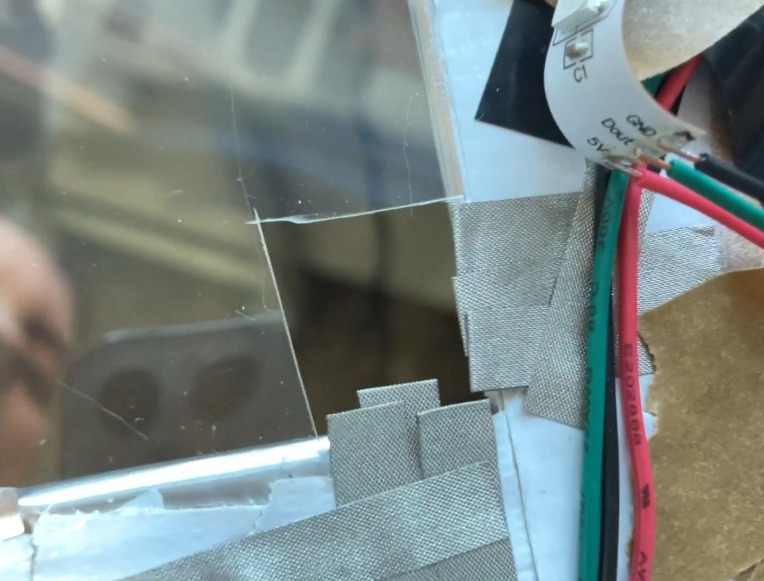
Just when we thought we’d seen it all in the infinity mirror department, [FieldCrafting] blazed a tiny, shiny new trail with their electroplated infinity mirror hair pin. We’d sure like to stick this in our French twist. Fortunately, [FieldCrafting] provided step-by-step instructions for everything from the 3D printing to the copper electroplating to the mirror film and circuitry application.

And what tiny circuitry it is! This pin is powered by a coin cell and even has a micro slider switch to conserve it. The stick parts are a pair of knitting needles, which is a great idea — they’re pointy enough to get through hair, but not so pointy that they hurt.

[FieldCrafting] was planning to solder 1206 LEDs to copper tape and line the cavity with it, but somehow the CAD file ended up with 0603, so there wasn’t enough space for two tape traces. We think it’s probably for the better — [FieldCrafting]’s solution was to use two-conductor wire, strategically stripped, which seems a lot less fiddly than trying to keep two bare tape traces separated and passing pixies.

Don’t have enough hair for one of these? Surely you could use some handsome infinity coasters to round out that home bar setup.

The Bright Side Of The Moon Lamp: It’s Any Colour You Like

One of the easiest ways to get into hardware hacking is by piecing together a few modules and shoehorning them into a really cool home. For example, why buy a commercial moon lamp when you can spend 30+ hours printing your own, and a few more hours hacking the guts together?

[Amit_Jain] was inspired by a project that combined a color map and bump map of the moon into a highly-detailed printable model. Displeased with the lack of features like portability and pretty colors, [Amit] took it to the next level by designing a threaded cap that unscrews to show the streamlined guts of an off-the-shelf RGB LED controller.

[Amit] freed the controller board from its plastic box and soldered the LED strip’s wires directly to it. For power, [Amit] taped the board to the battery from an old cell phone and stepped it up to 12 V with a boost converter. We think this looks quite nice and professional, especially with the stand. A brief demo is on the rise after the break.

If you’ve got the room for a much, much larger light-up moon, you should go for it.

Continue reading “The Bright Side Of The Moon Lamp: It’s Any Colour You Like”

These Plastic Pavers Are Earth Savers

Plastic waste is everywhere you look, and there’s seemingly no end in sight for both the demand and production of plastic goods. So isn’t it time to try putting all that waste from the plastic industry to good use? [Nzambi Matee], a materials engineer in Kenya, thinks so. She was tired of seeing plastic littering the streets of Nairobi, and saw an opportunity to solve two problems at once — cleaning up the streets and paving them with plastic.

Three years ago, [Nzambi] quit her job as an oil industry data analyst and used all her savings to pursue a solution for the pesky plastic problem. She built a lab in her mother’s backyard and begin experimenting with plastics and sand, melding them together to make blocks.

After about a year of trial and error, she had discovered which plastics worked and which didn’t. Then she developed machinery to churn out the sand-plastic paste and stamp it into sturdy paving bricks. Her company Gjenge Makers gets most of their plastic free from factories that would otherwise have to pay to dispose of it. The bricks are strong, lightweight, and nearly indestructible compared to concrete pavers. In the video after the break, there’s a shot of [Nzambi] spiking one on the ground to demonstrate its toughness.

Now, her company produces about 1,500 of these pavers each day. [Nzambi] and her team are planning to start making building blocks as well. With a melting point somewhere above 350° C, the material seems pretty well-suited for that purpose.

Want to do more than just recycle your plastic, but don’t know how? You could start by turning plastic bottles into rope, and then use the rope to make things like brooms and brushes.

Continue reading “These Plastic Pavers Are Earth Savers”

Sensing Danger With Spinach

Do you need more proof that we’re living in the future? A group of MIT engineers have found a way for spinach, aka Popeye’s favorite short-term strength booster, to send potentially lifesaving emails regarding explosives in the area.

As the team outlined in a paper published in 2016, the field of plant nanobionics uses nanotechnology to enhance the natural abilities of plants and make them do new tricks. Here’s how this one works: the roots of the spinach plants absorb nitroaromatic compounds such as picric acid from the groundwater, and these transpire up through the stem and into the leaves along with water and other nutrients. When the compounds reach the leaves, they accumulate in the plants’ mesophyll — the inner tissue of the leaves.

A pair of sensors made of single-walled carbon nanotubes are built into the leaves. One sensor is engineered to detect nitroaromatic compounds using near-infrared fluorescent emission, and the other is used as a reference signal. As the the compounds build up in the mesophyll, the IR signal gets stronger. This change is detected by a camera, which triggers an email alert to the researchers within a matter of minutes. After running the experiments with a fancy-pants indium-gallium-arsenide camera, the researchers were able to duplicate the results using a Raspberry Pi and a CCD camera module with the infrared filter removed.

Plants have an ear to the groundwater like none other and absorb a lot of information about the environment around them, so the researchers believe that detecting explosive materials is only the beginning — they could also be harbingers of pollution and other environmental concerns.

Even if there is no threat of landmines in the vicinity, weeds are a problem everywhere. There’s a Raspberry Pi-based solution for those, too.

Bike Wheel Light Flashes Just Right

When it comes to safely riding a bike around cars, the more lights, the better. Ideally, these lights would come on by themselves, so you don’t have to remember to turn them on and off every time. That’s exactly the idea behind [Jeremy Cook]’s latest build — it’s an automatic bike light that detects vibration and lights up some LEDs in response.

The build is pretty simple — a coin cell-powered ATtiny85 reads input from a spring vibration sensor and flashes the LEDs. This is meant to complement [Jeremy]’s primary bike light, which is manually operated and always on. We especially like that form follows function here — the board shape is designed to be zip-tied to the spokes so it’s as close to the action as possible. He cleverly used cardboard and a laser cutter to mock up a prototype for a board that fits between the spokes. Pretty cool for your second professionally-fabbed PCB ever, if you ask us. Ride past the break to check out the build video.

If you don’t think fireflies on your spokes are enough to keep you safe, go full rainbow party bike.

Continue reading “Bike Wheel Light Flashes Just Right”

Zoom Out Of The Classroom With A Mushroom Button

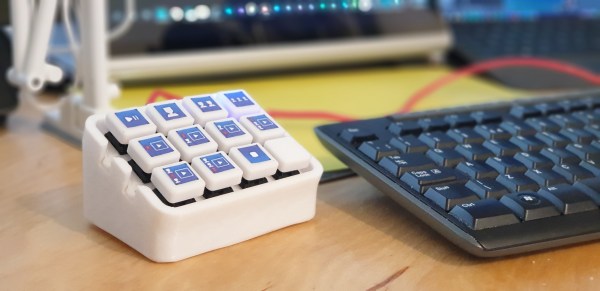
Considering the state of well, everything, we can’t tell you how glad we are to be out of school. That goes double for not being a teacher these days. [Elena] had some awesome light-up tactile buttons set aside for a killer Kerbal Space Program controller, but it’s funny how a pandemic will change your priorities. Instead, those buttons found a good home in this colorful and enticing Zoom control panel.

[Elena]’s ready pile of Arduinos yielded no Leonardos or Pro Micros, but that’s okay because there’s a handy bootloader out there that allows you to reprogram the USB interface chip of an Uno or a Mega and use it as a keyboard. After setting that up, it was mostly a matter of wiring all those latching and momentary buttons and LEDs to the Mega and making them look fantastic with a set of icons. (We all know the big red mushroom button is for aborting the call; so does it really need an icon?)

[Elena] was inspired by the Zoom call-terminating pull chain we saw a month or so ago as well as the pink control box that launched a thousand or so macro keyboards. Have you made your own sanity-saving solution for our times? Let us know!