Dynamic Macro Keyboard Controls All The Things

Keyboard shortcuts are great. Even so, a person can only be expected to remember so many shortcuts and hit them accurately while giving a presentation over Zoom. [Sebastian] needed a good set of of shortcuts for OBS and decided to make a macro keyboard to help out. By the time he was finished, [Sebastian] had macro’d all the things and built a beautiful and smart peripheral that anyone with a pulse would likely love to have gracing their desk.

The design started with OBS, but this slick little keyboard turned into a system-wide assistant. It assigns the eight keys dynamically based on the program that has focus, and even updates the icon to show changes like the microphone status.

This is done with a Python script on the PC that monitors the running programs and updates the macro keeb accordingly using a serial protocol that [Sebastian] wrote. Thanks to the flexibility of this design, [Sebastian] can even use it to control the office light over MQTT and make the CO2 monitor send a color-coded warning to the jog wheel when there’s trouble in the air.

This project is wide open with fabulous documentation, and [Sebastian] is eager to see what improvements and alternative enclosure materials people come up with. Be sure to check out the walk-through/build video after the break.

Inspired to make your own, but want to start smaller? There are plenty to admire around here.

Continue reading “Dynamic Macro Keyboard Controls All The Things”

DIY Bread Slice Paper Goes Against The Grain

It’s the dead of winter here in the northern hemisphere, and between the pandemic and the polar vortex, we’re getting pretty tired of staring at the same four walls and eating incessantly. It’s the perfect recipe for trying something new and low-calorie, like baking a loaf of bread-shaped note paper from the stuff in the recycling bin.

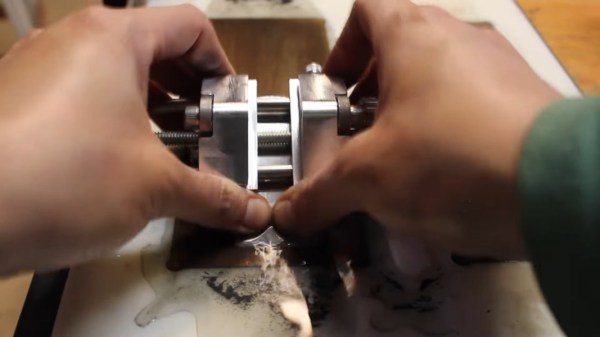
[SusanLand] likes to make paper out of whatever discarded things she has on hand, including old jeans. When she tried making paper out of nothing but toilet paper tubes, it didn’t work so well, but it gave her an idea for cooking up some offbeat stationery.  She beefed up the pulp with shredded office paper and corn starch, and dialed in the whole wheat hue with a pinch of yellow and orange paper. Once the pulp was ready, she poured it into bread-shaped molds made from a plastic milk jug.

This tidy introduction to making your own paper covers everything from pulping techniques to drying methods. Once the slices are dry, [SusanLand] embellishes them with a scoring tool, colored pencils, and a handful of seeds to complete the look. Check out that process in the videos after the break.

Don’t want to make paper out of your paper? Use it to weigh your car, or fold up a fleet of airplanes.

Continue reading “DIY Bread Slice Paper Goes Against The Grain”

Racing Game Crashes Into Its Next Life As A Sound Bender

They say the best things in life are free, but we would loudly argue that a dollar can go a long way, too. It all depends on what you do with it. When [lonesoulsurfer] saw this busted-up handheld racing game at the junk store, he fell in love with the lines of the case and gladly forked over a buck in order to give it a new life as a wicked little sound-bending machine with dancing LEDs.

Here’s how it works: [lonesoulsurfer] records a few seconds of whatever into the mic with the looping function switched off, then turns it back on to start the fun. He can vary the pitch with the speed controller pot, or add in some echo and reverb. Once the sound is dialed in, he works the pause button on the left to make melodies by stopping and restarting the loop, or just pausing it momentarily depending on the switch setting.

The electronics are a mashup of modules mixed with a custom PCB that combines the recording module with an LM386 amplifier and holds the coolest part of this build — those LEDs that dance to the music behind the toy’s original lenticular screen. Like most of [lonesoulsurfer]’s builds, it’s powered by an old cell phone battery that’s buck-boosted to 5 V. Check out the build and bleep-bloop video after the break.

Lenticular lenses are all kinds of fun. Get one that’s big enough, and you can use it to disappear for a while.

Continue reading “Racing Game Crashes Into Its Next Life As A Sound Bender”

The Rotary-X Engine Is A Revolution In Thermodynamics

If you’re running an army, chances are good that you need a lot of portable power for everything from communications to weapons control systems. When it comes to your generators, every ounce counts. The smaller and lighter you can get them, the better.

Connecticut-based company LiquidPiston is developing a high-powered generator for the US Army that uses the company’s own rotary x-engine — a small, light, and powerful beast that sounds like a dream come true. It can run on gasoline, diesel, natural gas, kerosene, or jet fuel, and is scalable from 1 to 1,000 horsepower (PDF).

Co-founder and CEO Alex Schkolnik describes the design as a combination of the best parts of the Otto and Atkinson cycle engines, the Diesel, and the Wankel rotary while solving the big problems of the latter two. That sounds impressive, but it doesn’t mean much unless you understand how each of these engines work and what their various advantages and disadvantages are. So let’s take a look under the hood, shall we?

Continue reading “The Rotary-X Engine Is A Revolution In Thermodynamics”

Stray Cat Shelter Is Nicer Than Our First Apartment

There are a lot of stray cats roaming around [Red Tie Projects’] neighborhood, and no one seems to care much about what happens to them. Fortunately for the cats, [Red Tie Projects] cares quite a lot, as evidenced by this colossal cat condo they built. The cats retain their freedom, but get food and a warm, sheltered bed whenever they decide to grace [Red Tie Projects] with their presence.

[Red Tie Projects] built this sturdy shelter from pallet wood and did a fine job of it, sealing all the seams and screws up with wood putty and waterproofing it with silicone. Inside there’s a heated pillow, a light, and a remote-controlled camera so RTP] can pan around and keep an eye on the cats. All the wires run out through a weatherproof junction box attached to the side and over to a control box made from an ATX power supply.

Most of the build is made from scrap, including the best part — an Arduino-driven motorized zip line for delivering food from the balcony to the cat porch. Details on the control box and the food delivery system are coming soon, as [Red Tie Projects] teases in the video after the break. We’re looking forward to seeing those. Oh, and don’t worry — there’s more than enough footage to cover the cat tax.

If [Red Tie Projects] ever takes any of those cats in, their demands will only increase. Maybe they can handle the sound of a motorized chair that follows the sun, since they’re tough street cats and all.

Continue reading “Stray Cat Shelter Is Nicer Than Our First Apartment”

Express Your Love With Candy And Engineering

Still don’t have anything for Valentine’s Day? We wholeheartedly suggest that you fire up that printer and get ready to fall in love with engineering all over again, because [JBV Creative] has designed a super-sweet piece of machinery that would turn the gears of anyone’s heart. He calls this the most overly-engineered candy dispenser ever, and we have to agree. It’s certainly one of the most beautiful we’ve ever seen.

There’s no electronics at all in this elegant design, just purely mechanical, hand-cranked fun. Turning the crank does two things at once — it moves a little access panel back and forth underneath the chute that governs the number of candies given, and at the same time, moves the conveyor belt along to deliver the goods to the receiving area.

This entire design is absolute genius, especially the decoupling mechanism that shuts off the flow of candy but allows the belt to keep moving. Be sure to watch the build video where [JBV Creative] effortlessly snap-fits the machine together without a single tool, and stay for the follow-up video where he discusses the engineering challenges and shows just how much work went into it.

Of course, there’s more than one way to overly-engineer a candy dispenser. Here’s one that finds the holy grail of peanut M&Ms — the ones that didn’t get a peanut.

Continue reading “Express Your Love With Candy And Engineering”

Making Printed Food More Palatable For Those Who Need It

Most foods when pureed become pretty unappetizing to look at. For that reason, patients who have trouble swallowing are often given pureed food that’s been molded into fun shapes to make it more appealing. The problem with molding food is that it’s labor-intensive, time-consuming, and the resulting edible toys require a lot of storage space.

When 3D printing came along, it was poised to solve the problem, but in the quest to make foods printable, they became even worse. Printable food paste typically starts with dehydrated and/or freeze-dried vegetables, and then hydrocolloids like xanthan gum and locust bean gum are added so the paste holds together after extrusion. Unfortunately, these additives are a big step backward; they change the texture for the worse, and make the food smell and taste bad, too.

The solution is one of those things that sounds obvious in hindsight: some researchers in Singapore tried using fresh and frozen foods instead of freeze-dried, and figured out the minimum amount of hydrocolloids they could get away with for a given food. In their research they categorized all the feasible foods this way. Some vegetables like garden peas which have higher starch and lower water percentages don’t need any hydrocolloids to be printable. As the starch level falls and water rises, more hydrocolloids are needed. So carrots can get away with using just one type of hydrocolloid, while things like bok choy need two types to print effectively. Even so, results of the study show that fresh vegetable printing calls for far less than their powdered counterparts to the extent that it no longer affects the taste of the end product.

The researchers envision a future where every hospital and elder care facility has a food printer to churn out carrot boats and spinach skylines on demand. We think this tasty development is totally awesome — it’s just too bad the carrot boats don’t look more like Benchy.

In the mood for printed food? Our own [Tom Nardi] sampled the menu of additive edibles a while back.

Thanks for the tantalizing tip, [Qes]!