Steampunk Water Thief Clock Steals Attention, Too

The funny thing about clocks is that the more intriguing they are to look at, the more precious time is wasted. This steampunk clepsydra is no exception. A clepsydra, or water thief clock is an ancient design that takes many forms. Any clock that uses the inflow or outflow of water to measure time could be considered a clepsydra, even if it uses electronics like this steampunk version.

[DickB1]’s sticky-fingered timepiece works by siphoning water from the lower chamber into the upper chamber on a one-minute cycle. An MSP430 and a MOSFET control the 12 V diaphragm pump. As the water level rises in the upper chamber, a float in the siphon pushes a lever that moves a ratchet and pawl that’s connected to the minute hand. The hour hand is driven by gears. A hidden magnet and Hall effect sensor help keep the clock clicking at one-minute intervals.

Although [DickB1] doesn’t tell you exactly how to replicate this clock, he offers enough information to get started in designing your own. Take a second to check it out after the break.

Most of the thieving around here is done for the joules, so here’s a joule thief running a clock.

Continue reading “Steampunk Water Thief Clock Steals Attention, Too”

Rock ‘n Roll With 3D-Printed Tonewheels

What can you do with ferromagnetic PLA? [TheMixedSignal] used it to give new meaning to the term ‘musicians’ gear’. He’s made a proof of concept for a DIY tone generator, which is the same revolutionary system that made the Hammond organ sing.

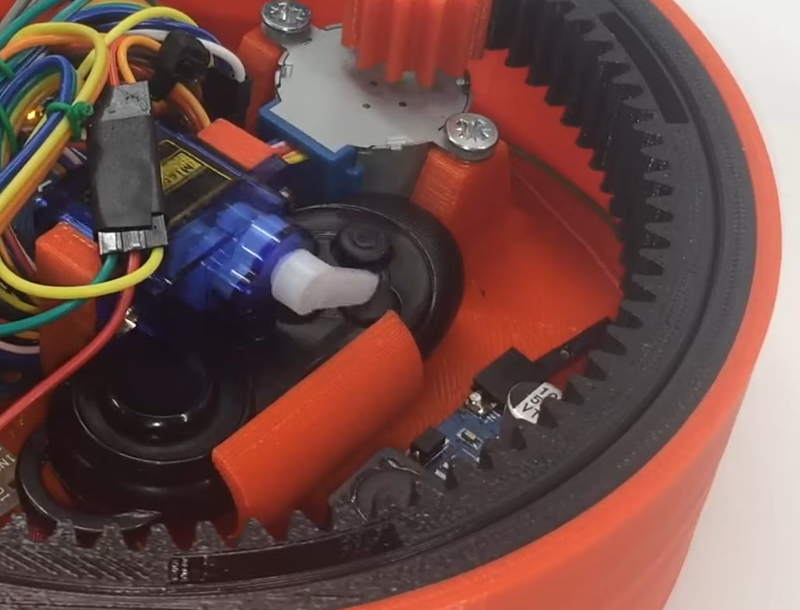
Whereas the Hammond has one tonewheel per note, this project uses an Arduino to drive a stepper at varying speeds to produce different notes. Like we said, it’s a proof of concept. [TheMixedSignal] is proving that tonewheels can be printed, pickups can be wound at home, and together they will produce audible frequencies. The principle is otherwise the same — the protruding teeth of the gear induce changes in the magnetic field of the pickup.

[TheMixedSignal] fully intends to expand on this project by adding more tone wheels, trying different gear profiles, and replacing the stepper with a brushless motor. We can’t wait to hear him play “Karn Evil 9”. In the meantime, put on those cans and check out the demo/build video after the break.

We don’t have to tell you how great Hammond organs are for making music. But did you know they can also encode secret messages?

Continue reading “Rock ‘n Roll With 3D-Printed Tonewheels”

Ramen Pen Lets You Doodle With Noodles

Don’t write off your weird ideas — turn them into reality. For years, woodworkers have used pen bodies as a canvas for showing off beautiful wood. But what’s the fun in that? [JPayneWoodworking] made a pen out of Ramen noodles just to see if he could.

The process is pretty straightforward, as he explains in the build video after the break. He hammered the uncooked noodle mass into pieces small enough to fit a pen blank mold, but not so small that they’re unrecognizable. Then he poured in pigmented epoxy in orange, silver, and black. [JPayneWoodworking] chose those colors for Halloween, but rather than looking freaky, we think it makes the pen look like a bowl of beef broth-y goodness from a fancy Ramen place.

After adding the flavor packet pigments, he put it in a pressure tank to remove all air pockets. Once it sets up, the process is the same as any other pen blank — take it for a spin on the lathe, polish it up, ream it out, and fit it with the parts from a pen kit. We’d like to see the look on the face of the next person to ask [JPayneWoodworking] for a pen.

Want to get into woodworking just to make weird stuff like this? We don’t blame you. But how does a hardware hacker such as yourself get started? [Dan Maloney]’s got you covered.

Continue reading “Ramen Pen Lets You Doodle With Noodles”

The Murky Business Of Stopping Oil Spills

Six years before Deepwater Horizon exploded in April 2010, the force of Hurricane Ivan blew an offshore drilling platform off its legs and into the Gulf of Mexico. For the last 14 years, that well’s pipes, long buried in mud and debris have been spilling oil into the Gulf every single day. That makes it the longest-running spill in history. Every day for fourteen years. Let that sink in for a bit.

Taylor Energy’s platform sat just 10 miles off the coast, much closer to the Louisiana shore than Deepwater Horizon was. Since the hurricane hit, Taylor has tried a number of unsuccessful things to stop the spill. They’ve only been able to plug 9 of the 25 broken pipes so far. The rest are buried deep in mud and debris. Why on Earth haven’t you heard about this before? Taylor spent six years covering it up. And they might have gotten away with it, too, if it weren’t for pesky watchdog groups surveying the Gulf after Deepwater Horizon exploded.

So how are oil spills stopped, anyway? The answer depends on many things. Most immediately, the answer depends whether the spill happened onshore or offshore, and the inciting incident that caused the spill. Underwater oil spills are much more difficult to stop because of the weight and existence of the ocean. In Taylor Energy’s case, the muddy Gulf bed has become a murky tomb for the broken and buried pipes, which makes it even more messy.

Continue reading “The Murky Business Of Stopping Oil Spills”

Downdraft Device Dismisses Dust

Woodworking is messy business, especially the sanding part. But even if you don’t care what happens to your shop floor, you don’t want dead tree particulate matter in your lungs. Wearing a mask or even a respirator is a good start, but a dust collection system is better. Someday, [XYZ Create] might have a shop-wide sawdust-slurper installed. In the meantime, he made a downdraft table out of scrap plywood and a plastic storage box.

The only thing he didn’t already have on hand was a port that matched his shop vacuum. We like his workaround to avoid drilling a huge hole in plastic that would certainly crack — use a hose clamp to get the OD of the port, heat up the clamp on a hot plate, and let it melt a hole into the box. Hopefully, he at least opened a window. [XYZ Create] glued four pieces of scrap plywood together for the top, and drilled all 117 holes by hand. Who needs pegboard?

Not fancy or big enough for your needs? Here’s one with a built-in filtration system.

Continue reading “Downdraft Device Dismisses Dust”

Fresh-Squeezed OJ Served In Orange Peel-Ay

Though it’s really more apple cider weather here at Hackaday HQ, freshly-squeezed OJ is a treat that knows no season. Sure generates a lot of peel, though. Not something you think about when you’re used to buying it in jugs at the grocery store. What a waste, huh?

Italian design firm [Carlo Rotti] teamed up with global energy company [Eni] to develop “Feel the Peel”, a 10-foot-tall real-time juice bar that celebrates the orange by using the entire thing. Fifteen hundred juicy orbs move single-file down the circular track toward their total destruction. One at a time, they are severed in half and wrung out by the machine, and their peels are dropped into a clear bin for all to see. Once the peels dry out, they are shredded, mixed with PLA, and fed into a delta printer that prints juice cups right there on site.

This live process of reuse is pretty interesting to watch — check it out after the break. [Eni] touts this as completely circular, but that really depends on what happens to the cups. If they collect the empties and compost them, great. Anyway, it seems way more sustainable than the Juicero.

Continue reading “Fresh-Squeezed OJ Served In Orange Peel-Ay”

Superconference Interview: Ted Yapo

We’re just two weeks away from the fifth annual Hackaday Superconference, the single biggest gathering of hardware enthusiasts on at least one continent. It’s gearing up to be great, and we’re super excited for the opportunity to bring you such a diverse array of talks, workshops, and more.

What makes Supercon so great? All the awesome people you meet there. One of them is [Ted Yapo], who joined the Hackaday writing crew this year after gracing our pages and winning our contests for so long. You might remember him as the guy who turned an innocent USB-to-serial adapter into an SDR transmitter, or as the guy who tried to jump-start a car with a coin cell.

At last year’s Supercon, [Ted] gave a talk about dealing with cheap spectrum analyzers, which doubled as a live look into the article he wrote for the Hackaday Journal of What You Don’t Know. [Mike Szczys] caught up with [Ted] last year for a brief interview in the hardware hacking area, which you can catch after the break.

[Ted]’s back again this year with a talk about building an open-source multi-GHz sampling ‘scope, and why that’s harder than it seems. You really should be there, you know. Oh, what? It’s sold out? Don’t worry, just kick back and watch the live stream! Subscribe to our YouTube channel and you’ll be notified when it starts, which will be around 10:00 am Pacific on November 15th.

If you do already have a Supercon ticket, but didn’t get tickets for the workshop you wanted, go check again! We released a limited amount of tickets this morning and emailed everyone about it. See you there!

Continue reading “Superconference Interview: Ted Yapo”