Cash Register Hotkey Board Is On The Money

When presented with a pile of free electronics, sometimes you grab things for their ‘someday’ potential. Other times, you know exactly what you’re after. [Bryce] got a big old cash register for free from school because they’ve moved on to using Square or something. He scored two VFDs and a solenoid as a side effect, but he was really after that sturdy keypad and its paper-label keycaps, ripe for customization.

Two hours of reverse engineering later, he knew where the button presses were going well enough to reach for a knockoff Arduino Pro Micro and a couple of shift registers. [Bryce] wanted his hotkey-board to handle keyboard presses as well as media key input, so he went with the HID-Project library over the standard-issue Arduino version. Of course, the whole point of making your own hotkey-board is customization. For [Bryce], that means Word shortcuts and quick access to Greek letters for all those engineering reports he must write. Dig that Half-Life lambda!

What? You don’t have access to free electronics? You could make a hotkey-board out of arcade buttons. Those things can really take a beating.

Xpedit Is A Mood Ring For Mother Nature

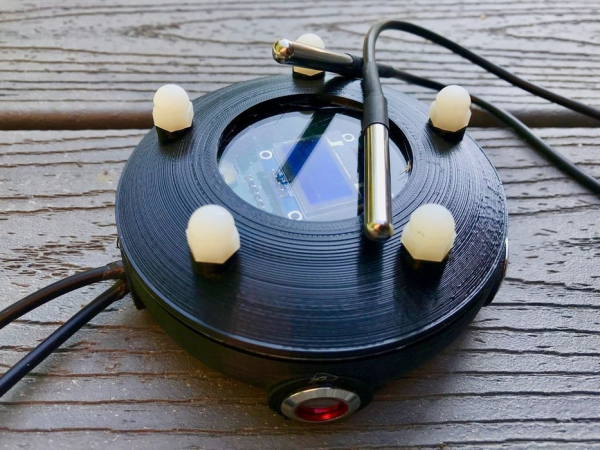
Whether you’re in the woods or way up a mountain, basic knowledge of your environment can yield a lot of power. The more you know about the temperature, humidity, barometric pressure, and your altitude, the easier it is to predict future weather and stick to your height limits. Sure, you could buy some pre-fab doohickey that does all of this, but why? [DIYMechanics] shows how easy it is to build your own pocket-sized weather station for under $20.

Xpedit’s brain is an ATMega328 running on a 20MHz crystal heartbeat. The atmospheric readings come from a BME280, a nifty all-in-one module that’s available for pennies on Ali. The rotary encoder handles user inputs, and the simple interface displays on an OLED. There’s even a tiny compass embedded in the 3D printed case.

We really like the custom alarm feature, which can buzz you via vibe motor if you’ve climbed too high, or the pressure is dropping. [DIYMechanics] has Xpedit completely open-sourced, so trek on down to the GitHub for the latest Eagles, Gerbers, and INOs. Don’t have a USBtiny ISP yet? He’s got the plans for that, too.

Maybe you’re the indoorsy type who’d rather read about mountainous jungle adventures than experience them firsthand. Add some weather-driven ambiance to your book nook by hacking an IKEA cloud lamp.

Cat Feeder Adds Metrics To Meow Mix

If there’s one thing any cat will work for, it’s food. Usually, this just consists of meowing and/or standing on your chest until you give up the goods. [DynamicallyInvokable] has a beautiful cat, Emma, who meows loudly for food at obscene hours of the morning. As she ages, it’s getting harder and more important to control her weight. Clearly, it was time to build the ultimate automatic cat feeder—one that allows him to get lazy while at the same time getting smart about Emma’s weight.

After a year and a half of work, the feeder is complete. Not only does it deliver the goods several times a day, it sends a heap of data to the cloud about Emma’s eating habits. There’s a scale built into the platform, and another in the food bowl. Together, they provide metrics galore that get automatically uploaded to AWS. Everything is controlled with an ESP32 Arduino, including a rainbow of WS2812s that chases its tail around the base of the feeder. The faster it goes, the closer it is to feeding time.

The best part about this unique feeder is that nearly every piece is 3D printed, including the gears. Be sure to check out the build gallery, where you can watch it come together piece by piece. Oh, and claw your way past the break to see Emma get fed.

Emma doesn’t have to worry about sharing her food. If she did, maybe [DynamicallyInvokable] could use facial recognition to meet the needs of multiple cats.

Continue reading “Cat Feeder Adds Metrics To Meow Mix”

Quilting Desk Is An Absolute Unit

Most hobbies come with a lot of tools, and thread injecting is no different. Quilting itself may be Queen Hobby when it comes to the sheer volume of things you can buy: specialized templates, clips, thimbles, disappearing ink pens, and so on. And of course, you want it all within arm’s reach while sitting at the machine.

Ruler rack via Amazon.

Years ago, [KevsWoodworks] built an impressive custom quilting desk for his wife. He’d added on to it over the years, but it was time for a bigger one. This beautiful beast has 21 drawers and 6 large cubbyholes for plastic bins. At the wife’s request, one of the drawers is vertical. [Kev] doesn’t say what she put in there, but if it were our desk, that’s where we’d stash all our large plastic rulers that need to be kept flat (or vertical). There’s also a lift, so any sewing machine can be brought up flush with the enormous top.

Fortunately for us, [Kev] likes to teach. He documented the build in a series of videos that go nicely with his CAD drawings, which are available for download. Thread your way past the break to see those videos.

Want to do some thread injecting, but don’t want to spend hundreds on a machine? We got lucky with our entry-level injector. If yours is a piece of scrap or has limited stitch options, replace the motor, or add an Arduino.

Continue reading “Quilting Desk Is An Absolute Unit”

Tiny ThinkPad Plays Tiny Games

[Paul Klinger] can’t seem to get enough of building tiny, amazing gaming rigs, and we love him for that. They combine two of our favorites: miniatures and portable gaming. His newest creation honors the form of the formidable ThinkPad.

Of course it has the red nipple and lid LED—wouldn’t be a ThinkPad without ’em. ThinkTiny’s nipple is a 5-way joystick that plays Snake, Tetris, Lunar Lander, and more on an OLED screen. Like its predecessor the Tiny PC, [Paul] used an ATtiny1614, which (FYI) has a new one-wire UDPI interface. He can easily reprogram it through pogo pin holes built into the case.

There are some nice stylistic details at play here, too. The lid LED is both delivered and diffused by a 2mm grain of fiber-optic cable. And [Paul] printed the cover with a color change to transparent filament to make the Think logo and the charging LEDs shine through. Maneuver your way past the break to see it in action.

If you haven’t leveled up to AVR programming yet, introduce yourself to Arduboy.

Continue reading “Tiny ThinkPad Plays Tiny Games”

ESP8266 Sound Machine Soothes Baby Remotely

[Zack] had trouble getting his six-month-old to sleep through the night. That was before he found out about ‘shh’ videos on YouTube. These are exactly what they sound like: eight hours of someone whooshing white noise into a microphone. He set a phone up on a charger in the nursery and let one of these play overnight. But the phone was unreliable. It would lock up, or just crash completely, making the baby’s distress worse.

To restore peace in the house, he built a sound machine that both simplifies and fortifies the white noise shh-loution. It uses an ESP8266 and a DFPlayer Mini to loop a lone MP3 file of shh-video audio and play it from a small speaker. By integrating the machine with Home Assistant, he’s able to trigger the sound remotely at baby’s bedtime. ESP Home has no module for the DFPlayer, but [Zack] built one that he’s happy to share.

If you are mired in early parenthood, this is a nice, simple solution. The DFPlayer does all the work of reading from the SD card and converting the signal to analog for speaker output, so there’s no need to get your hands dirty wasting valuable sleeping or kid-playing time.

Once the kid starts toddling out of babyhood, [Zack] could turn to ESP8266-based ambient lighting to help establish the difference between sleep and wake time.

DIY Teensy Looper Multiplies Music

If you’re into electronic music, chances are good that you like to roll your own. While step one is usually to build something, anything that makes sound, a natural step two is to build a looping device to extend and play with those sounds.

[Cutlasses] has finished version one of his Teensy-based Eurorack-style looper. He plugs in a thing, records some tunes, and the resulting loop gets divvied up into eight equal pieces. He can cut the loop together live using the eight buttons to jump around between sections. It supports unlimited overdubs, although too many will cause clipping. But hey, that just means free derivative sounds.

The looper records its audio to an SD card. Since this is typically a slow endeavor, [Cutlasses] used two circular buffers. One reads audio, and the other writes it. This took a lot of trial and error, which he may have to repeat with future SD cards.

[Cutlasses]’ plans for future versions include a separate audio CODEC for better sound, CV control, and a pedal option for hands-free operation. We’d love to hear some sweet Theremin loopage, wouldn’t you? Jog past the break to watch [Cutlasses] demo his looper with a kalimba and a DIY noise box that uses a string bow to make metal tines sing.

Feeling out of the music-making loop? There are (slightly) easier ways. Check out this LEGO looper or this multiplayer Pi-ano.

Continue reading “DIY Teensy Looper Multiplies Music”