Mechanisms: The Spring

Most people probably don’t think about springs until one kinks up or snaps, but most of the world’s springs are pretty crucial. The ones that aren’t go by the name Slinky.

We all use and encounter dozens of different types of springs every day without realizing it. Look inside the world of springs and you’ll find hundreds of variations on the theme of bounce. The principle of the spring is simple enough that it can be extended to almost any shape and size that can be imagined and machined. Because it can take so many forms, the spring as a mechanism has thousands of applications. Look under your car, take apart a retractable pen, open up a stapler, an oven door, or a safety pin, and you’ll find a spring or two. Continue reading “Mechanisms: The Spring”

DIY Designer Wallet From Designer Bag

Why do people drop hundreds of dollars on designer goods? The easy answer is that, in theory, the goods are worth the expense. The materials, craftsmanship, and attention to detail are all top-notch and culminate in the finest finery money can buy.

So, would you spend hundreds of dollars on a designer wallet? If you have leather crafting skills and a thrift store nearby, you could just follow [Corter Leather]’s example and make your own. He found a diamond in the rough—a genuine, well-loved Louis Vuitton bag languishing in a secondhand shop. The leather bottom and handles were dry and worn, but the signature LV canvas was still in great shape. Never crafted leather? If you can’t get free scraps for practicing, then deconstructing cheap, used stuff is the next best thing.

To isolate the canvas, [Corter] carefully removed the bag’s handles, bottom, liner, and zipper and then popped the rivets and peeled the backing from the fabric. He drew up a pattern in Illustrator that pays homage to the illustrious designer’s wallets and cut the pieces out of 3oz vegetable tanned leather using card stock templates.

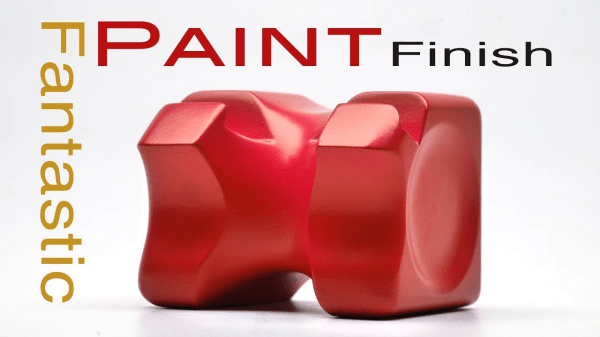
[Corter] brought his A-game to the details. Every visible edge is painted Italian red, which he applied with an awl for a crisp line. The larger pockets have hidden stitches that keep cards from drifting to the bottom and throwing off the shape. No need to open your wallet to see how he did it—just watch the video after the break.

Though it technically isn’t a real Louis Vuitton, a thief wouldn’t know it until later. Maybe [Corter] should add a pickpocket alarm.

Continue reading “DIY Designer Wallet From Designer Bag”

Soda Can Lamp Pinpoints Your Interests

We’ve said it a million times before: 3D printing will expand your horizons. The more you print, the more you think about things you could print and new ways to use printing in the process of building projects. [AHNT] knows all about this phenomenon, because he thought of a way to use soda cans as canvases for customizable pixel art lamp shades.

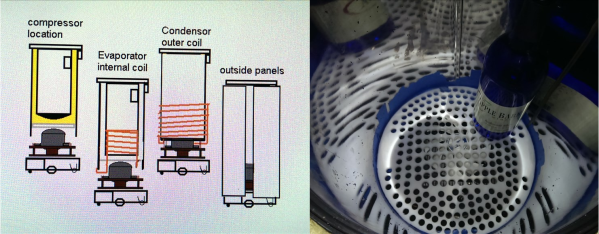
[AHNT] designed a printable sleeve that fits perfectly over 250mL cans. It provides a sturdy grid for poking tiny holes with a medical needle, and can be reused indefinitely with any pattern imaginable. He created two different printable bases to illuminate the lamp: one is sized to hold a votive candle, and the other is made for an LED strip circuit with a rocker switch and 12 VDC barrel jack. We suppose it wouldn’t take much to use an RGB LED instead—a Trinket or a Gemma would surely fit in the base.

In the video after the break, [AHNT] talks about prepping the can by cleanly removing the lid, which he does by filing the top edge until the layers separate. He also discusses a few methods for removing the paint, and notes that sandblasting worked the best.

Don’t need another lamp? There’s a million things you can do with that empty soda can. You could make a theremin, or a battery, or even a treasure box. Cut it open and make a solder stencil. Or do something else entirely, and send us a tip.

Continue reading “Soda Can Lamp Pinpoints Your Interests”

Lawn Dog Faithfully Cuts The Grass

As a kid, [Josh] always dreamed of building robots to do his boring, dangerous chores like mowing and weed-eating the lawn. Now that he’s built Lawn Dog, an all-terrain robotic lawn mower, he can kick back and mentally high-five his younger self.

Lawn Dog is the result of hitching the business end of a Jazzy electric mobility chair to a Ryobi lawn mower with a custom flexible bracket, and then tweaking it to handle the worst that [Josh]’s lawn has to offer. It’s powered by two 24 V lawn and garden batteries and driven with a Sabertooth 2X12 motor controller. After a slippery maiden voyage, Lawn Dog now masters rough and green with aplomb thanks to doubled-up omniwheels on the Ryobi and very special tires on the Jazzy.

[Josh] wants nothing to do with weed-eating and mowing the ditch, so it’s important that the Lawn Dog is up to the job. He put some solid rubber tires on the Jazzy and then drove 50 screws into each one to add serious traction. Prime the carburetor and pull that cord there to see Lawn Dog’s mowing and ditch handling skills.

Continue reading “Lawn Dog Faithfully Cuts The Grass”

Rotating Lithophane Box Turns With Time

If you wanted to make a rotating display box, what would you use to make it spin? A servo? A stepper motor? [ChrisN219] didn’t need his to move quickly by any means, and this opened up his options to something we probably wouldn’t have thought to use: a clock movement. Specifically, the hour minute part of the shaft.

Rotating lithophanes of your loved ones makes for a pretty cool project, and there isn’t a whole lot to this build to make it difficult. Much of it is 3D printed, including the tube in the center that the LED strip is wrapped around. The base is just big enough to hold the clock movement and the LED strip controller, so it would fit nicely on a desk or a mantel.

This is version two of [Chris]’ lithophane box, which gave him a chance to perfect the frame and design a thicker center post to withstand the heat from the LED strip. All the files are available if you want to print your own panels and take them for a spin. Since it’s so easy to change them out, you may end up with a big pile to choose from.

Nancy Grace Roman, Mother Of The Hubble

When she was four years old, Nancy Grace Roman loved drawing pictures of the Moon. By the time she was forty, she was in charge of convincing the U.S. government to fund a space telescope that would give us the clearest, sharpest pictures of the Moon that anyone had ever seen. Her interest in astronomy was always academic, and she herself never owned a telescope. But without Nancy, there would be no Hubble.

Goodnight, Moon

A view of the Milky Way from Reno, Nevada. Via Lonely Speck

Nancy was born May 16, 1925 in Nashville, Tennessee. Her father was a geophysicist, and the family moved around often. Nancy’s parents influenced her scientific curiosities, but they also satisfied them. Her father handled the hard science questions, and Nancy’s mother, who was quite interested in the natural world, would point out birds, plants, and constellations to her.

For two years, the family lived on the outskirts of Reno, Nevada. The wide expanse of desert and low levels of light pollution made stargazing easy, and Nancy was hooked. She formed an astronomy club with some neighborhood girls, and they met once a week in the Romans’ backyard to study constellations. Nancy would later reminisce that her experience in Reno was the single greatest influence on her future career.

By the time Nancy was ready for high school, she was dead-set on becoming an astronomer despite a near-complete lack of support from her teachers. When she asked her guidance counselor for permission to take a second semester of Algebra instead of a fifth semester of Latin, the counselor was appalled. She looked down her nose at Nancy and sneered, “What lady would take mathematics instead of Latin?”

Continue reading “Nancy Grace Roman, Mother Of The Hubble”