Teardown: KC Bearifone Could Talk Circles Around Teddy Ruxpin

At the risk of dating myself, I will tell you that grew up in the 80s — that decade of excess that was half drab and half brightly colored, depending on where you looked, and how much money you had for stuff like Memphis design. Technology seemed to move quickly in almost every aspect of life as the people of the Me decade demanded convenience, variety, and style in everything from their toilet paper (remember the colors?) to their telephones. Even though long distance cost a fortune back then, we were encouraged to ‘reach out and touch someone’.

A Healthy Fear of Bears

Looking back, it’s easy to see how all that advanced technology and excess filtered down to children. I may be biased, but the 80s were a pretty awesome time for toys, and for children’s entertainment in general. Not only were the toys mostly still well-made, even those that came in quarter machines — many of them were technologically amazing.

Take Teddy Ruxpin, which debuted in 1985. Teddy was the world’s first animatronic children’s toy, a bear that would read stories aloud from special cassette tapes, which moved his eyes and mouth along with the words. One track contained the audio, and the other controlled three servos in his face.

I remember watching the commercials and imagining Teddy suddenly switching from some boring bedtime story over to a rockin’ musical number a là the animatronic Rock-afire Explosion band at ShowBiz Pizza (a Chuck E. Cheese competitor). That’s the kind of night I wanted to be having.

The current lineup of the Rock-afire Explosion. Image via Servo Magazine

Although I went to ShowBiz a fair number of times to play Skee-Ball and stare at the Rock-afire Explosion animals and their cool set pieces, I never did have a Teddy Ruxpin. I remember being torn between wanting one and thinking they were kind of scary, which in turn made me a bit tangentially afraid of the Snuggle bear. When it came down to it, Teddy simply cost too much — $69.99 for the bear alone, and another $20 for a single cassette with storybook. And that’s 1985 dollars — according to my favorite inflation calculator, that’s $250 in today’s money for a talking bear and one lousy story.

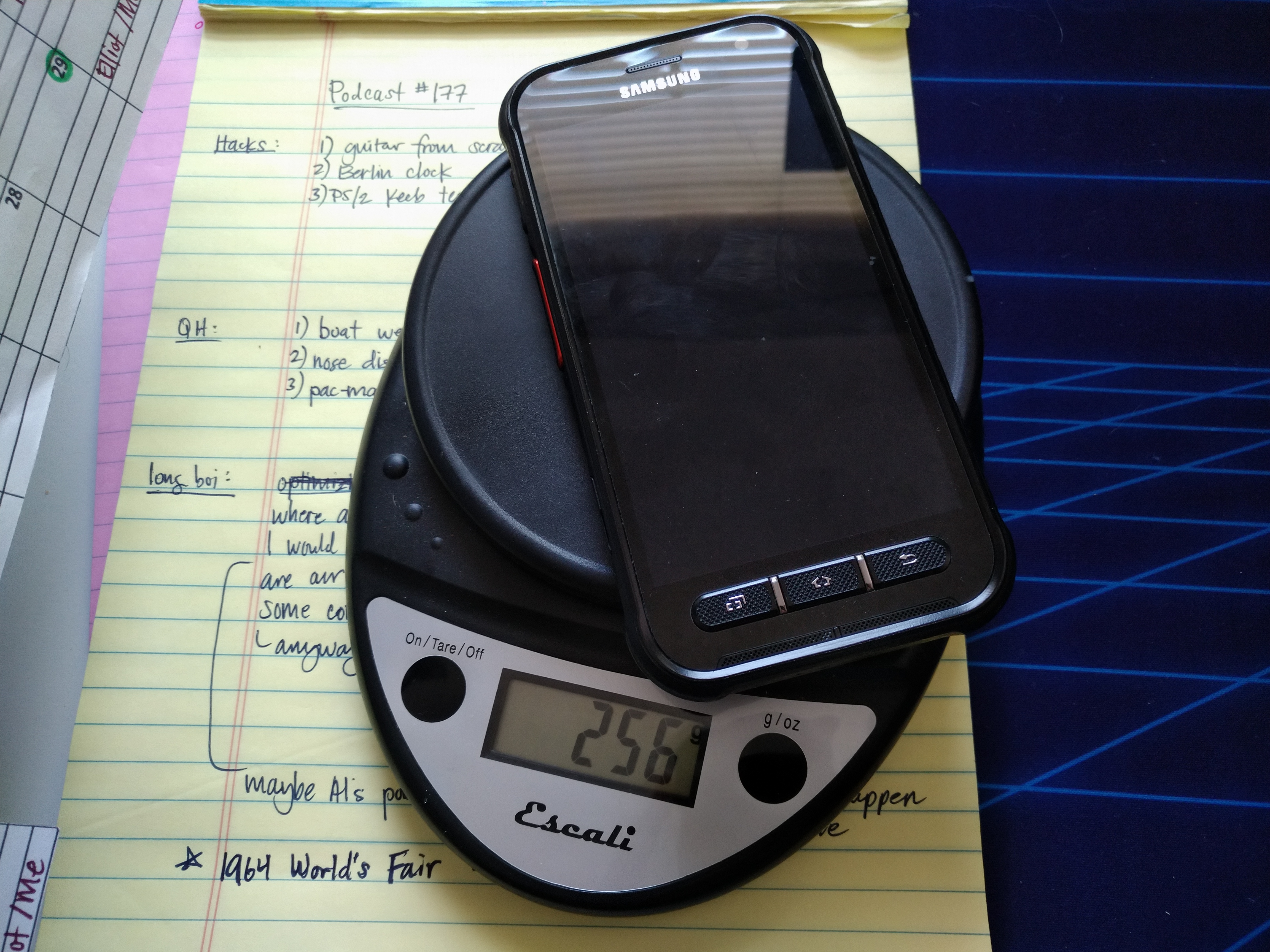
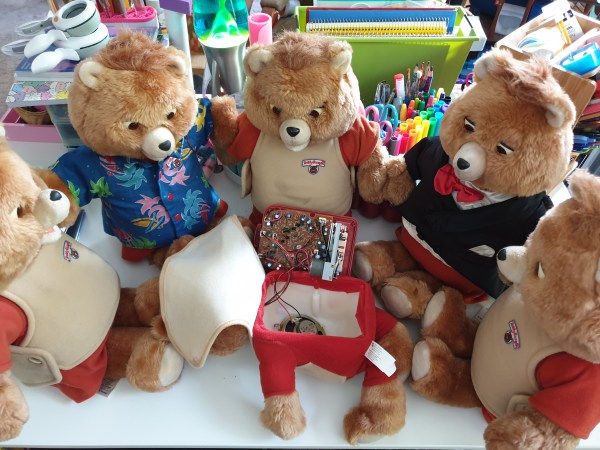
Which brings us to KC Bearifone, an animatronic teddy bear telephone. Honestly, part of the reason I bought the Bearifone was some sort of false nostalgia for Teddy. The main reason is that I wanted to own a Teleconcepts unit of some kind, and this one seemed like the most fun to mess around with. A robot teddy bear that only does speakerphone? Yes, please.

Continue reading “Teardown: KC Bearifone Could Talk Circles Around Teddy Ruxpin”

Hackaday Prize 2022: Turning Big Box Trash Into Art Student Treasure

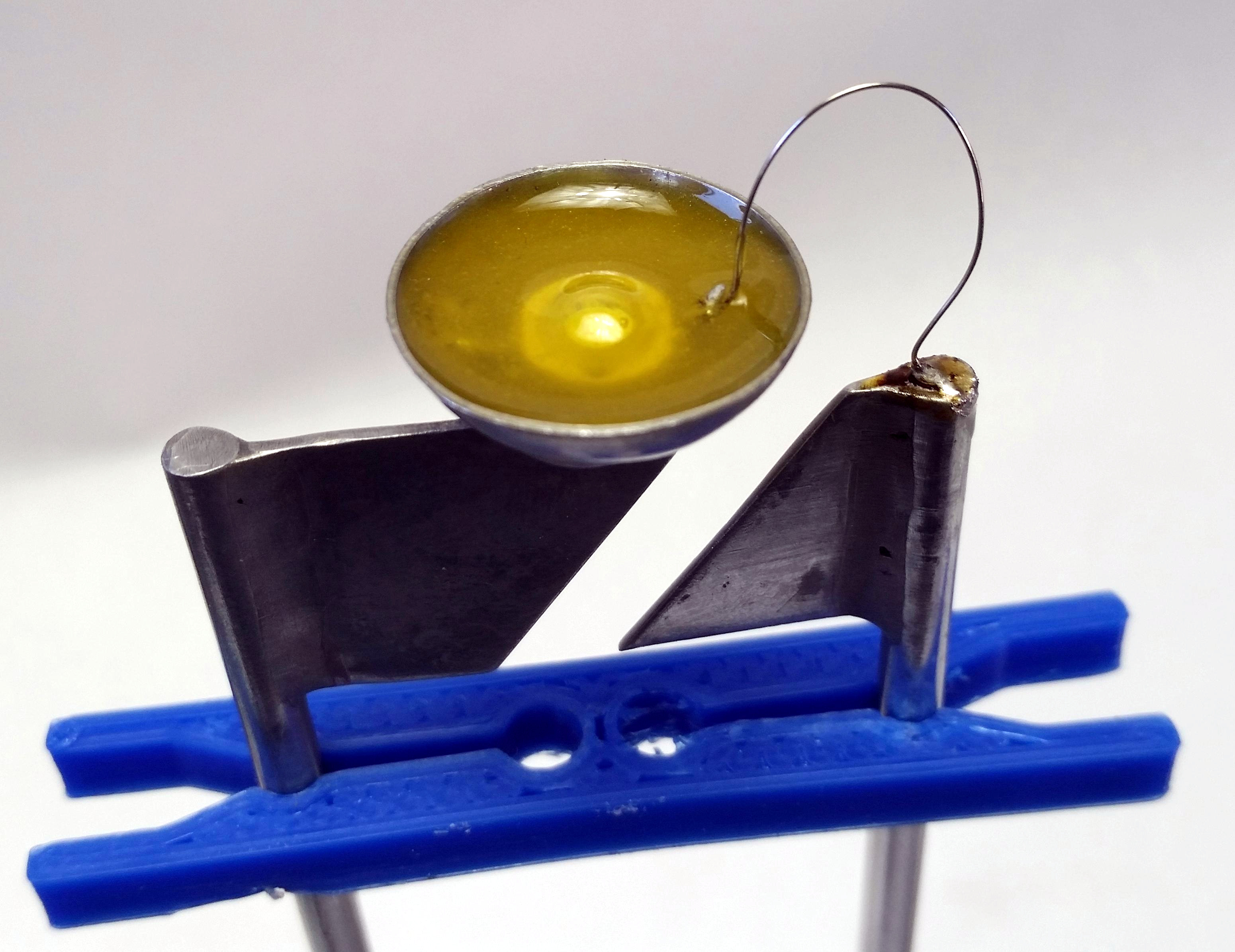
How can the big box store mix the perfect shade of English Wedgwood right before your eyes? The answer is in highly-concentrated pigments that come in many different sizes up to a whopping five gallons. Now, just imagine the amount of watercolor, acrylic, or other types of paint that could be made by simply scraping the walls of an empty 5-gallon tub, which you know is just getting thrown away with all that usable pigment inside.

Not only is [technoplastique] making watercolors and other paints out of these pigments, but their true focus is on creating an easily-reproducible process for turning not just pigments into paint, but other things as well, like dried turmeric, charcoal, or any other feasible material.

The process will likely take the form of an open-source three-roller milling machine, which are commonly used in paint manufacture. Basically you have three rollers that process the pigment and binder, and the mixture is run through as many times as necessary. Although they are fairly simple machines in design, building them to work well requires adherence to precise technical specs.

We can’t wait to see what [technoplastique] comes up with to use for the stainless steel rollers. The rest of the plan involves a Raspberry Pi Pico, one DC motor per roller, a motor shield, and a power supply, but the rollers are pretty crucial. If you have any ideas other than steel rolling pins (the kitchen kind) or pipe couplings (which are too short, anyway), let us know in the comments!

Office Life: The Old Gray Mare, She Ain’t What She Used To Be

Ding, dong; the office is dead. The real office is in your head.

This is what I tell myself when working from home gets too weird, too stale, too impossible. By now, many of you know some version what I’m talking about. Our circumstances may vary wildly, but the outcome is the same: working from home is pretty awesome, but, some small, secret part of us longs for the office. Why is that?

The answer will be different for everyone. Maybe you’re a social butterfly who misses face-time and the din of familiar voices. Maybe you just appreciate the physical separation between work and home life. If you’re lucky, the choice to go to the office is yours at this point, and if not, well, we have to wonder if you’re looking for new work. It’s 2022, we’re still in a pandemic, and of course there’s this, that, and the other multi-national Dumpster fire you haven’t heard about yet. Isn’t it time we prioritized work output over office attendance when it comes to our livelihoods?

To no one’s surprise, few major companies agree with me. Elon recently decreed that ‘remote work is no longer acceptable‘, and that those who want to work remotely may only do so as a reward after serving a minimum of 40 hours per week in the office. Apple tried to enforce three appearances a week until they received an open letter with 1,000+ signatures against.

Continue reading “Office Life: The Old Gray Mare, She Ain’t What She Used To Be”

Custom 40% Model F Keyboard Is 100% Awesome

Look closely at this beauty. No, that’s not a chopped IBM Model M or anything — it’s a custom 40% capacitive buckling spring keyboard with an ortholinear layout made by [durken]. Makes it easy to imagine an alternate reality where IBM still exists as IBM and has strong keyboard game, or one where Unicomp are making dreams come true for those who don’t need anywhere near 101 or 104 keys.

Buckling what now? This lovely board uses capacitive buckling spring switches from an old IBM Model F. Basically, every time you press a key, a little spring is bent over (or buckled) in the name of connectivity. In the capacitive version, the spring pushes a hammer onto a pair of plates, causing a change in capacitance that gets recognized as a key press. In this case, those key presses are read by a TH-XWhatsit controller.

Using a Model F XT’s PCB as a guide, [durken] made a field of capacitive pads on one PCB, and made a second, ground plane PCB to avoid interference. In a true homage to these keyboards, [durken] decided to curve the PCB slightly, which naturally complicated almost everything, especially the barrel plate.

The solution was to make a separate barrel plate that slides into the case and gets screwed to the top via mounting bracket. For an extra bit of fun, [durken] mounted an SKCL lock switch under the IBM logo which enables solenoid mode. Be sure to check that out in the (updated!) video after the break.

One of the best things about a buckling spring keyboard is that each key sounds slightly different. Not so in solenoid mode, unless you were to use multiple solenoids.

Continue reading “Custom 40% Model F Keyboard Is 100% Awesome”

Hackaday Podcast 172: Frickin’ Laser Beams, Squishy Stomp Switches, And A Tiny But Powerful DIY Loom

Join Hackaday Editor-in-Chief Elliot Williams and Assignments Editor Kristina Panos for a free-as-in-beer showcase of the week’s most gnarly but palatable hacks. But first, a reminder! Round 2 of the 2022 Hackaday Prize comes to an end in the early hours of Sunday, June 12th, so there’s still enough time to put a project together and get it entered.

This week, we discuss the utility of those squishy foam balls in projects and issue the PSA that it is in fact pool noodle season, so go get ’em. We drool over if-you-have-to-ask-you-can’t-afford-it 3D printers with staircases and such, and wonder why breadboard game controls didn’t already exist. Later on we laugh about lasers, shake the bottle of LTSpice tips from [fesz], and ponder under-door attacks. Finally, we’re back to frickin’ laser beams again, and we discover that there’s a fruity demoscene in Kristina’s backyard.

Direct Download link

Check out the links below if you want to follow along, and as always, tell us what you think about this episode in the comments!

Continue reading “Hackaday Podcast 172: Frickin’ Laser Beams, Squishy Stomp Switches, And A Tiny But Powerful DIY Loom”

Throw Out That Box? No, Build A Shelving Unit

Are you one of those people who hoards cardboard for someday, and then periodically breaks it all down and puts it out for recycling because you haven’t done anything with it yet? Well, load up a new blade in the utility knife and fire up that hot glue gun, because the [Cardboard Ninja]’s gonna show you how to make a shelving unit from the biggest box in your collection.

[Cardboard Ninja] goes about the build quite smartly, cutting the legs from the four long bends already in the cardboard. This is repeated in the shelves, which are made from the box’s sides — [Cardboard Ninja] takes advantage of the bends when it comes to cutting out the shelves and creates the other three with the edge of a metal ruler. The rest of the cardboard is devoted to supports for shelves and legs.

While you could use this unit to hold all the other, smaller boxen you have lying around, that would be a gross under-utilization. You see, the way this is put together, it can hold upwards of 133 lbs (60 kg) total, provided the rules of weight distribution are followed, and the heaviest things are on the bottom shelf.

That does seem like a lot of weight, but given that this was constructed by someone who has a holster for their utility knife and calls themselves [Cardboard Ninja], I think we can trust their stress tests and just go with it. Given that, it’s always a good idea to anchor shelving units to the wall.

You know, this would make a pretty good entry into the second Challenge of this year’s Hackaday Prize. Remember: this is the final weekend to enter, and the window closes at 7AM Pacific on Sunday, so get hackin’!

Continue reading “Throw Out That Box? No, Build A Shelving Unit”

The Case For Designer Landline Phones

Long before the idea of hot dog-shaped iPhone cases, Otter Boxen, or even those swappable Nokia face plates, people were just as likely to express themselves with their landline phones. Growing up at my house in the 80s, the Slimline on the kitchen wall was hidden inside a magneto wall set from the early 1900s, the front of which swung out to reveal the modern equipment behind it. Back in my bedroom, I had the coolest phone ever, a see-through Unisonic with candy-colored guts. Down in the basement was my favorite extension, tactility-wise: a candy apple-red wall unit with dimly-lit circular push buttons that were springy and spongy and oh-so fun to dial.

Popular culture shows us that people were dreaming of cool telephone enclosures before they were even a thing. Obviously, TV secret agent Maxwell Smart’s shoe phone wasn’t plausible for the technology of that era, but it also wasn’t really feasible for aesthetic reasons. For decades, phone subscribers had to use whatever equipment Ma Bell had to offer, and you couldn’t just buy the things outright at the mall — you had to lease the hardware from her, and pay for the service.

Continue reading “The Case For Designer Landline Phones”