Scratch-Built Robot Arm Looks Like Something Off The Factory Floor

[Jeremy Fielding] is rightly impressed with the power and precision of industrial robot arms. The big arms that you see welding cars on assembly lines and the like are engineering feats in their own right, which is why his leap into scratch-building one in the home shop promises to be quite an adventure, and one we’re eager to follow.

From the look of the video below, [Jeremy]’s arm is already substantially complete, so it seems like he’ll be releasing videos that detail how he got to the point where this impressively large and powerful arm took over so much of his shop. He’s not fooling around here — this is a seven-axis articulated arm built from aluminum and powered by AC servos. [Jeremy] allows that some of the structural parts are still 3D-printed prototypes that he’s using to finalize the design before committing to cutting metal, a wise move as he notes that most of the metalworking skills he needs to complete the build are still fairly new to him. It still looks amazing, and we’re looking forward to the rest of the series to see how he got to this point.

We always appreciate [Jeremy]’s enthusiasm and presentation style, and we generally learn a lot from his videos. Whether it’s a CNC table saw, a homebrew dynamometer, or supersonically melting baseballs, his videos are always great to watch.

Continue reading “Scratch-Built Robot Arm Looks Like Something Off The Factory Floor”

Three-Piece Cyberdeck Plays The Role Of Military Computer That Never Was

While we’re not at all sick of the cyberdeck movement yet, we do have to admit that some of the builds we see are starting to fall into categories that are beginning to seem a little familiar. The clamshell aesthetic comes to mind, but really, with spaces for a display and a keyboard, the form factor is pretty much a natural for cyberdecking. Which is why we like this three-piece twist on the cyberdeck concept so much.

Like many cyberdeck builds, inspiration for the awesomely mustachioed [Max]’s deck came from the military surplus world. As the story goes, he has a smallish clamshell case that once held radio tools and supplies for the Bundeswehr. Figuring it would make the perfect case for half of a split keyboard, he tracked down a couple more of the sturdy aluminum cases and got to work. As a mechanical keyboard aficionado, [Max] already had PCBs that would fit into two of the cases, so he populated those with suitably clicky switches, came up with cool-looking faceplates, and connected the two boxes with retractile cables. The third case got a Raspberry Pi 4 with a trimmed-down heatsink, a battery and power management, and a generous touchpad and LCD panel display. A Kali Linux install completes the tacticool look.

The three-piece cyberdeck looks very cool when all wired up together, but [Max] needed one more piece to really sell it. So he 3D-printed a slipcase for all three units; painted in military colors and suitably distressed, the whole thing really just works. We’ve seen a lot of cyberdecks lately in all sorts of styles, but this one really pleases.

Continue reading “Three-Piece Cyberdeck Plays The Role Of Military Computer That Never Was”

Shoot Above The Waves On This E-Foil Made From A Rifle Case

So you say you want to fly above the waves on an electric hydrofoil, but you don’t have the means to buy a commercial board. Or, you don’t have the time and skills needed to carve a board and outfit it with the motor and wing that let it glide above the water. Are you out of luck? Not if you follow this hackworthy e-foil build that uses a waterproof rifle case as the… hull? Board? Whatever, the floaty bit.

If you haven’t run across an e-foil before, prepare to suddenly need something you never knew existed. An e-foil is basically a surfboard with a powerful brushless motor mounted on a keel of sorts, fairly far below the waterline. Along with the motor is a hydrofoil to provide lift, enough to raise the board well out of the water as the board gains speed. They look like a lot of fun.

Most e-foils are built around what amounts to a surfboard, with compartments to house the battery, motor controller, and other electronics. [Frank] and [Julian] worked around the difficult surfboard build by just buying a waterproof rifle case. It may not be very hydrodynamic, but it’s about the right form factor, it already floats, and it has plenty of space for electronics. The link above has a lot of details on the build, which started with reinforcing the case with an aluminum endoskeleton, but at the end of the day, they only spent about 2,000€ on mostly off-the-shelf parts. The video below shows the rifle case’s maiden voyage; we were astonished to see how far and how quickly the power used by the motor drops when the rifle case leaves the water.

Compared to some e-foil builds we’ve seen, this one looks like a snap. Hats off to [Frank] and [Julian] for finding a way to make this yet another hobby we could afford but never find time for.

Continue reading “Shoot Above The Waves On This E-Foil Made From A Rifle Case”

Harmonic Drive Uses Compliant Mechanism To Slim Down

[Levi Janssen] has a secret: he doesn’t like harmonic drives. But rather than abandon the torque-amplifying transmission completely, he decided to see about improving them using 3D-printed compliant mechanisms.

For the uninitiated, harmonic drives, also known as strain-wave gears, are a compact, high-torque gearbox that has become popular with “robotic dog” makers and other roboticists. The idea is to have a rigid, internally-toothed outer ring nested around an externally-toothed, flexible cup. A wave generator rotates within the inside cup, stretching it so that it meshes with the outer ring. The two gears differ by only a couple of teeth, meaning that very high gear ratios can be achieved, which makes them great for the joints of robot legs.

[Levi]’s problem with the harmonic drive is that due to the depth of the flexible spline cup, compactness is not among its virtues. His idea is to couple the flex spline to the output of the drive through a flat spring, one that allows flexion as the wave generator rotates but transmits torque efficiently. The entire prototype is 3D-printed, except for the wave generator bearings and stepper motor, and put to the test.

As the video below shows after the excellent introduction to harmonic drives, the concept works, but it’s not without its limitations. Even lightly loaded, the drive made some unpleasant crunching sounds as the PLA springs gave out. We could easily see that being replaced with, say, a steel spring, either machined or cut on a water-jet machine. That might solve the most obvious problem and make [Levi]’s dream of a compact harmonic drive a reality. Of course, we have seen pretty compact strain-wave gears before.

Continue reading “Harmonic Drive Uses Compliant Mechanism To Slim Down”

Diving Into The Details Of Keyboard Interfaces At The Gate-Level

Never doubt the value of a good teacher. Even if you know — or think you know — the material being presented, a good teacher can open your eyes to new ways of looking at things that will pay dividends you never expected.

That’s the feeling we got while watching [Ben Eater]’s latest video on building a keyboard interface (embedded below) for his breadboard 6502 computer. On the face of it, getting a keyboard to talk to a computer should be a simple job. [Ben] had previously looked at the serial protocol used by the old PS/2 keyboard and even built a wildly complex circuit out of discrete shift register chips to visualize the data being sent by the keyboard. The video below continues that work, this time concentrating on using the keyboard with his 6502 breadboard computer.

After some instructive preliminaries on interrupt programming, [Ben] dives into the logic-level details of teasing useful signals from the keyboard. His signal processing starts with some inverters and an RC network to turn multiple clock pulses into one logic level transition. Walking through this circuit step by step was the really interesting bit; even if you know that the answer is eventually going to be “Schmitt trigger,” getting to that point was really instructive.

Of course, what [Ben]’s videos mainly accomplish is making us want to follow along with him and build a breadboard computer of our own. From a low-rez VGA card to a reliable UART, following along with his discrete chip builds is always educational.

Continue reading “Diving Into The Details Of Keyboard Interfaces At The Gate-Level”

This Custom Dynamometer Is A Stirling Example Of Homebrewing

[Leo Fernekes] has fallen down the Stirling engine rabbit hole. We mustn’t judge — things like this happen in the best of families, after all. And when they do happen to someone like [Leo], things can get interesting mighty quickly.

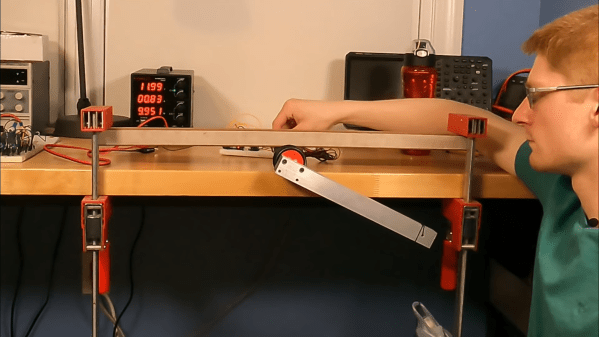
His current video, linked below, actually has precious little to do with his newfound Stirling engine habit per se. But when you build a Stirling engine, and you’re of a quantitative bent, having some way to measure its power output would be handy. That’s a job for a dynamometer, which [Leo] sets out to build in grand fashion. Dynos need to measure the torque and rotational speed of an engine while varying the load on it, and this one does it with style.

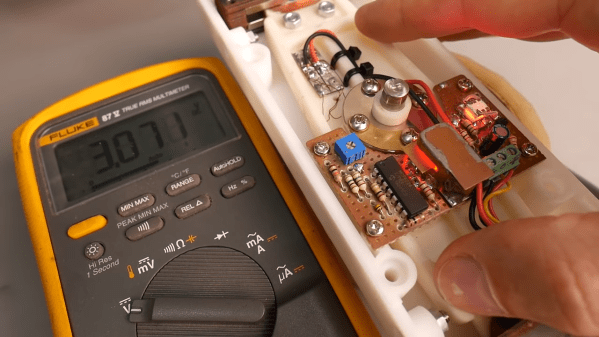
[Leo]’s torque transducer is completely DIY, consisting of hand-wound coils on the ends of a long lever arm that’s attached to the output shaft of the engine under test by a magnetic coupling. The coils are free to move within a strong magnetic field, with a PID loop controlling the current in the coils. Feedback on the arm’s position is provided by an optical sensor, also DIY, making the current necessary to keep the arm stationary proportional to the input torque. The video goes into great detail and has a lot of design and build tips.

We just love the whole vibe of this build. There may have been simpler or quicker ways to go about it, but [Leo] got this done with what he had on hand for a fraction of what buying in off-the-shelf parts would have cost. And the whole thing was a great learning experience, both for him and for us. It sort of reminds us of a dyno that [Jeremy Fielding] built a while back, albeit on a much different scale.

Continue reading “This Custom Dynamometer Is A Stirling Example Of Homebrewing”

Haptics Hack Chat With Nanoport Technology

Join us on Wednesday, April 7 at noon Pacific for the Haptics Hack Chat with Tim Szeto and Kyle Skippon!

Of all our senses, the sense of touch is perhaps the most underappreciated. We understand and accept the tragedy that attends loss of vision or hearing, and the impact on the quality of life resulting from olfactory and gustatory sensations can be severe. But for some reason, we don’t give a second thought to our sense of touch, which is indeed strange given that we are literally covered with touch sensors. That’s a bit of a shame, since touch can reveal so much about the world around us, and our emotional well-being is so tightly tied to the tactile senses that those deprived of it in infancy can be scarred for life.

Haptics is the technology of tactile feedback, which seeks to leverage the human need for tactile experiences to enrich the experience of dealing with the technological world. Haptic feedback devices are everywhere now, and have gone far beyond the simple off-balance motor used since the days when a pager was a status symbol. To help us sort out what’s new in the haptics world, Tim and Kyle from Nanoport Technology will stop by the Hack Chat. Nanoport is a company on the cutting edge of haptics, so they’ll have a wealth of details about what haptics are, where the field is going, and how you can start thinking about making touch a part of your projects.

join-hack-chatOur Hack Chats are live community events in the Hackaday.io Hack Chat group messaging. This week we’ll be sitting down on Wednesday, April 7 at 12:00 PM Pacific time. If time zones have you tied up, we have a handy time zone converter.

Click that speech bubble to the right, and you’ll be taken directly to the Hack Chat group on Hackaday.io. You don’t have to wait until Wednesday; join whenever you want and you can see what the community is talking about.
Continue reading “Haptics Hack Chat With Nanoport Technology”