Alarm System Defeated By $2 Wireless Dongle, Nobody Surprised

It seems a bit unfair to pile on a product that has already been roundly criticized for its security vulnerabilities. But when that product is a device that is ostensibly deployed to keep one’s family and belongings safe, it’s plenty fair. And when that device is an alarm system that can be defeated by a two-dollar wireless remote, it’s practically a responsibility.

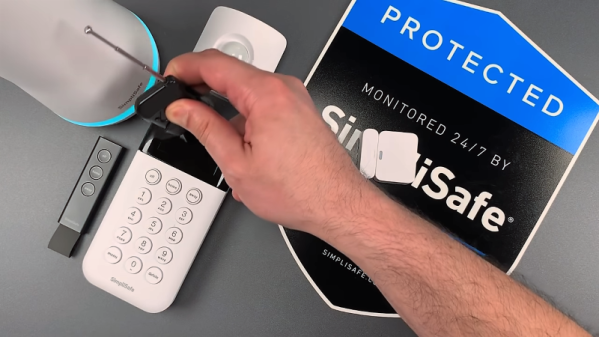
The item in question is the SimpliSafe alarm system, a fully wireless, install-it-yourself system available online and from various big-box retailers. We’ve covered the system’s deeply flawed security model before, whereby SDRs can be used to execute a low-effort replay attack. As simple as that exploit is, it looks positively elegant next to [LockPickingLawyer]’s brute-force attack, which uses a $2 RF remote as a jammer for the 433-MHz wireless signal between sensors and the base unit.

With the remote in close proximity to the system, he demonstrates how easy it would be to open a door or window and enter a property guarded by SimpliSafe without leaving a trace. Yes, a little remote probably won’t jam the system from a distance, but a cheap programmable dual-band transceiver like those offered by Baofeng would certainly do the trick. Not being a licensed amateur operator, [LockPickingLawyer] didn’t test this, but we doubt thieves would have the respect for the law that an officer of the court does.

The bottom line with alarm systems is that you get what you pay for, or sadly, significantly less. Hats off to [LockPickingLawyer] for demonstrating this vulnerability, and for his many other lockpicking videos, which are well worth watching.

Continue reading “Alarm System Defeated By $2 Wireless Dongle, Nobody Surprised”

Automatic Rewinder Makes Kite Retrieval A Breeze

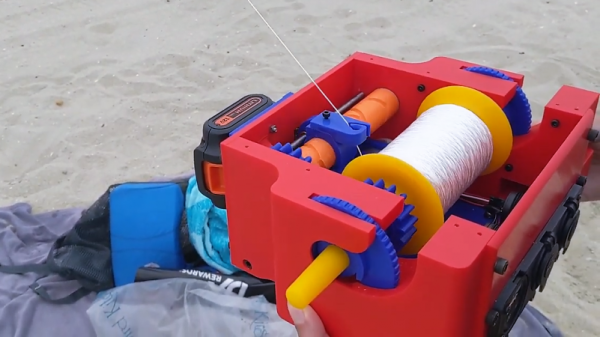
So you’ve built a fine kite, taken it to the beach, and let it ride the wind aloft on a spool of line. Eventually it has to come down, and the process of reeling all that line that was so easily paid out is likely a bigger chore than you care to face. What to do?

If you’re like [Matt Bilsky], the answer is simple: build a motorized kite reel to bring it back in painlessly. Of course what’s simple in conception is often difficult to execute, and as the second video below shows, [Matt] went through an extensive design and prototype phase before starting to create parts. Basic questions had to be answered, such as how much torque would be needed to reel in the kite, and what were the dimensions of a standard kite string reel. With that information and a cardboard prototype in hand, the guts of a cordless drill joined a bunch of 3D-printed parts to form the running gear. We really liked the research that went into the self-reversing screw used to evenly wind the string across the spool; who knew that someone could do a doctoral dissertation on yarn-winding? Check out the “Reeler-Inner” in action in the first, much shorter video below.

With some extra power left from the original drill battery, [Matt] feature-crept a bit with the USB charger port and voltmeter, but who can blame him? Personally, we’d have included a counter to keep track of how much line is fed out; something like this printer filament counter might work, as long as you can keep the sand out of it.

Continue reading “Automatic Rewinder Makes Kite Retrieval A Breeze”

Fail Of The Week: How Not To Light Pipe

You’d think that something made out of glass and epoxy would transmit a decent amount of light. Unfortunately for [Jeremy Ruhland], it turns out that FR4 is not great light pipe material, at least in one dimension.

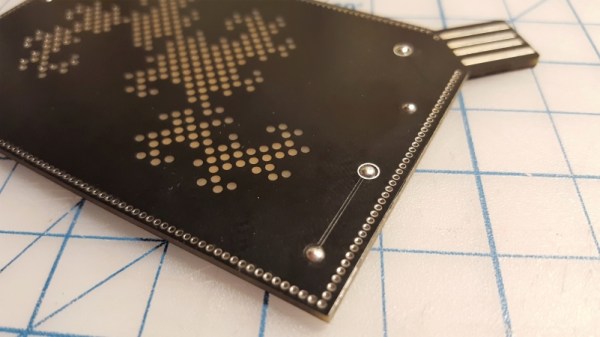
The backstory on this has to do with #badgelife, where it has become popular to reverse mount SMD LEDs on areas of PCBs that are devoid of masking, allowing the light to shine through with a warm, diffuse glow – we’ve even featured a through-PCB word clock that uses a similar technique to wonderful effect. [Jeremy]’s idea was to use 0603 SMD LEDs mounted inside non-plated through-holes to illuminate the interior of the board edgewise. It seems like a great idea, almost like the diffusers used to illuminate flat displays from the edge.

Sadly, the light from [Jeremy]’s LEDs just didn’t make it very far into the FR4 before being absorbed – about 15 mm max. That makes for an underwhelming appearance, but all is certainly not lost. Valuable lessons about PCB design were had, like exactly how to get a fab to understand what you’re trying to do with non-plated holes and why you want to fence the entire edge of the board in vias. But best of all, [Jeremy] explored what’s possible with Oreo construction, and came away with ideas for other uses of the method. That counts as a win in our book.

Life At JPL Hack Chat

Join us on Wednesday, August 21st at noon Pacific for the Life at JPL Hack Chat with Arko!

There’s a reason why people use “rocket science” as a metaphor for things that are hard to do. Getting stuff from here to there when there is a billion miles away and across a hostile environment of freezing cold, searing heat, and pelting radiation isn’t something that’s easily accomplished. It takes a dedicated team of scientists and engineers working on machines that can reach out into the vastness of space and work flawlessly the whole time, and as much practice and testing as an Earth-based simulation can provide.

Arko, also known as Ara Kourchians, is a Robotics Electrical Engineer at the Jet Propulsion Laboratory, one of NASA’s research and development centers. Nestled at the outskirts of Pasadena against the flanks of the San Gabriel Mountains, JPL is the birthplace of the nation’s first satellite as well as the first successful interplanetary probe. They build the robots that explore the solar system and beyond for us; Arko gets to work on those space robots every day, and that might just be the coolest job in the world.

Join us on the Hack Chat to get your chance to ask all those burning questions you have about working at JPL. What’s it like to build hardware that will leave this world and travel to another? Get the inside story on how NASA designs and tests systems for space travel. And perhaps get a glimpse at what being a rocket scientist is all about.

join-hack-chatOur Hack Chats are live community events in the Hackaday.io Hack Chat group messaging. This week we’ll be sitting down on Wednesday, August 21 at 12:00 PM Pacific time. If time zones have got you down, we have a handy time zone converter.

Click that speech bubble to the right, and you’ll be taken directly to the Hack Chat group on Hackaday.io. You don’t have to wait until Wednesday; join whenever you want and you can see what the community is talking about.

MIDI Controller In A Concertina Looks Sea Shanty-Ready

Did you know that the English concertina, that hand-pumped bellows instrument favored by sailors both legitimate and piratical in the Age of Sail, was invented by none other than [Sir Charles Wheatstone]? We didn’t, but [Dave Ehnebuske] knew that the venerable English gentleman was tickling the keys of his instrument nearly two decades before experimenting with the bridge circuit that would bear his name.

This, however, is not the reason [Dave] built a MIDI controller in the form of an English concertina. That has more to do with the fact that he already knows how to play one, they’re relatively easy to build, and it’s a great form factor for a MIDI controller. A real concertina has a series of reeds that vibrate as air from the hand bellows is directed over them by valves controlled by a forest of keys. [Dave]’s controller apes that form, with two wind boxes made from laser-cut plywood connected by a bellows made from cardboard, Tyvek, and nylon fabric. The keys are non-clicky Cherry MX-types that are scanned by a Bluefeather microcontroller. To provide some control over expression, [Dave] included a pressure sensor, which alters the volume of the notes played depending on how hard he pushes the bellows. The controller talks MIDI over Bluetooth, and you can hear it in action below.

We’ve seen MIDI controllers in just about everything, from a pair of skate shoes to a fidget spinner. But this is the first time we’ve seen one done up like this. Great job, [Dave]!

Continue reading “MIDI Controller In A Concertina Looks Sea Shanty-Ready”

Hackaday Links Column Banner

Hackaday Links: August 18, 2019

To the surprise of nobody with the slightest bit of technical intuition or just plain common sense, the world’s first solar roadway has proven to be a complete failure. The road, covering one lane and stretching all of 1,000 meters across the Normandy countryside, was installed in 2016 to great fanfare and with the goal of powering the streetlights in the town of Tourouvre. It didn’t even come close, producing less than half of its predicted power, due in part to the accumulation of leaves on the road every fall and the fact that Normandy only enjoys about 44 days of strong sunshine per year. Who could have foreseen such a thing? Dave Jones at EEVBlog has been all over the solar freakin’ roadways fiasco for years, and he’s predictably tickled pink by this announcement.

I’m not going to admit to being the kid in grade school who got bored in class and regularly filled pages of my notebook with all the binary numbers between 0 and wherever I ran out of room – or got caught. But this entirely mechanical binary number trainer really resonates with me nonetheless. @MattBlaze came up with the 3D-printed widget and showed it off at DEF CON 27. Each two-sided card has an arm that flops down and overlaps onto the more significant bit card to the left, which acts as a carry flag. It clearly needs a little tune-up, but the idea is great and something like this would be a fun way to teach kids about binary numbers. And save notebook paper.

Is that a robot in your running shorts or are you just sporting an assistive exosuit? In yet another example of how exoskeletons are becoming mainstream, researchers at Harvard have developed a soft “exoshort” to assist walkers and runners. These are not a hard exoskeleton in the traditional way; rather, these are basically running short with Bowden cable actuators added to them. Servos pull the cables when the thigh muscles contract, adding to their force and acting as an aid to the user whether walking or running. In tests the exoshorts resulted in a 9% decrease in the amount of effort needed to walk; that might not sound like much, but a soldier walking 9% further on the same number of input calories or carrying 9% more load could be a big deal.

In the “Running Afoul of the FCC” department, we found two stories of interest. The first involves Jimmy Kimmel’s misuse of the Emergency Alert System tones in an October 2018 skit. The stunt resulted in a $395,000 fine for ABC, as well as hefty fines for two other shows that managed to include the distinctive EAS tones in their broadcasts, showing that the FCC takes very seriously indeed the integrity of a system designed to warn people of their approaching doom.

The second story from the regulatory world is of a land mobile radio company in New Jersey slapped with a cease and desist order by the FCC for programming mobile radios to use the wrong frequency. The story (via r/amateurradio) came to light when someone reported interference from a car service’s mobile radios; subsequent investigation showed that someone had programmed the radios to transmit on 154.8025 MHz, which is 5 MHz below the service’s assigned frequency. It’s pretty clear that the tech who programmed the radio either fat-fingered it or misread a “9” as a “4”, and it’s likely that there was no criminal intent. The FCC probably realized this and didn’t levy a fine, but they did send a message loud and clear, not only to the radio vendor but to anyone looking to work frequencies they’re not licensed for.

A Real All-In-One Printer Should Have A Computer In It, Too

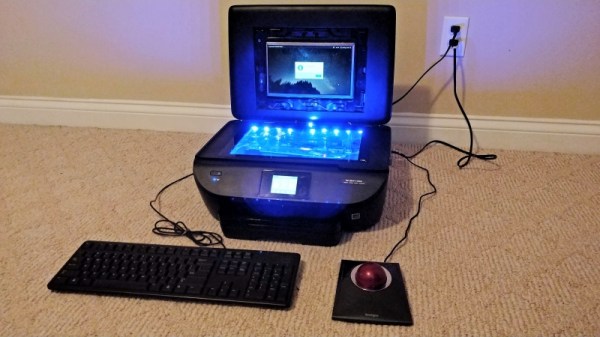
With printers generally being cheaper to replace than re-ink, there are plenty of cast-offs around to play with. They’re a great source for parts, but they’re also tempting targets for repurposing for entirely new uses. Sure, you could make a printer into a planter, but slightly more useful is this computer built into a printer that still prints.

This build is [Mason Stooksbury]’s earlier and admittedly useless laptop-in-a-printer build, which we covered a few months back. It’s easy to see where he got his inspiration, since the donor printer’s flip-up lid is a natural for mounting a display, and the capacious, glass-topped scanner bed made a great place to show off the hybrid machine’s guts. But having a printer that doesn’t print didn’t sit well with [Mason], so Comprinter II was born. This one follows the same basic approach, with a Toshiba Netbook stuffed into an H-P ENVY all-in-one. The laptop’s screen was liberated and installed in the printer’s lid, the motherboard went into the scanner bay along with a fair number of LEDs. This killed the scanner but left the printer operational, after relocating a power brick that was causing a paper jam error.

[Mason]’s Comprinter II might not be the next must-have item, but it certainly outranks the original Comprinter on the utility spectrum. Uselessness has a charm of its own, though; from a 3D-printed rotary dial number pad to a useless book scanner, keep the pointless projects coming, please.