Magic 8 Of Hearts Plies Your True Love With Cheesy Sayings

Just in time for Valentine’s Day, here’s a project out of the LVL1 hackerspace in Louisville that should warm the heart of that special someone in your life. Behold the Magic 8 of Hearts.

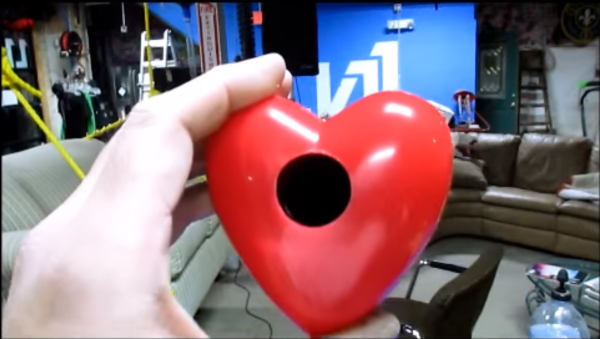
The metaphors are somewhat mixed here, what with the heart-shaped box, the mysterious black window of a Magic 8-ball, and the cheesy once-a-year sayings like those printed on Sweethearts candies. [JAC_101] began surgery by punching a hole in the plastic heart for an OLED display. The white on black display evokes the Magic 8-Ball look, although adding a blue filter would have nailed it. A 3-axis accelerometer detects shaking motion and an Arduino Nano selects a message to display. Some white LEDs light up the enclosure and add a little pizzazz. As a bonus, the whole thing is inductively charged – no extra holes needed in this heart.

If your true love would appreciate something a little flashier, try this animated LED Valentine heart. And if you’re successful in your romantic endeavors, you might just find yourself building these ultra-geeky wedding invitations.

Continue reading “Magic 8 Of Hearts Plies Your True Love With Cheesy Sayings”
Simple Headphone Bracket Shows Off Carbon Fiber Basics

The carbon fiber look is a pretty hot design element for things these days. Even things that have no need for the strength and flexibility of carbon fiber, from phone cases to motorcycle fenders, are sporting that beautiful glossy black texture. Some of it only looks like the real stuff, though, so it’s refreshing to see actual carbon fiber used in a project, like this custom headphone rack.

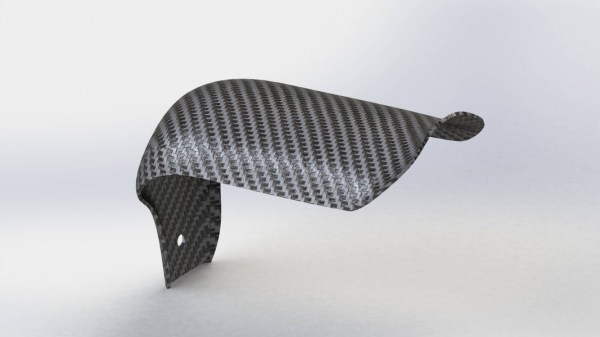
True, this is one of those uses of carbon fiber that doesn’t really need it – it just looks cool. But more importantly, [quada03]’s build log takes us through the whole process, from design to mold construction to laying up the fiber mats and finishing, and shows us how specialized equipment is not needed to achieve a great result. A homemade CNC router carves the two-piece mold out of Styrofoam, which is then glued up and smoothed over with automotive body filler. The epoxy-soaked carbon fiber mats are layered into the mold with careful attention paid to the orientation of the fibers, and the mold goes into one of those clothes-packing vacuum bags for 24 hours of curing. A little trimming and sanding later and the finished bracket looks pretty snazzy.

We’ve discussed the basics of carbon fiber fabrication before, but what we like about [quada03]’s build is that it shows how approachable carbon fiber builds can be. Once you hone your skills, maybe you’ll be ready to tackle a carbon fiber violin.

[via r/DIY]

Robot Does The Worm To Get Around

Walking, jumping, rolling, flying, swimming – robotic locomotion is limited only by the imagination of the inventor. [Roger Rabbit] apparently has a pretty vivid imagination, because he’s building robots that move like worms.

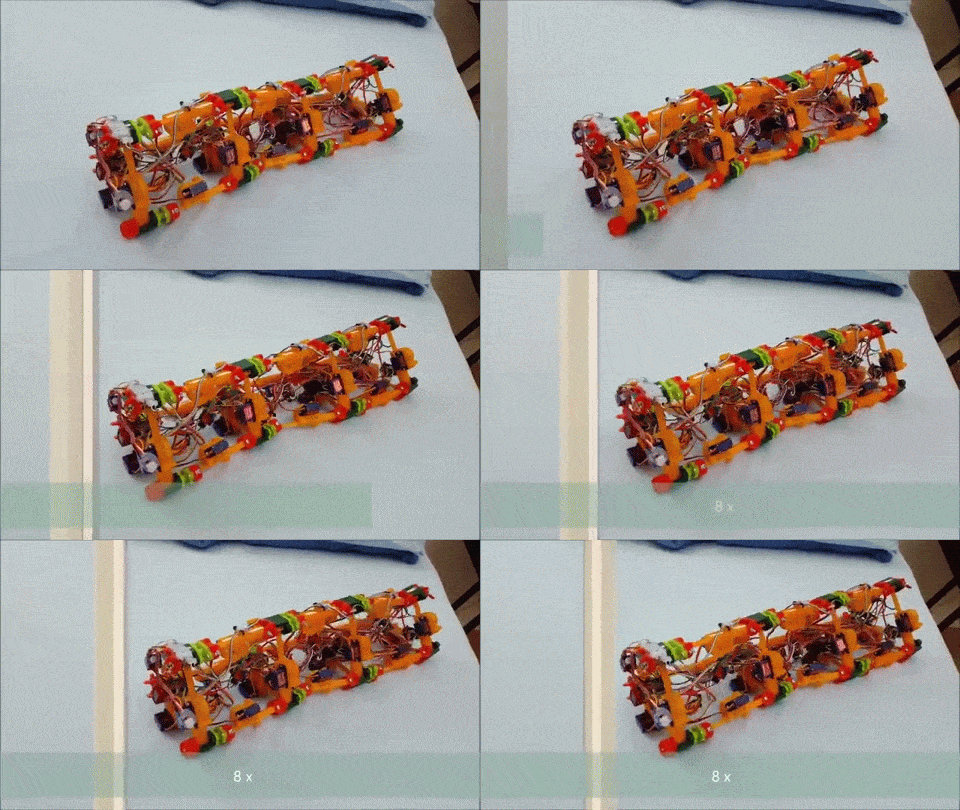
2823251454881775155inchworm-robot-thumbnailVersion 1 of [Roger]’s robot is only semi-vermiform and is more of tube climber. It has a pair of 3D-printed pantographs that expand and contract with servos and move along the robot’s axis on a stepper-driven lead screw. An Arduino reads sensors and coordinates the expansion of the pantographs to grip the internal diameter of a pipe and push the worm-bot along. It’s a slow but effective way to get around in the limited confines of a pipe.

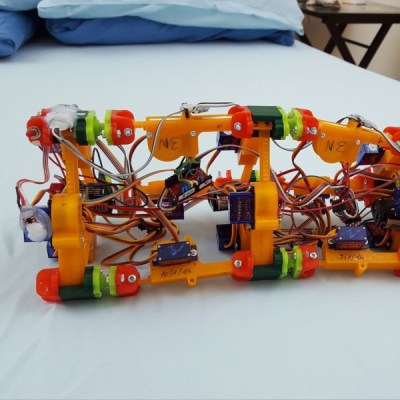
The next iteration, dubbed [Wolly],  is much more worm-like and not restricted to pipe-running. It has four expandable triangular frames connected to each other with rack-and-pinion backbones. The first frame contracts, the racks push it forward, it expands, the next contracts, and soon it’s doing the worm across the floor. Still slow, but pretty neat to watch, and you can see how it can be steered. It might even be able to roll around its long axis, and it’d make a decent tube climber as well.

This creepy autonomous worm-bot seems very similar to [Wolly], but aside from that we haven’t covered too many robots like these. There’s a lot of thought and effort in these worm-bots, and we’re keen to see where [Roger] takes this unique robot body plan.

Continue reading “Robot Does The Worm To Get Around”

Retrotechtacular: Cut All The Cables In This Speedy Teleco Switch Upgrade

In this short but intense classic of corporate cinematography, we get to watch as the Pacific Bell central office in Glendale, California is converted to electronic switching in a 47-second frenzy of cable cutting in 1984.

In the 1970s and 1980s, conversion of telephone central office (CO) switch gear from older technologies such as crossbar (XBar) switches or step-by-step (SxS) gear to electronic switching systems (ESS) was proceeding apace. Early versions of ESS were rolling out as early as the 1950s, but telcos were conservative entities that were slow to adopt change and even slower to make changes that might result in service outages. So when the time finally came for the 35,000 line Glendale CO to cutover from their aging SxS gear to ESS, Pacific Bell retained Western Electric for their “Speedy Cutover Service.”

Designed to reduce the network outage time to a minimum, cuts like these were intricately planned and rehearsed. Prep teams of technicians marked the cables to be cut and positioned them for easy access by the cutters. For this cut, scaffolding was assembled to support two tiers of cutters. It looks like the tall guys got the upper deck, and the shorter techs – with hard hats – worked under them.

At 11PM on this cut night, an emergency coordinator verified that no emergency calls were in progress, and the cut began. In an intense burst of activity, each of the 54 technicians cut about 20 cables. Smiles widened as the cut accelerated, and sparks actually flew at the 35.7 second mark. When done, each tech turned around and knelt down so the supervisors knew when everyone was done. At least one tech couldn’t help but whoop it up when the cut was done. Who could blame him? It must have been a blast.

Continue reading “Retrotechtacular: Cut All The Cables In This Speedy Teleco Switch Upgrade”

Cheap WiFi Outlets Reflashed; Found To Use ESP8266

There’s a bunch of simple WiFi-enabled outlets on the market today, and all of these blister-pack goodies seem to have something in common – crappy software. At least from the hacker’s point of view; there always seems to be something that you want to do that the app just doesn’t support. Stuck in this position, [scootermcgoober] did the smart thing and reflashed his cheap IoT outlets.

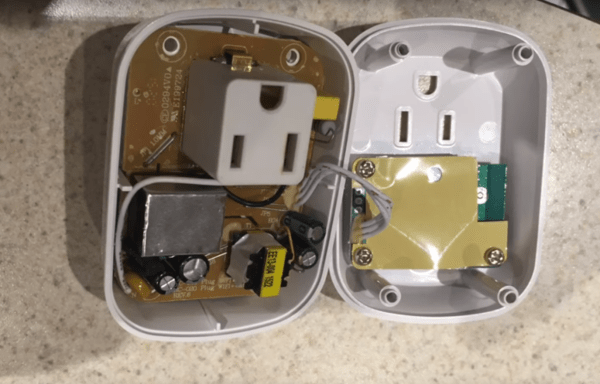
Although [scooter]’s video is very recent, and he says he got his plugs at Home Depot, we were unable to find them listed for sale at any store near us. Walmart lists the same device for a paltry $15, though, so the price is right for repeating his experiment. The video after the break shows his teardown, which locates all the major components, including a mystery module that was revealed to be an ESP8266 upon decapping. Pins were traced, leads were tacked to his serial-to-USB adapter, and soon new firmware was flashing. [scooter]’s new app is simple, but there’s plenty of room for improvement once you’ve got the keys. All the code is up on GitHub.

WiFi outlets like this and the WeMo have proved to be fertile ground for hacking. Of course, if you’re not into the whole blister-pack thing, you could always roll your own WiFi outlet.

Continue reading “Cheap WiFi Outlets Reflashed; Found To Use ESP8266”

“You Sank My Dysprosium!”: Periodic Table Battleship

Kids these days, they have it so easy. Back in the old days, we learned our elements the hard way, by listening to “The Elements” by Tom Lehrer over and over until the vinyl wore out on the LP. Now, thanks to [Karyn], kids can learn the elements by playing “Battleship” – no tongue-twisting lyrics required.

For anyone familiar with the classic “Battleship” game, you’ll wonder why no one thought of this before. [Karyn]’s version of the game is decidedly low-tech, but gets the job done. She printed out four copies of the periodic table, added letters to label the rows, and laminated them. A pair of tables goes into a manila file folder, the tops get clipped together, and dry-erase markers are used to mark out blocks of two to five elements to represent the ships of the Elemental Navy on the lower table. Guesses at the location of the enemy ships can be made by row and series labels for the elementally challenged, or better yet by element name. Hits and misses are marked with Xs and Os on the upper table, and play proceeds until that carrier hiding in the Actinide Archipelago is finally destroyed.

This is pure genius in its simplicity and practicality, but of course there’s room for improvement. The action-packed video after the break reveals some structural problems with the file folders, so that’s an obvious version 2.0 upgrade. And you can easily see how this could be used for other tabular material – Multiplication Table Battleship? Sounds good to us. And if your nippers catch the chemistry bug from this, be sure to take a deeper dive into the structure of the periodic table with them.

Now, if you’ll excuse me: “There’s antimony, arsenic, aluminum, selenium, and hydrogen and oxygen and nitrogen and rhenium….”

Continue reading ““You Sank My Dysprosium!”: Periodic Table Battleship”

This Is How You Run A Hackathon: Tech Valley Center Of Gravity

What’s not to love about a hackathon? The junk food and caffeine that fuel the weekend; the highs that come with success and the lows that come when the blue smoke is released; the desperate search for inspiration as the clock ticks away; nerve-wracking pitches to the judges, hoping against hope that everything works in the demo. Hackathons are the contact sport of the hacker world, bringing in top competitors and eager upstarts, and when done well you just might attract interested “civilians” and other newbies that will catch the hacking bug from what they witness.

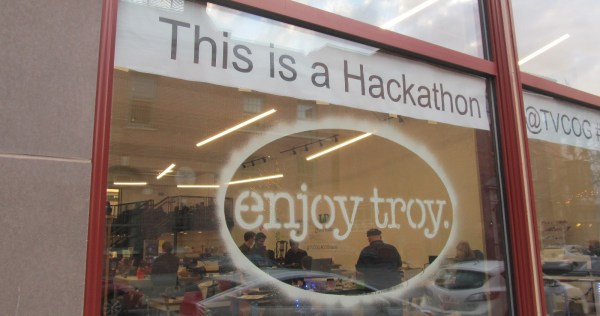
Such was the scene at the Tech Valley Center of Gravity in Troy, NY over the last weekend of January. New for 2016, the CoG is hosting a series of four hardware hackathons this year, each with a different theme. This event’s theme was “Internet of Things”, and the call went out to any and all to come compete for bragging rights and over $1,000 in prizes. Incentives to compete included some big name corporate sponsors, like AT&T, and judging and mentoring provided by the likes of SparkFun’s [Jeff Branson]. There was also a steady stream of food and drink, saturation coverage by local media outlets, and your humble Hackaday writer and his son, who made the trip up to Troy with a small passel of Hackaday swag and a curiosity to see how the CoG has fared since our last visit at the grand opening of their glorious new home. We were not disappointed.

Continue reading “This Is How You Run A Hackathon: Tech Valley Center Of Gravity”