Fire Breathing Animatronic Waterfowl, Just Because

Unless you’re a collector or a hunter, waterfowl decoys are pretty boring. Radio controlled decoys that can putt around are kind of cool. But a radio controlled animatronic fire-breathing decoy? That’s the very opposite of boring.

This is another one of those projects from the “Why the Hell Not?” files, and [David Windestål] is pretty clear that there’s no practical purpose for a flame-throwing, floating fowl. This doesn’t stop him from including 100-plus pictures as well as the video below in his detailed build log, and there are actually some tips to be had here. The remains of an RC racing boat that can hit 30 km/h are used for the floating gear; sadly the decoy superstructure reduces the speed by a factor of 10, so if you’re hoping for a high-performance decoy you’ll be disappointed. The rotating head and evil glowing LED eyes make up for that, though, as does the articulated beak. But the butane flame thrower, with laser-cut acrylic frame and servo flow control, really adds to the menace of the Duck from Hell. Or goose. Whatever.

As with most projects of this type, this is clearly a “do not try this at home” build, but it looks like a bunch of fun. For more ill-advised fun check out this mini RC flame thrower or the Doof warrior ukulele.

Continue reading “Fire Breathing Animatronic Waterfowl, Just Because”

How A Hacker Jump Starts A Car

Here’s the Scenario: you need to get somewhere in a hurry. The problem is that your car has a dead battery and won’t turn over. The Obvious solution would be to call a friend for a jump. But is the friendless hacker out of luck in such a situation? Not if you can whip up a quick parts bin jump starter.

Clearly, [Kedar Nimbalkar]’s solution would be practical only under somewhat bizarre circumstances, so we’ll concentrate on what we can learn from it. A spare PC power supply provides the electrons – [Kedar]’s 250W supply pushes 15A at 12 volts, which is a pretty respectable amount of current. The voltage is a little anemic, though, so he pops it up to 14.2 volts with a 150W boost converter cooled with a PC fan. A dual panel meter reads out the voltage and current, but a VOM could substitute in a pinch. About the only thing you might not have on hand is a pair of  honking 10A diodes to keep current from creeping back into the boost converter. [Kedar] claims he got enough of a charge back in the battery in five minutes to start his car.

As jump-starting goes, this hack is a bit of a stretch. It’s not the first time we’ve seen a MacGyver’d jump starter, though, and you never know when the principles and hardware behind these hacks will come in handy.

Continue reading “How A Hacker Jump Starts A Car”

Adorable Quadruped Robot Hops And Walks

The ESP8266 is finding its way into all sorts of projects these days. It’s a capable little device, to be sure, but we’d have to say that finding it running a quadruped robot that can hop and run was a little unexpected. And to have it show up in such an adorable design was pretty cool too.

From the looks of [Javier Isabel]’s build log, he put a lot of thought into [Kame]. All the body parts and linkages are 3D printed from PLA, with the nice touch of adding a contrasting color. The legs are powered by eight high-speed Turnigy servos, and good quality bearings are used in the linkages. A NodeMCU runs the show with custom oscillator algorithms that control the various gaits, including the hopping motion. The BOM even lists “Adhesive 12mm diameter eyes” – perhaps that’s some sort of slang for the more technically correct “googly eyes.”

Built primarily as a test platform for studying different gaits, there doesn’t seem to be much in the way of sensors in [Kame]’s current incarnation. But with an ESP8266 under the hood, the possibilities for autonomous operation are good. We look forward to seeing where this project goes next. And we kid about the cuteness factor, but never doubt the power of an attractive design to get the creative juices flowing.

We’ve covered a lot of quadruped robots before, and a lot of them seem to trend toward the cute end of the spectrum. Check out this baby-quad that’s learning to walk or this quad that thinks it’s a puppy.

Continue reading “Adorable Quadruped Robot Hops And Walks”

The Michigan Mighty-Mite Rides Again

One of the best things about having your amateur radio license is that it allows you to legally build and operate transmitters. If you want to build a full-featured single-sideband rig with digital modes, have at it. But there’s a lot of fun to be had and a lot to learn from minimalist builds like this Michigan Mighty-Mite one-transistor 80-meter band transmitter.

If the MMM moniker sounds familiar, it may be because of this recent post. And in fact, [W2AEW]’s build was inspired by the same SolderSmoke blog posts that started [Paul Hodges] on the road to his breadboard and beer can build.  [W2AEW]’s build is a bit sleeker, to be sure, but where the video really shines is in the exploration and improvement of the signal quality. The basic Mighty-Mite outputs a pretty dirty signal – [W2AEW]’s scope revealed 5 major harmonic spikes, and what was supposed to be a nice sine wave was full of divots and potholes. There’s only so much one transistor, a colorburst crystal and a couple of capacitors can do, so the video treats us to an explanation of the design of the low-pass filter needed to get rid of the harmonics and clean up the output into a nice solid sine wave.

If your Morse skills aren’t where they should be to take advantage of the Might-Mite’s CW-only mode, then you’ll need to look at other modulations. Maybe a tiny FM transmitter would suit your needs better?

Continue reading “The Michigan Mighty-Mite Rides Again”

Super Slick, Super Portable Styrofoam Slicer

[The King of Random] always seems to have something fun going on in his shop, and his builds tend to be impressively complete. No exception to that rule is his recent hot-wire foam cutter that looks like a ton of fun both to build and to use.

Starting with a simple PVC tubing frame to form the bow of the cutter, the rig ends up looking a little like a scroll saw when [Random] is done with it. A generous work surface sits atop a wood frame, which houses the electrics. A light dimmer and step-down transformer control the cutting wire’s temperature, and the bow even pivots to allow the wire to make miter cuts. A nice final touch is that the frame holding the bow detaches from and store inside the base, making the whole thing portable. It even runs off solar or batteries if you need to work off-grid, which might be handy for quick repairs on the R/C flight line.

Speaking of R/C, check out these hot-wire cut foam airplane wings. And the completeness of this build gets us thinking about the potential for CNC foam cutters.

Continue reading “Super Slick, Super Portable Styrofoam Slicer”

Homemade Bulletproof Glass, Built And Tested

Hackers tend to stash away lots of stuff that seems useless, right up until it saves the day. This includes not just junk in our parts bin but brains full of tips and tricks for the shop. With that in mind, you might want to file away a few of the tips in [AvE]’s video of how he made bulletproof glass for a rainy day.

By his own admission, [AvE]’s video is a little disjointed, and the topic of the bulletproof glass is only covered at the beginning and again briefly at the end. Most of the video concerns the machining of a stout stand for the glass for testing on the range. There’s plenty to learn from the machining, though, and [AvE] is always good for a laugh, so the video is worth a watch. The bulletproof glass itself is part of a long-term project that [AvE] is releasing first to his Patreon patrons – a ridiculously over-built flashlight dubbed “The Midnight Sun”. His first two tries at laminating the Lexan discs were less that optimal, as both brands of cyanoacrylate glue clouded the polycarbonate. Stay tuned to the end of the video for the secret of welding Lexan together into an optically clear sandwich.

As for testing under fire, [AvE] sent the rig off to buddy [TAOFLEDERMAUS] for the hot lead treatment. The video after the break shows that the glass is indeed bulletproof, as long as the bullet in question is a .22LR. Not so much for the 9mm, though – that was a clear punch-through. Still, pretty impressive performance for homebrew.

If you want something that can stop an arrow, there’s a lot of materials science to be learned from the ancient Greeks.

Continue reading “Homemade Bulletproof Glass, Built And Tested”

Old School Gauges Let You Know Which Way The Wind Blows

When your passion is a sport that depends on Mother Nature’s cooperation, you need to keep a close eye on weather conditions. With this in mind, and not one to let work distract him from an opportunity to play, [mechanicalsquid] decided to build a wind-monitoring gauge with an old-school look to let him know when the wind is right for kitesurfing.

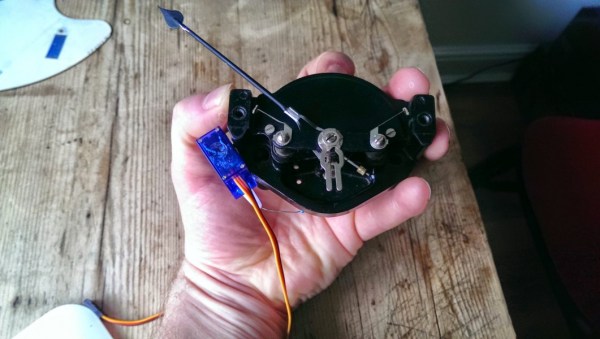
old-school-meter-for-windBeing an aficionado of big engineering helped [mechanicalsquid] come up with a style for his gauge – big old dials and meters. We hesitate to apply the “steampunk” label to every project that retasks old technology, but it sure looks like a couple of the gauges he used could have been for steam, so the moniker probably fits here. Weather data for favorite kitesurfing and windsurfing locales is scraped from the web and applied to the gauges to indicates wind speed and direction. [mechanicalsquid] made a valiant effort to drive the voltmeter coil directly from the Raspberry Pi, but it was not to be. Servos proved inaccurate, so steppers do the job of moving the needles on both gauges. Check out the nicely detailed build log for this one, too.



For more weather station fun be sure to check out this meter-based weather station with a slightly more modern look. And for another build in the steampunk style, this vintage meter and Nixie power display is sure to impress.