The New Heathkit Strikes Again

Alright, this is getting embarrassing.

The rebooted Heathkit has added another kit to its offerings. This time it’s an inexplicably simple and exorbitantly priced antenna for the 2-meter band. It joins their equally bizarre and pricey AM radio kit in the new product lineup, and frankly we’re just baffled by the whole affair.

About the most charitable thing you can say about their “Pipetenna” is that it’ll probably work really well. Heathkit throws some impedance and SWR charts on the website, and the numbers look pretty good. Although Heathkit doesn’t divulge the design within the “waterproof – yes, waterproof!” housing, at 6 dBi gain and only five feet long, we’re going to guess this is basically a Slim Jim antenna stuffed in a housing made of Schedule 40 PVC tubing. About the only “high-end” component we can see is the N-type coax connector, but that just means most hams will need and adapter for their more standard PL-259 terminated coax.

Regardless of design, it’s hard to imagine how Heathkit could stuff enough technology into this antenna to justify the $149 price. Hams have been building antennas like these forever from bits and pieces of wire lying around. Even if you bought all new components, including the PVC pipe and fittings, you’d be hard pressed to put $50 into a homebrew version that’ll likely perform just as well.

The icing on this questionable cake, though, is the sales copy on the web page. The “wall of text” formatting, the overuse of superlatives, and the cutesy asides and quips remind us of the old DAK Industries ads that hawked cheap import electronics as the latest and greatest must-have device. There’s just something unseemly going on here, and it doesn’t befit a brand with the reputation of Heathkit.

When we reviewed Heathkit’s AM radio kit launch back in December, we questioned where the company would go next. It looks like we might have an answer now, and it appears to be “nowhere good.”


Picture Frame Mashup Taps Subreddits For “Deep Thoughts”

Remember “Deep Thoughts by Jack Handey”? We do, and we always enjoyed the quirky mix of soothing music, soft-focus nature images, and random absurd thought scrolling across the screen as bumpers between segments on Saturday Night Live. Clearly, [tvm78] remembers them, because his picture frame mashups of the r/EarthPorn and r/ShowerThoughts subreddits could have been written by Jack himself.

While [tvm78] shares no photos of his build and offers no tutorials, he makes it clear that this was his first build of any kind. He does offer a few details, like the fact that he’s driving a display with a Raspberry Pi, and he handily references a similar build that includes the code he borrowed to make his frame happen. While we feel that the original mashup works well, several helpful redditors offer suggestions for other combinations, like r/ArchitecturePorn and /r/nocontext, or r/abandonedporn and r/onelinehorror. Of course a straight grab from r/demotivational could be fun too.

We’ve seen tons of web-enabled picture frames before, and plenty of “magic mirror” builds that display useful information on a two-way mirror. But this one appeals to the cynic in us, and would make Jack Handey proud.

A Field Guide To The North American Utility Pole

We live under the umbrella of an intricate and fascinating web of infrastructure that enables every aspect of modern technology. But how often do we really look at it? I’ve been intrigued by utility poles for years, and I’ve picked up a thing or two that I’d like to share. Bear in mind these are just my observations from the ground in my area; I’m sure utility professionals will have better information, and regional practices will no doubt lead to very different equipment arrangements. But here’s a little of what I’ve picked up over my years as a pole geek.

Continue reading “A Field Guide To The North American Utility Pole”

Punch Card Reader For The 10 Types Of People In The World

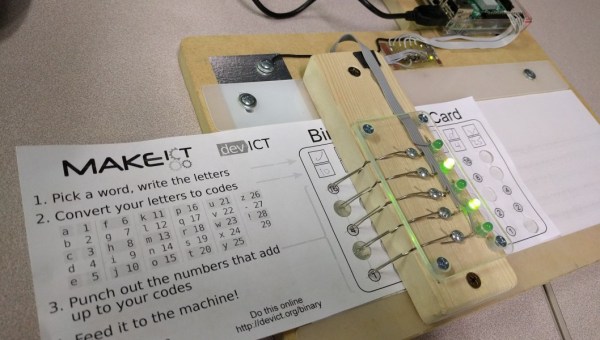
Punch card data input is so 1890 US Census, right? Maybe not, if your goal is to educate kids about binary numbers and how they can encode characters. In which case, this paper clip and metal tape punch card reader might be just the thing you need.

Built as part of the educational outreach efforts of the MakeICT hackerspace, this project allows kids and adults to play with binary numbers and get some instant feedback. The reader itself is a simple affair of wood and plastic; bent paperclips make contact with a foil tape strip and LEDs show the state of the five input bits. A card is provided to students with spaces for the letters of a word that they want to input, along with a table to translate each letter into a number. Students use a paper punch to encode each character in binary. As the card is pulled through the reader, the letters are spoken by the Pi in turn and the whole word is pronounced at the end.

We’ll no doubt hear quibbles with the decision not to use ASCII for the character set, but we can see the logic in keeping the number of bits to a minimum and not distracting from the learning process. What’s cool about this is that it engages kids on so many levels. They learn about binary numbers, encoding systems, interfacing a computer to the real world, and if they care to delve deeper, they can learn about the code behind everything. It’s a great hook into the hacking arts.

And once the kids learn a thing or two, maybe they can use this punch-card Twitter interface to tweet their new-found knowledge.


Raspberry_Pi_LogoSmall

The Raspberry Pi Zero contest is presented by Hackaday and Adafruit. Prizes include Raspberry Pi Zeros from Adafruit and gift cards to The Hackaday Store!
See All the Entries || Enter Your Project Now!

Nixie Thermometer Destined For Custom PC Case

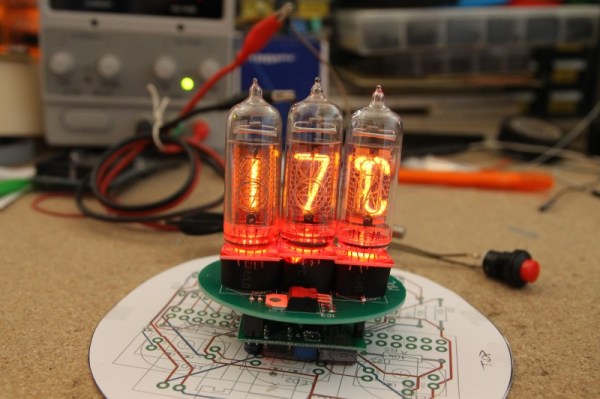
There’s no denying the retro appeal of the warm glow of a set of Nixies, and when a friend was looking for a unique touch for the case of his new liquid-cooled PC, [Luca] pitched in with this sweet Nixie thermometer.

From the look of [Luca]’s detailed blog entries, he’s been at this build since the New Year. He starts with a list of requirements, including the oddly specific need for a round PC board. For the thermometer, three Nixies are enlisted for the display, two for the temperature and one for the units. Everything was prototyped on perf board before committing to a PCB design, but even with careful planning, the Nixie sockets on the final PCB came out a tiny bit too close together. Luckily the tubes still fit, even if they are snuggled together some. And yes, the tube bases all include the hated RGB LEDs – hey, it’s what the customer wanted. The specs are for the colors to change at the touch of a button; we’d like to see a color gradient linked to the temperature – blue for “nice and cool”, red for “leave the room.” You can see the finished thermometer in action below the break.

The recent run of Nixie projects continues unabated, and this one has a nice look that’s sure to complement the finished case. We’ve asked [Luca] to keep us up-to-date on the project, so hopefully we’ll get a look at why a round PCB is needed. While we wait for that, check out an earlier Nixie thermometer build with a bar graph twist.

Continue reading “Nixie Thermometer Destined For Custom PC Case”

Rope Braiding Machine Built Entirely From LEGO Technics

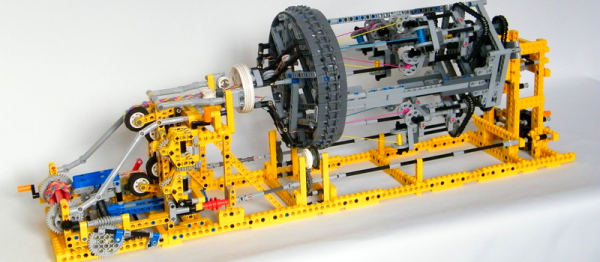
If you’ve ever seen a rope-braiding machine in action, you know they’re amazing machines where bobbins of thread whirl and spin in a complex dance to weave the threads under and over each other. Building one of these machines must be incredibly difficult; building one out of LEGO Technics pieces is darn near insane.

[Nico71], as hardcore a Technics builder as they come, tackled this complex build and made it work. A large drum spins horizontally and carries three groups of three planetary-mounted thread bobbins. The entire drum spins in one direction while the bobbins and another die with three holes spin the other way. The resulting braids are then fed through another spinning die, and the resulting 9-strand rope is taken up by a winding drum. The drum has a self-reversing feeding mechanism to keep the finished spool neat and tidy. The most impressive thing about the build, though, is the fact that it’s all powered by a single motor, and that everything is synchronized via gears, shafts, sprockets, chains and clutches. It’s a Technics tour de force you can see in action after the break.

[Nico71]’s build are pretty amazing. Some are pure art, others are models of classic cars and motorcycles, but things like his loom and the calculator he’s working on now are remarkable. Of course if you need to see more of the mesmerizing ballet of rope-braiding machines, check out this 16-bobbin hand-cranked version.

Continue reading “Rope Braiding Machine Built Entirely From LEGO Technics”

Hacking Hearing With A Bone Conduction Bluetooth Speaker

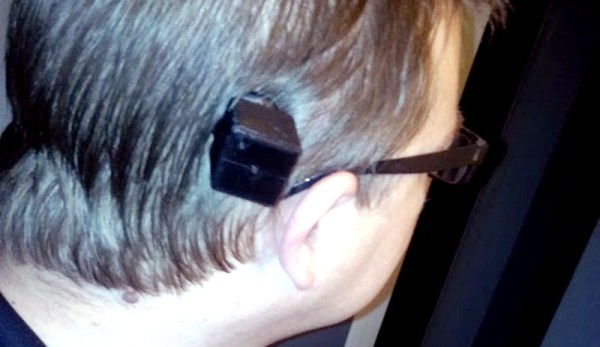
When a hacker finds himself with a metal disc and magnet surgically implanted in his skull, chances are pretty good that something interesting will come from it. [Eric Cherry]’s implant, designed to anchor a bone-conduction hear aid, turned out to be a great place to mount a low-cost Bluetooth speaker for his phone – at least when he’s not storing paperclips behind his ear.

With single-sided deafness, [Eric]’s implant allows him to attach his bone-anchored hearing aid (BAHA), which actually uses the skull itself as a resonator to bypass the outer ear canal and the bones of the middle ear and send vibrations directly to the cochlea. As you can imagine, a BAHA device is a pretty pricey bit of gear, and being held on by just a magnet can be tense in some situations. [Eric] decided to hack a tiny Bluetooth speaker to attach to his implant and see if it would work with his phone. A quick teardown and replacement of the stock speaker with a bone-conduction transducer from Adafruit took care of the electronics, which were installed in a 3D printed enclosure compatible with the implant. After pairing with his phone he found that sound quality was more than good enough to enjoy music without risking his implant. And all for only $22 out-of-pocket. While only a Bluetooth speaker in its current form, we can see how the microphone in the speakerphone might be used to build a complete hearing aid on the cheap.

We think this is a great hack that really opens up some possibilities for the hearing impaired. Of course it’s not suitable for all types of hearing loss; for more traditional hearing aid users, this Bluetooth-enabled adapter might be a better choice for listening to music.