Turn Signal Jacket How-to


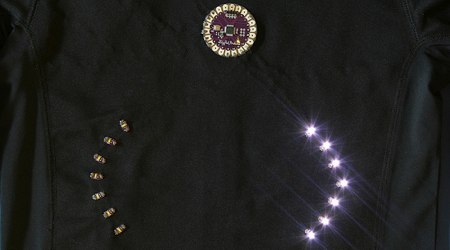
[Leah Buechley], whose work we’ve been covering since way back when, has built this lovely turn signal jacket. The project photos were posted in March, but she’s just added a well illustrated project guide. The jacket is based around a LilyPad Arduino, a lightweight Arduino board with radial pads designed to be used in wearable projects. You make your connections by sewing conductive thread through the pads. The how-to covers attaching the LilyPad parts properly and then insulating the wires with fabric paint after you’ve verified they work.

The guide has an interesting discussion about placing the power supply. The 4-ply silver coated thread used has a resistance of approximately 14ohms/foot. So, if you place the power supply one foot from the LilyPad, the two wires combine for 28ohms, causing a 1.4V drop. The power supply is only 5V, which means the LilyPad will be 3.6V. A voltage of 3.3V will cause the Arduino to reset. If your resistance is too high, you’ll have to add more thread.

The power supply on this jacket is under the collar. Each cuff has a single button plus an LED. The button will make the jacket flash the direction for 15 seconds (also indicated on the sleeve LED). If you press both buttons at the same time, it switches to night mode by flashing both directions at the same time to make you more visible.


Rear View Jacket


Is your popped collar so epic it emulates horse blinders? Are punk teens always skitching your coattails? Are you constantly moonwalking into power poles, trash cans, and the elderly? [Paul Coudamy]’s Hard-Wear Jacket solves all of these problems. It has a micro-camera embedded in the back of the neck and streams live video to a sleeve mounted monitor. The goal is to expand the perception of the wearer and how they interact with the environment. We know this is just a small step and doubt many people will be scrambling to never turn their neck again. It’s something interesting to contemplate though: how will people behave when brain taps allow their peripheral vision to have the same clarity as normal vision?

[via Gizmodo]

Free Web Development Tools


OStatic has a collected some great free tools for web developers. We talked about Quanta in an earlier post, but this article reaches beyond just HTML editors. LaunchSplash can be used to generate splash pages while you build. IBM, responsible for the Eclipse IDE, has built Project Zero to encourage web app development; even the IDE is web based. OpenX is an open ad server. Piwik is a free web analytics package. There are also quite a few open source CMS’s and sites collecting open source designs.

3x3x3 LED Cube


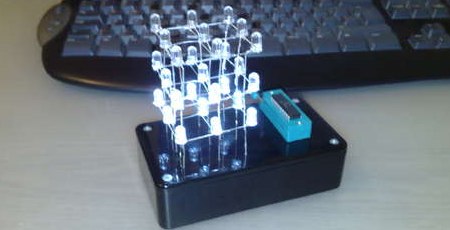
[portreathbeach] built this simple 3x3x3 LED matrix. It uses a PIC16F690 in a ZIF socket for the brains. Each layer has nine LEDs with the cathodes tied together. The anodes from each LED are connected to the LED below. The LEDs are multiplexed so that even though all layers appear to be on, they’re being addressed individually. He’s included software, so you can build your own animations. Video of the matrix in motion is after the break.

Continue reading “3x3x3 LED Cube”

Playstation 2 Controller Analysis


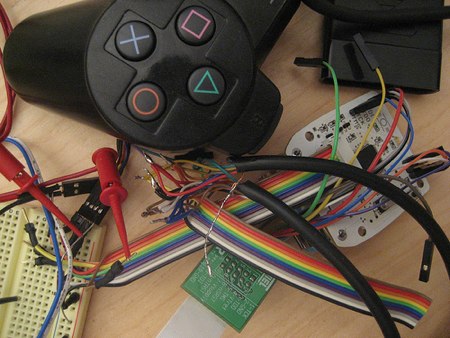
The people at Near Future Laboratory are trying to spoof the behavior of a Playstation 2 controller using just a microcontroller. They wrote some initial code using the controller info found here, but decided the best way to figure out what was going on, was to probe the interface. They’re using a Logicport, which features 34 channels plus two clock channels. They only need six channels because the PS2 implements an SPI protocol plus an ACK line. The post is just a preliminary investigation, but will give you a little insight into how the Logicport works and why you might find it useful.

Ice On Mars


It’s official: the Phoenix Lander has discovered ice on Mars. A few days ago, the lander exposed some bright white chunks of material while retrieving a soil sample. These spots have since disappeared over the following days, suggesting they’ve melted. An additional trench found a hard layer at the same depth as the original ice.

The spacecraft team has been dealing with some data storage issues as well and will be pushing a software patch soon.