Destroy Your Volkswagen Touch Adapter For Bluetooth’s Sake

[Mansour]’s Volkswagen Polo has a touch-screen adapter with voice recognition to control a bunch of the car’s features, but he wanted it gone.

Voice control of your car sounds like a great thing, right? Well, the touch adapter blocked other Bluetooth devices from connecting directly to the car, and prevented him from streaming music from his phone while he’s connecting it through the adapter. But if you simply throw the adapter away, the car won’t connect to any Bluetooth devices.

So what options are left? Other than a couple of expensive or complicated options, [Mansour] decided to open up the device and desolder the Bluetooth chip and antenna. Admittedly, it’s not the deepest hack in the world, but we’ve gotta give [Mansour] credit for taking the technology into his own hands.

Disabling unwanted functionality is not uncommon these days. Who hasn’t stuck tape over their laptop’s camera or kept an RFID card in a Faraday wallet? What other devices have you had to “break” in order to make them work for you?

Digital “Crystal” Breathes New Life Into Old Radio

[Bill Meara] of the Soldersmoke Podcast has a nice old Drake 2B radio, and wanted to use it for the 12 meter amateur band. These old radios normally make switching tuning bands easy — you just swap out one frequency crystal for another and you’re set.

Only [Bill] didn’t have the 21 MHz crystal that he needed. No problem, because he had a junk crystal, a hacksaw, and a modern direct-digital synthesis (DDS) chip sitting around. So he takes the donor crystal, cuts it open, and solders the two wires directly from the DDS to the crystal’s pins. Now he’s got a plug-in replacement digital oscillator that doesn’t require modifying the nice old Drake receiver at all. A sweet little trick.

The video’s a little bit long, but the money shot comes in around 5:00.

Now, one might worry about simply plugging a powered circuit (the DDS) in place of a passive element (the crystal), but it seems to work and the proof of the pudding is in the tasting. We wonder how far this digitally-controlled-analog-receiver idea could be extended.

Dusty Junk-bin Downconverter Receives FM On An AM Radio

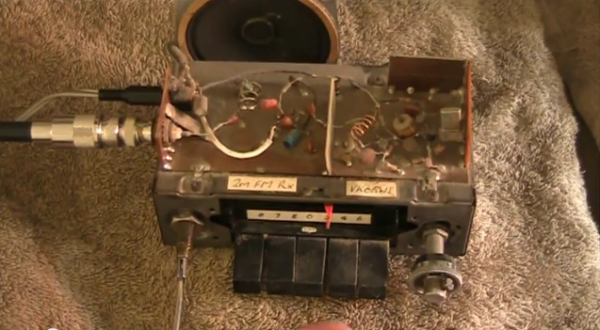
This amateur radio hack is not for the faint of heart! With only three transistors (and a drawer-full of passive parts), [Peter Parker, vk3ye] is able to use a broken-looking AM car radio to receive FM radio signals (YouTube link) on 2 meters, an entirely different band.

There are two things going on here. First, a home-made frequency downconverter shifts the 147 MHz signal down to the 1 MHz neighborhood where the AM radio can deal with it. Then, the AM radio is tuned just slightly off the right frequency and the FM signal is slope detected.

The downconverter consists of a local tuned oscillator and a mixer. The local oscillator generates an approximate 146 MHz signal from an 18 MHz crystal, accounting for two of the three transistors. Then this 146 MHz signal and the approximately 147 MHz signal that he wants to listen to are multiplied together (mixed) using the third transistor.

If you’re not up on your radio theory, a frequency mixer takes in two signals at different frequencies and produces an output signal that has various sums and differences of the two input signals in it. It’s this 147 MHz – 146 MHz = 1 MHz FM signal, right in the middle of the AM radio band’s frequency range, that’s passed on to the AM radio.

Next, the AM radio slope detects the frequency-modulated (FM) signal as if it were amplitude modulated (AM). This works as follows: FM radio encodes audio as changes in frequency, while AM radios encode the audio signal in the amplitude, or volume, of the radio signal. Instead of tracking the changing frequency as an FM radio would, slope detectors stick on a single frequency that’s tuned just slightly off from the FM carrier frequency. As the FM signal gets closer to or farther away from this fixed frequency, the received signal gets louder or quieter, and FM is detected as AM.

At 5:23, [vk3ye] steps through the circuit diagram. As he mentions, these are old tricks from circa 50 years ago, but it’s very nice to see a junk-box hack working so well with so few parts and receiving (very) high frequency FM on an old AM car radio. A circuit like this could make a versatile front end for an SDR setup. It makes us want to warm up the soldering iron.

Continue reading “Dusty Junk-bin Downconverter Receives FM On An AM Radio”

Twittering Chicken Coops, Batman!

By now you’ve seen almost anything Tweet. But have you seen the (French) twittering chicken coop? (Google translate link) [Hugo] had kept two chickens as part of a household-waste reduction campaign, and then afterward started work.

Even if you don’t read French, the chickens’ twitter feed basically tells the story.

The setup can take IR photographs of sleeping chickens and notify [Hugo] when it’s time to collect the eggs. Naturally, an abundance of other sensors are available. The coop can tweet based on ambient temperature, nest temperature, light level, motion sensor status, or the amount of remaining chicken feed. You can easily follow whether the two fowl are in the coop or out in the yard. It’s like Big Brother, only for birds.

The application is, frankly, ridiculous. But if you’re into home (or coop) automation, there’s a lot to be learned and the project is very well documented. [Hugo] used OpenCV for visual egg detection, and custom Python code to slightly randomize the tweets’ text. All of these details are up on his Github account.

And if you just can’t get enough chicken-coop hacks, be sure to check out this mobile chicken coop, this coop in the shape of a golden spiral, or this Bluetooth-enabled, talking chicken coop, among others. You’d think our name was Coop-a-Day.

Quadrotor Pod Racing

A group of multicopter enthusiasts from Argonay, France cordoned off a path through the forest and spent the day racing. The resulting video makes it look like a heck of a good time.

Twenty “drone” pilots all used first-person view (FPV) camera setups for complete immersion, racing at up to 50 kilometers per hour through a 150m course in the woods that was chosen for maximum thrills and spills. The track basically followed a footpath, but the pilots still had to be extremely alert to avoid natural obstacles (we call them “trees”). The narrator adds that the nearly random lighting and camera artifacts added an extra level of difficulty to the event.

After practicing a few times just to get around the track in one piece, they started racing each other in heats. On the final heat, at 3:40 in the video, five copters start off head-to-head and tear out into the woods. Of them, only two cross the finish line.

FPV drone crash scenes still make us wince a little bit. We wonder how many of the participants spent the next few nights in the repair bay.

Continue reading “Quadrotor Pod Racing”

Art From Brainwaves, Antifreeze, And Ferrofluid

Moscow artist [Dmitry Morozov] makes phenomenal geek-art. (That’s not disrespect — rather the highest praise.) And with Solaris, he’s done it again.

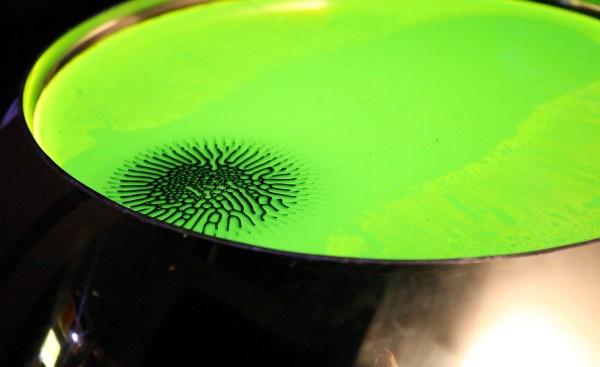
The piece itself looks like something out of a sci-fi or horror movie. Organic black forms coalesce and fade away underneath a glowing pool of green fluid. (Is it antifreeze?) On deeper inspection, the blob is moving in correspondence with a spectator’s brain activity. Cool.

You should definitely check out the videos. We love to watch ferrofluid just on its own — watching it bubble up out of a pool of contrasting toxic-green ooze is icing on the cake. Our only wish is that the camera spent more time on the piece itself.

Two minutes into the first video we get a little peek behind the curtain, and of course it’s done with an Arduino, a couple of motors, and a large permanent magnet. Move the motor around with input from an Epoc brain-activity sensor and you’re done. As with all good art, though, the result is significantly greater than the sum of its parts.

[Dmitry’s] work has been covered many, many times already on Hackaday, but he keeps turning out the gems. We could watch this one for hours.

Add CNC To Your…Propane Tank??!?

It’s starting to be that time of year again; the Halloween-themed hacks are rolling in.

[John Lauer] needed a propane-powered flame effect for his backyard ICBM “crash site”. Rather than pony up for an expensive, electronically-controlled propane
valve, he made a custom bracket to connect a stepper motor to the propane burner’s existing valve.

With the stepper motor connected up, a TinyG stepper motor controller and [John’s] own graphical interface, ChiliPeppr, take care of the rest.

The hack is almost certainly a case of “everything looks like a nail when you have a hammer” but you have to admit that it works well and probably didn’t take [John] all that much time to whip up. Maybe everyone should have a couple spare stepper motors with driver circuitry just lying around ready to go? You know, just in case.

All the details of the build are in the video. If you’re done watching the flames, skip to around 2:50 where we see the adapter in action and then [John] steps us through its construction.

You may have seen coverage of the TinyG motor controller here before.

Additional thanks to [Alden Hart] for the tip.