Noise Cancelling Isn’t As Easy As You’d Think

On the face of it, producing a set of noise cancelling headphones should be a relatively straightforward project. But as [Pete Lewis] found out, things are not always as they seem. The result is a deep dive into microphone specifications, through which most of us could probably learn something.

Noise cancelling headphones have a set of microphones which provide anti-phase noise through an amplifier to the ‘phones, thus in theory cancelling out the external noise. Since [Pete] is a musician this pair would have to be capable of operating at high noise levels, so he checked the spec for his microphone and with an acoustic overload point at 124 dB for a 115 environment he was ready to go.

Unfortunately these ‘phones showed distortion, which brings us back to the acoustic overload point. This is the sound level at which the microphone has 10% distortion, which is a very high figure, and certainly meant there was enough distortion to be audible at the lower level. After a search for a higher spec microphone and a move to a digital codec-based solution with an ESP32 he eventually cracks it though, leading to an inexpensive set of noise cancelling headphones for high-noise environments.

If distortion interests you, it’s a subject we’ve visited in the past.

Header image: fir0002, GFDL 1.2.
A Flasher Mac, 25 Years Later

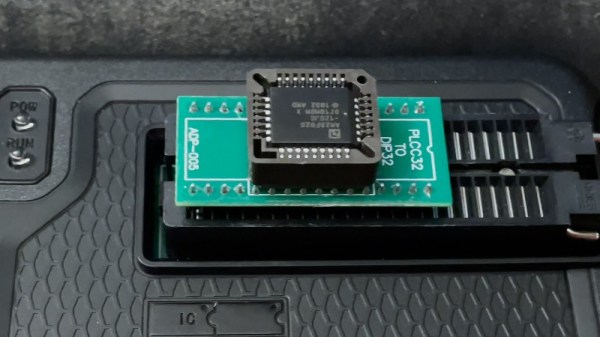
Apple Macintosh computers of the 1990s came with a system ROM containing an Open Firmware implementation and the Mac Toolbox required to start the operating system. In many cases this was on a SIMM-like daughter board, and it would have been a true ROM that was unable to be reprogrammed. This is not the end of the story though, and [Doug Brown] set out on the trail of a Flash-based ROM module allowing the firmware on these machines to be updated.

The trail was warm thanks to an Apple developer utility found on a secondhand Mac prototype, allowing ROM flashing. A little disassembly allowed a list of valid IDs to be made, and this info coupled with a bit of reverse engineering from online photos of a real Apple Flash ROM from the ’90s allowed a new board to be created with four Am28F020  chips. He can now flash at will, with such oddities as running ROMs from different machines with the “wrong” startup chime. It’s an interesting little piece of 1990s Mac trivia, settled.

This isn’t the first time we’ve peered at Apple ROMs, indeed some of the older ones had plenty of Easter eggs hidden within.

A 48 Volt Battery Pack With Carefully Balanced Cells

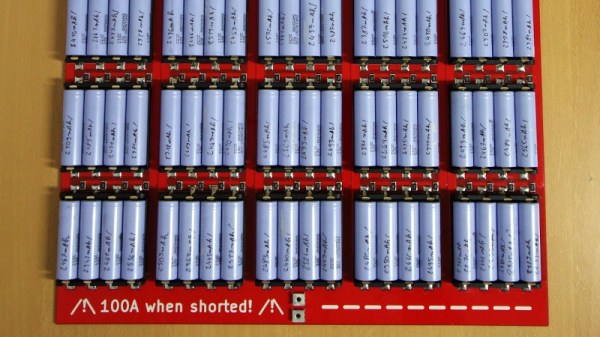
Many readers will have at some time or another built their own lithium-ion battery packs, whether they are using tiny cells or the huge ones found in automotive packs. A popular choice it to salvage ubiquitous 18650 cylindrical cells, as [limpkin] has with this 48 volt pack. It’s based around an off-the-shelf kit aimed at the e-bike market, but it’s much more than a simple assembly job.

Faced with a hundred salvaged cells of unknown provenance, the first thing to do was ensure that they were all balanced and showed the same voltage. Some might do this the inefficient way by hooking each one up to a charger and a programmable load, but in this case a much more radical route was taken. A huge PCB was designed with sockets for all hundred cells, connected in parallel through individual series resistors. This allowed them to balance to a common voltage before being discharged to a safe voltage for assembly. Their individual ESRs were the measured, and the best performing examples were then spot-welded into the final 13s-6p final pack.

We all use lithium-ion batteries, but how many of us know how they work?

A Tube Guitar Amp For A Modest Budget

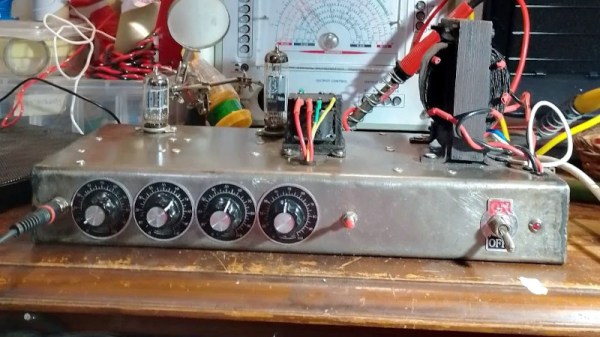
There’s a mystique among both audiophiles and musicians about vacuum technology, thus having a tube amp still carries a bit of a cachet. New ones can be bought for eye-watering prices and old ones can be had for the same price with the added frisson of unreliability. Happily it’s surprisingly straightforward to build your own, as [_electroidiot] shows us with a fairly inexpensive build.

The design is inspired by the guitar amps of the 1950s and 1960s so it’s not for audiophiles. The circuit is a pretty conventional single-ended one with a two stage double triode preamp and a single power output tube. The transformers are usually the difficult part of a build like this one, and here instead of resorting to using a mains transformer for audio they come from a defunct 1960s Phillips radio. We especially like the old-school construction technique with a folded aluminium chassis and liberal use of tag strips on which to build the circuits.

The result is something that would have been in no way out of place in the 1960s, and proves that tube circuitry isn’t beyond the constructor in 2023. If it’s whetted your appetite for more, we can help you there.

Could North Korea’s New Satellite Have Spied On Guam So Easily?

Earlier this week, another nation joined the still relatively exclusive club of those which possess a satellite launch capability. North Korea launched their Malligyong-1 spy satellite, and though it has naturally inflamed the complex web of political and military tensions surrounding the Korean peninsula, it still represents something of a technical achievement for the isolated Communist state. The official North Korean news coverage gleefully reported with much Cold War style rhetoric, that Kim Jong-Un had visited the launch control centre the next day and viewed intelligence photographs of an American base in Guam. Could the satellite have delivered in such a short time? [SatTrackCam Leiden] has an interesting analysis. Continue reading “Could North Korea’s New Satellite Have Spied On Guam So Easily?”

What It Takes To Make A Raspberry Pi Killer

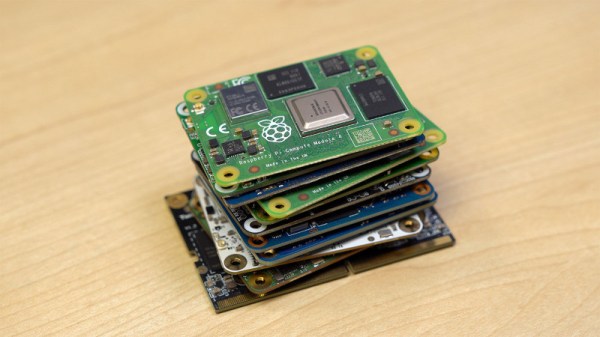
The folks at Raspberry Pi are riding on a bit of a wave at the moment, with the launch of the Pi 5 with its PCIe and RP1 peripheral chip, the huge success of the RP2040 microcontroller, and the supply chain issues that dogged the Pi 4 and Compute Module 4 during and after the pandemic finally working themselves out. But as always there are plenty of would-be competitors snapping at their heels, so [Jeff Geerling] has posed the question of what it takes to make a Raspberry Pi killer. He’s in a good position to do this, as he’s amassed an impressive collection of every competing Compute Module board.

It’s a well-observed analysis of the world of small Linux SBCs, on hardware, software, community, and price, and we find ourselves pretty much in agreement with it. The Pi hardware has quirks and is rarely the best on paper when compared to the competition, but they win hands-down on distribution support and community. In a sense what you really buy when you get a PI is this, because Raspberry Pi OS will run on it for the reasonable future. Rival makers would do well to read his piece, because we sense that if one of them tried to give the Pi a run for its money away from the hardware it would make for a much better SBC ecosystem. Take a look at his Compute Module comparison below the break.

We recently took a look at the strategic importance of the Pi 5 and in particular the RP1.

Continue reading “What It Takes To Make A Raspberry Pi Killer”

Tesla Claims To Have Open Sourced The Roadster

In an interesting step for anyone who follows electric car technology, the automaker Tesla has released a trove of information about its first-generation Roadster car into the public domain. The documents involved include service manuals, circuit diagrams, and technical details, and Elon Musk himself Tweeted posted on X that “All design & engineering of the original @Tesla Roadster is now fully open source.

We like the idea and there’s plenty of interesting stuff there, but we can’t find an open-source licence anywhere and we have to take issue with his “Whatever we have, you now have” comment. What we have is useful maintenance information and presents a valuable window into 2010’s cutting edge of electric vehicles, but if it’s everything they have then something must have gone very wrong in the Tesla archives. It’s possible someone might take a Lotus Elise and produce something close to a Roadster replica with this info, but it’s by no means enough to make a car from. Instead we’re guessing it may be a prelude to reducing support for what is a low-production car from over a decade ago.

When it comes to electric vehicle manufacturers open-sourcing their older models we already have a model in the form of Renault’s open-source version of their Twizy runabout. This is a far more credible set of information that can be used to make a fully open-source version of the car, rather than a set of workshop manuals.

Tesla Roadster, cytech, CC BY 2.0.