Multi-way Capacitor Replacement Without The Pain

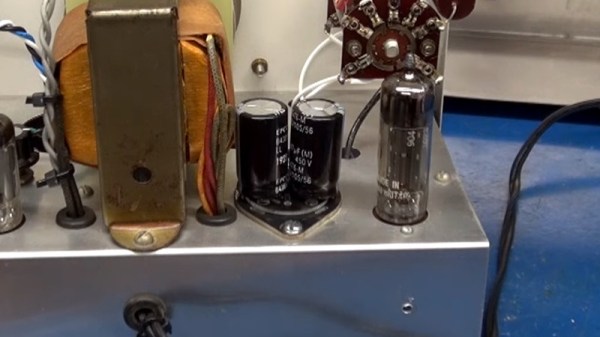
Anyone who’s worked with older tube-based equipment will be familiar with the type of vintage electrolytic capacitor which integrated several capacitors into one can. Long obsolete, they can be bought as reproduction, but unfortunately at an eye-watering price. [D-Lab Electronics] introduces us to a solution using a very useful kit, that it’s worth sharing.

The piece of equipment in the video below the break is a rather lovely Heathkit oscillator, following the familiar phase shift model with a light bulb in its feedback loop. It’s a piece of test equipment that produces a low-distortion sine wave output, and would still be of use to an audio engineer today. He replaces the capacitor with two modern ones on a multi-cap board from [W8AOR], who sells a variety of these kits for different configurations.

We’ve done this very repair more than once, and it has usually involved wiring, heatshrink sleeving, hot glue, and cable ties, looking very messy indeed. It’s not that often that a kit catches our eye as this one has, but we know we’ll be finding it useful here some time in the future. Meanwhile if you’d like to know why this oscillator has a light bulb, take a look at our piece on distortion.

Continue reading “Multi-way Capacitor Replacement Without The Pain”

This Time It’s Toyota: Takata Airbag Recalls Continue

The automotive industry is subject to frequent product recalls, as manufacturers correct defects in their vehicles that reveal themselves only after some use. While such events may be embarrassing for a marque, it’s not necessarily a bad thing — after all, we would rather put our trust in a carmaker prepared to own up and fix things rather than sweep their woes under the carpet.

There’s one recall that’s been going on for years which isn’t the vehicle manufacturer’s fault though, and now it seems Toyota are the latest to be hit, with some vehicles as old as two decades being part of it. Long time Hackaday readers will probably recognize where this is going as we’ve covered it before; at its centre are faulty airbag charges from Takata, and the result has been one of the largest safety related recalls in automotive history.

An automotive airbag is a fabric structure inflated at high speed by a small explosive charge when triggered by the sharp deceleration of an incident. It is intended to cushion any impact the occupant might make upon the car’s interior. The problem with the faulty Takata units is that moisture ingress could alter the properties of the charge, and this along with corrosion could increase its power and produce a hail of metal fragments on detonation.

Our colleague [Lewin Day] has penned a series of informative and insightful investigations of the technology behind the Takata scandal, going back quite a few years. With such relatively ancient vehicles now being recalled we can’t help wondering whether it would be easier for Toyota to run a buyback scheme and take the cars off the road rather than fix them in this case, but we’re curious as non automotive safety engineers why the automotive airbag has evolved in this manner. Why is one of very few consumer explosive devices not better regulated, why is it sold with an unlimited lifetime, and why are they not standardized for routine replacement on a regular schedule just like any other vehicle consumable?

2003-2004 Toyota Corolla: IFCAR, Public domain.

Making An Aircraft Wing Work For An Audience

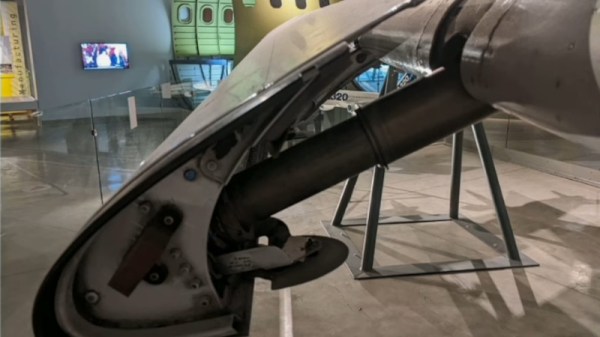
Many of us will have sat and idly watched the flaps and other moving parts of an airliner wing as we travel, and it’s likely that most of you will know the basics of how an aircraft wing works. But there’s more to an aircraft wing than meets the eye, which is why the Aerospace Bristol museum has an Airbus A320 wing on display. [Chris Lymas] was part of the team which turned a surplus piece of aircraft into an interactive and working exhibit, and he told the Electromagnetic Field audience all about it in his talk Using Arduinos to Resurrect an Airliner Wing.

The talk starts with an explanation of how a variable surface wing works, and then starts to talk about the control systems employed. We’re struck with the similarity to industrial robots, in that this is a a powerful and thus surprisingly dangerous machine to be close to. The various moving surfaces are moved by a series of shafts and gearboxes, driven by a DC motor. Running the show is an Arduino Mega, which has enough interfaces for all the various limit switches.

It’s fascinating to see how the moving parts in an airliner wing work up close, and we’re impressed at the scale of the parts which keep us safe as we fly. Take a look, the video is below the break.

Continue reading “Making An Aircraft Wing Work For An Audience”

A Basic USB-C Primer

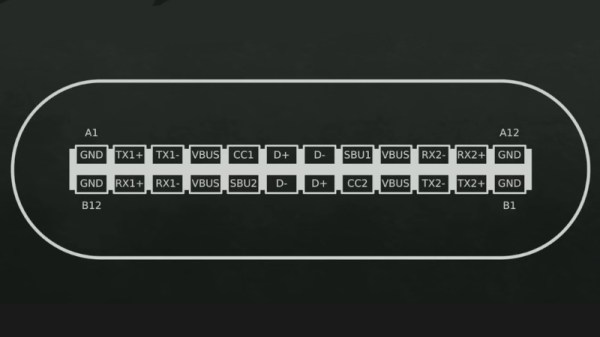
Over the last five years or so there has been a quiet take-over of the ports on laptops, phones, and other devices, as a variety of older ports as well as the familiar USB A and micro USB sockets have been replaced by the now-ubiquitous USB-C port. It’s a connector which can do so many things, so many in fact that it bears a handy explanation. The Electromagnetic Field 2022 hacker camp has been quietly uploading videos of its talks, and a recent one has [Tyler Ward] explaining the intricacies of the interface.

Many of you will be familiar with XKCD number 927 which makes a joke about proliferating connector standards, and it’s evident that USB-C is a rare case of a connector which bucks the trend of simply making another standard, and has instead created something with which it makes sense to replace what went before. We learn about the intricacies of inter-device communications and USB-PD, and the multiple high-speed connection  lanes shoehorned into it. That one small connector can plug into a laptop and provide power, USB peripherals including network, and display, is nothing short of amazing. Take a look at the video below the break, and if you’re interested in diving deeper, have a look at our colleague [Arya Voronova]’s USB-C for hackers series.

Continue reading “A Basic USB-C Primer”

A Complete Exchange From Scratch For Your Rotary Dial Phones

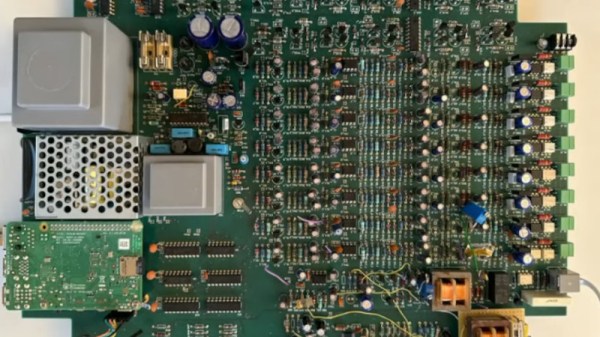
Such has been the success of the mobile phone that in many places they have removed the need for wired connections, for example where this is being written the old copper connection can only be made via an emulated phone line on an internet router. That doesn’t mean that wired phones are no longer of interest to a hardware hacker though, and many of us have at times experimented with these obsolete instruments. At the recent 37C3 event in Germany, [Hans Gelke] gave a talk on the analog exchange he’s created from scratch.

The basic form of the circuit is built around a crosspoint switch array, with interfaces for each line and a Raspberry Pi to control it all. But that simple description doesn’t fully express its awesomeness, rather than hooking up a set of off-the-shelf modules he’s designed everything himself from scratch. His subscriber line interface circuit uses a motor controller to generate the bell signal, his analogue splitter has an op-amp and a transistor, and his crosspoint array is a collection of JFETs. Having dabbled in these matters ourselves, it’s fascinating to see someone else making this work. Video below the break.

Have an analogue phone but nowhere to use it? Bring it to a hacker camp!

Continue reading “A Complete Exchange From Scratch For Your Rotary Dial Phones”

A Mouse Becomes A Camera

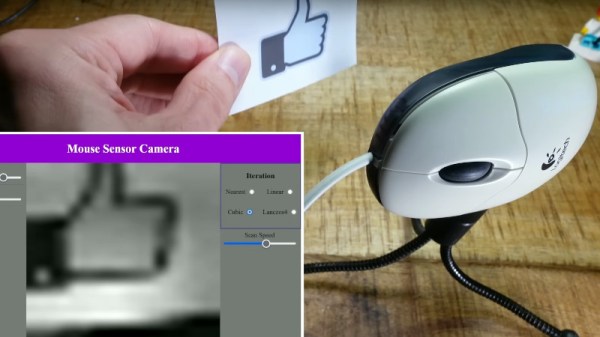
If your pointing device is a mouse, turn it over. The chances are you’ll see a red LED light if you’re not seriously old-school and your mouse has a ball, this light serves as the illumination for a very simple camera sensor. The mouse electronics do their thing by looking for movement in the resulting image, but it should be possible to pull out the data and repurpose the sensor as a digital camera. [Doctor Volt] has a new video showing just that with the innards of a Logitech peripheral.

The mouse contains a microcontroller and the camera part, which fortunately has an SPI interface. The correct register to query the sensor information was deduced, and as if my magic, an image appeared. An M12 lens provided focus with a handy 3D printed mount, and the board went back into the mouse case as a housing. The pictures have something of the Game Boy camera about them, being low-res and monochrome, but it’s still a neat hack.

If you’d like to give it a go you can find the code in a GitHub repository. You might find it worth finding a gaming mouse though, for the much higher resolution sensor.

Continue reading “A Mouse Becomes A Camera”

A Vintage Monitor Lives Again With A New Heart

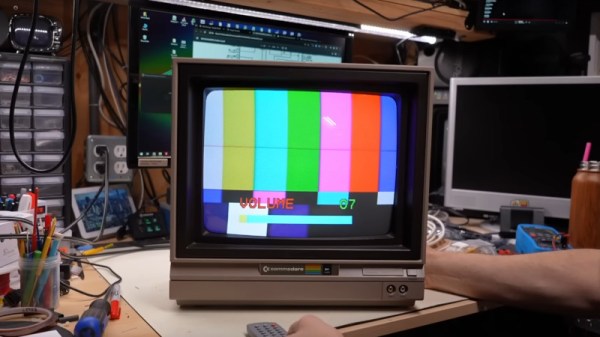
Aside from keeping decades-old consumer-grade computing hardware working, a major problem for many retrocomputing enthusiasts lies in doing the same for vintage monitors. Whether your screen is a domestic TV or a dedicated monitor, the heat and voltage stress of driving a CRT made these devices significantly less reliable than many of their modern-day counterparts. [Adrian’s Digital Basement] has a worn-out and broken Commodore 1701 monitor, which he’s brought back to life with a modern circuit board and a CRT transplant.

Following on from a previous project, he’s using a replacement board sold as a repair option for CRT TVs on AliExpress. The Commodore monitor has its board on a metal chassis which takes the replacement with a bit of modification. He doesn’t say where the new CRT came from, but we’re guessing it was a late model TV as CRTs made over the last few decades are more interchangeable than might be expected. There’s a moment of mild dodginess as he makes a voltage doubler to run the 220 V board from 120 V with a pair of large electrolytic capacitors hot glued in place, but otherwise it’s a success.

At the end of it all after some testing and set-up he has a Commodore monitor with a new heart and multi-standard support. Is it really a Commodore monitor though, or should it have been repaired? It’s a difficult one to answer, but we’d suggest that CRT monitor repair is less easy today than it used to be because many of the parts are now difficult to find. If it saves at least some of the original from the dumpster it’s better than doing nothing. We wonder how long these upgrades will remain possible as even with Chinese plants making these boards and a handful of CRT TVs still appearing on AliBaba it’s clear that CRTs are at the very end of their life.

Continue reading “A Vintage Monitor Lives Again With A New Heart”