An Electric Unicycle, In Minimalist Form

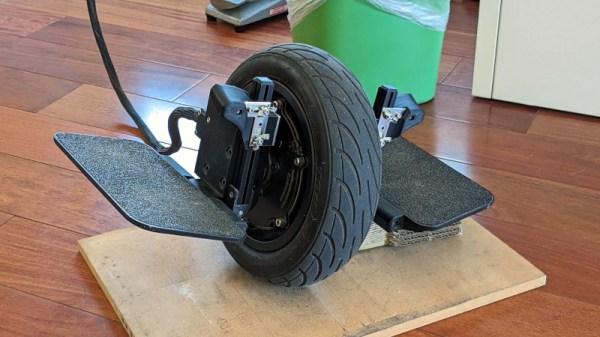
When self balancing scooters hit the market a few years ago they brought alongside them a range of machines, from the hoverboard kids toys which have provided so many useful parts, to the stand-astride electric unicycles. These last machines have a bulky battery and controller box atop the wheel, and [Dycus] set his sights on this by transferring it to a backpack with the vehicle’s IMU sensor relocated to one of the pedals.

Such a job is not merely a simple case of rewiring with some longer cables, as a first challenge the IMU communicates via I2C which isn’t suitable for longer distances. This is solved by a chipset which places the I2C on a differential pair, but even then it’s not quite a case of stepping on and zipping about. The PID parameters of the balancing algorithm on a stock machine are tuned for the extra weight of the battery on top, and these needed to be modified. Fortunately there have been enough people hacking the STM microcontroller and firmware involved for this task to be achievable, but we’d rate it as still something not for the faint-hearted.

The final result can be seen in the video below, and the quality of the physical work shows as very high. The former battery box is repurposed into a stylish backpack, and though the newly minimalist foot pedals and wheel are a little less easy to get going he zips around with ease.

Hungry for more? This ain’t the first we’ve shown you.

Continue reading “An Electric Unicycle, In Minimalist Form”

This CRT Luggable Makes Sense

There was a time when portable computing meant not a svelte laptop but a suitcase-sized machine that was really a slimmed-down desktop with a small CRT incorporated int he same box. They were heavy and unwieldy, but the computing compromises of using one at the time were less than with what served for more portable machinery. It’s a form factor which understandably has long ago disappeared, but that hasn’t stopped [Sdomi] from reviving it with a machine that packs plenty of modern computing power.

It’s a project that started with a monitor, a diminutive green-screen model which had previously adorned a CNC machine. It’s a composite model, so it’s driven from a VGA-to-composite converter. The computing power comes from a thin-client board that packs an up-to-date AMD Ryzen processor and 32 GB of memory, and the case is manufactured from oriented strand chipboard.

The result is a chunky but definitely practical and usable take on a portable cyberdeck, with the caveat that a composite monitor will not deliver the resolution some of us might be used to. We have to admit rather liking it, there’s nothing like the curved glass of a CRT.

It’s by no means the only up to date luggable we’ve seen, though more often now they feature an LCD.

Making An Injection Mold For Yourself

Injection molding is the obvious onward step from 3D printing when the making of a few plastic parts becomes their series manufacture. The problem with injection molding is though, that making a mold can be prohibitively expensive. Has the advent of affordable CNC machining changed that? [Teaching Tech] takes a look, and machines a mold for part of a bicycle bracket.

With a diversion into home-made silicone seals for the injection molding machine, he proceeds to machine the mold itself from a block of aluminium. It’s a basic introduction to mold construction for those of us who’ve never ventured in this direction before, and it provides some interesting lessons. As we’d expect he does a rough machining pass before returning with a ball-end tool to smooth off those curves, but there’s a lesson in measuring rather than believing the paperwork. The tool he used was a bit smaller then the spec, so his path left some rough edges that had to be returned to. Otherwise the use of a removable pair of bolts to form holes in the finished part is we guess obvious after watching the video, but it’s something we learned as injection molding newbies.

This video follows on from a previous one we also covered, in which we’re introduced to the machine itself.

Continue reading “Making An Injection Mold For Yourself”

Photography Goes Leaf Green

Something that haunts film photographers is the prospect of a film shortage. This won’t replace film in that event, but [Applied Science] demonstrates photography using leaves. That’s right, a plant can record an image on its leaves.

Anyone with a high-school level of education can tell you that the leaf is a solar energy harvester, with the green chlorophyll using CO2 scavenged from the air to make sugars in the presence of light. It stands to reason that this light sensitivity could be used to capture images, and indeed if you place a leaf in the dark for an extended period of time its chlorophyll fades away where there is no light. The technique described in the video below the break is different though, and much more sensitive than the days-long exposures required to strip chlorophyll. It relies on starch, which the leaf uses to store energy locally when it has an excess of light. Continue reading “Photography Goes Leaf Green”

Maker Faire Hannover: The Right Way To Do It

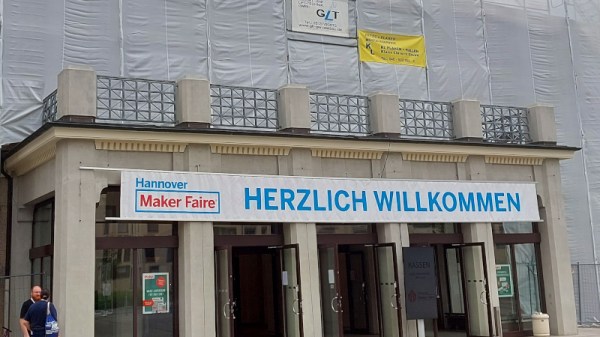
On these pages we bring you plenty of reports from events, most of which are from the hacker or hardware communities. These can be great fun to attend, but they’re not the only game in town when looking at things adjacent to our community. At what you might describe as the consumer end of the market there are the Maker Faires, which bring a much more commercial approach to a tech event. While so many of us are in Germany for Chaos Communication Camp there’s a maker faire ideally placed to drop in on the way back. We took the trip to Hannover, a large and rather pleasant city just off the Berlin to Amsterdam motorway roughly central to the top half of the country. It’s got one of the German emissions zones so without the green tax sticker in the car we took a park-and-ride on one of their clean and efficient trams to alight a short walk from the congress centre.

Plenty To See, And It’s Not All For Kids

Continue reading “Maker Faire Hannover: The Right Way To Do It”

The Briny Depths Give Wine An Edge, But How?

Though Hackaday scribes have been known to imbibe a few glasses in their time, it’s fair to say that we are not a wine critic site. When a news piece floated by about a company getting into trouble for illegally submerging crates of wine though, our ears pricked up. Why are vintners dumping their products in the sea?

Making wine, or indeed any alcoholic beverage, starts with taking a base liquor, be it grape juice, apple juice, barley malt solution, or whatever, and fermenting it with a yeast culture to produce alcohol. The result is a drink that’s intoxicating but rough, and the magic that turns it into a connoisseur’s tipple happens subsequently as it matures. The environment in which the maturation happens has a huge influence on this, which is one of many reasons why wine from the cellar of a medieval chateau tastes better than that from an industrial unit in southern England. The Californian company was attempting to speed up this process by leaving the bottles beneath the waves. Continue reading “The Briny Depths Give Wine An Edge, But How?”

GTA 6 Hacker Found To Be Teen With Amazon Fire Stick In Small Town Hotel Room

International cybercrime, as portrayed by the movies and mass media, is a high-stakes game of shadowy government agencies and state-sponsored hacking groups. Hollywood casting will wheel out a character in a black hoodie and shades, probably carrying a metallic briefcase as they board an executive jet.

These things aren’t supposed to happen in a cheap hotel room in your insignificant hometown, but the story of a British teen being nabbed leaking the closely guarded details of Grand Theft Auto 6 in a Travelodge room in Bicester, Oxfordshire brings the action from the global into the local for a Hackaday scribe. Bicester is a small town best known for a tacky outlet mall and as a commuter dormitory stop on the line to London Marylebone, it’s not exactly Vice City.

The teen in question is one [Arion Kurtaj], breathlessly reported by the BBC as part of the Lapsus$ gang, which is a sensationalist way of talking up a group of kids expert at computer infiltration but seemingly inept at being criminals. After compromising British telcos he was exposed by another group and nabbed by the authorities, before being moved to the hotel for his own safety.

Here the story becomes more interesting for Hackaday readers, because though denied access to a computer he purchased an Amazon Fire stick presumably at the Argos in the Sainsburys next door, and plugged it into the Travelodge TV. Using this he was able to access cloud services, we’re guessing a virtual Linux environment or similar, before continuing to compromise further organisations including Rockstar Games to leak that GTA 6 footage. He’s yet to be sentenced, but we’re guessing that he’ll continue to spend some time at His Majesty’s pleasure.

The moment of excitement in one’s hometown and the sensationalist reporting aside, we can’t help feeling sad that a teen with that level of talent evidently wasn’t given the support and encouragement by Oxfordshire’s education system necessary to put it to better use. Let’s hope when he’s older and wiser the teenage conviction won’t prevent him from having a useful career in the field.