It’s A Humble ‘Scope, But It Changed Our World

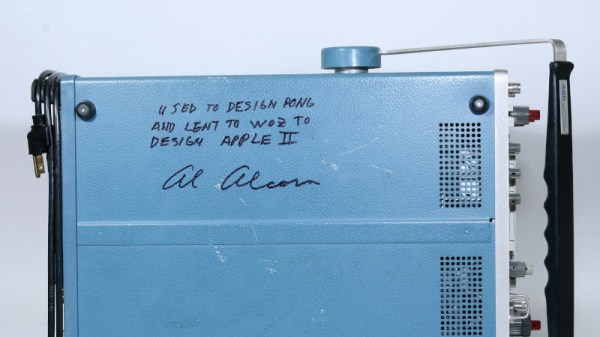
A few years ago on a long flight across the North Atlantic, the perfect choice for a good read was iWoz, the autobiographical account of [Steve Wozniak]’s life. In it, he described his work replicating the wildly successful Pong video game and then that of designing the 8-bit Apple computers. A memorable passage involves his development of the Apple II’s color generation circuitry, which exploited some of the artifacts of the NTSC color system to produce a color display in a far simpler manner than might be expected. Now anyone seeking a connection with both Pong and the Apple II can have one of their very own if they have enough money because [Al Alcorn]’s Tektronix 465 oscilloscope is for sale. He’s the designer of the original Pong and used the instrument in its genesis, and then a few years later, he lent it to [Woz] for his work on the Apple II.

This may be the first time Hackaday has featured something from the catalogue of a rare book specialist, but if we’re being honest, for $135,000, it’s a little beyond the reach of a Hackaday scribe. The Tek 465 was a 100 MHz dual-trace model manufactured from 1972 to the early 1980s and, in its day, would have been a very desirable instrument indeed. This one is in pretty good condition with accompanying leads and manual and comes with a letter of authenticity and a hand-written annotation from [Al] himself on its underside. It can be seen up close in the video below the break.

As a ‘scope it’s an instrument many of us would still find useful today, but as the instrument which set in motion not one but two of the seminal moments of our craft, its historical importance can’t be overstated. We hope it will find its way into a museum or similar place where the story of those two developments can be told and that [Al] profits handsomely from its sale.

Continue reading “It’s A Humble ‘Scope, But It Changed Our World”
System Essentially Contradicting American Methods

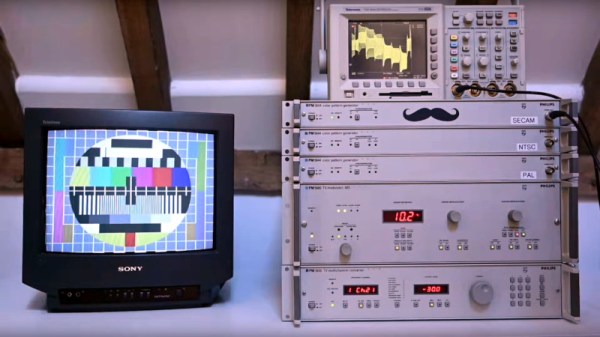
Today, acronyms such as PAL and initialisms such as NTSC are used as a lazy shorthand for 625 and 525-line video signals, but back in the days of analogue TV broadcasting they were much more than that, indeed much more than simply colour encoding schemes. They became political statements of technological prowess as nations vied with each other to demonstrate that they could provide their citizens with something essentially home-grown. In France, there was the daddy of all televisual symbols of national pride, as their SECAM system was like nothing else. [Matt’s TV Barn] took a deep dive into video standards to find out about it with an impressive rack of test pattern generation equipment.

At its simplest, a video signal consists of the black-and-while, or luminance, information to make a monochrome picture, along with a set of line and frame sync pulses. It becomes a composite video signal with the addition of a colour subcarrier at a frequency carefully selected to fall between harmonics of the line frequency and modulated in some form with the colour, or chrominance, information. In this instance, PAL is a natural progression from NTSC, having a colour subcarrier that’s amplitude modulated and with some nifty tricks using a delay line to cancel out colour shifting due to phase errors.

SECAM has the same line and frame frequency as PAL, but its colour subcarrier is frequency modulated instead of amplitude modulated. It completely avoids the NTSC and PAL phase errors by not being susceptible to them, at the cost of a more complex decoder in which the previous line’s colour information must be stored in a delay line to complete the decoding process. Any video processing equipment must also, by necessity, be more complex, something that provided the genesis of the SCART audiovisual connector standard as manufacturers opted for RGB interconnects instead. It’s even more unexpected at the transmission end, for unlike PAL or NTSC, the colour subcarrier is never absent, and to make things more French, it inverted the video modulation found in competing standards.

The video below takes us deep into the system and is well worth a watch. Meanwhile, if you fancy a further wallow in Gallic technology, peer inside a Minitel terminal.

Continue reading “System Essentially Contradicting American Methods”

Probably The Cheapest Lens You Will Ever Use

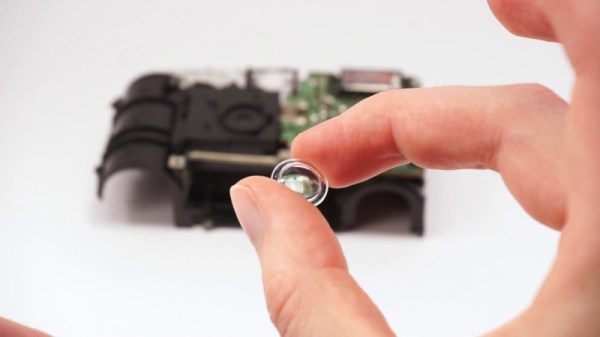
Photographic enthusiasts will invariably amass an extensive collection of lenses, and in their communities there are near-mythical and sought-after lenses that change hands for incredible prices. It’s probably the oldest photographic adage though, that the best camera in the world is the one in your hand when the scene presents itself, and probably one of the simplest cameras in the world remains the disposable film camera. Their tiny plastic lenses are not in the same league as the pricey ones, but can they be used by a more serious photographer? [Volzo] set out to find out.

Disposable cameras aren’t the most environmentally friendly items, and he rightly points out that a cheap compact camera can deliver the same in a more sustainable package. There’s also the point to make that the flash capacitor if it has one can deliver a nasty shock, but once past that it’s easy to remove the lens itself.

A single element lens brings with it some significant distortion, and it’s a surprise to find that the focal plane of a disposable camera is curved to take account of that. His first 3D printed mount and adapter for a Sony mirrorless compact camera uses a small aperture to reduce the distortion effects from the edge of the lens but he’s not out of tricks yet. Using a pair of the lenses back-to-back he halves the focal length but further corrects the distortion and delivers a consequent wider angle. Take a look, in the video below.

The result is a usable lens for the toy-camera look on your digital camera, and since the files can all be found at the link above it’s something you can try too. If a disposable camera comes our way, we certainly will.

This isn’t the first disposable camera lens project we’ve brought you.

Continue reading “Probably The Cheapest Lens You Will Ever Use”

A Faulty Keyboard From A Single LED

When the chance arrived to buy a mechanical keyboard for not a lot, naturally, [Hales] jumped at it. Then it started having odd intermittent problems with some keys appearing stuck, which led to a teardown and some fault finding. The culprit was a white LED — but why this was the case is a fascinating story.

Stripping it down there didn’t seem to be an obvious culprit, but eventually, the trail led to a lack of diodes in the matrix. This keyboard had an extremely clever yet rather cursed design in which it used LEDs as both illumination and as a diode in the keyboard matrix circuit, and the faulty LED had a reverse breakdown condition that could be triggered under certain operational conditions.

More unexpectedly, it would sometimes hold on to its reverse breakdown state even after power off. Just when you think you understand a component’s properties, there’s always room for surprise. And we can safely say we’ve learned something about the design of cheaper keyboards in reading the account. It’s clear that when it comes to ‘boards, it’s best to take no chances.

A Dusty Boat Anchor Back From The Brink

Many of us will have found dusty forgotten pieces of electronics and nursed them back to health, but we were captivated by [Don]’s tale of electronic revival. Instead of perhaps a forgotten computer or television, his barn find was a Heathkit linear amplifier for radio amateurs. In that huge box underneath an impressive layer of grime were a pair of huge tubes, along with all the power supply components to give them the 2 kV they need. It should have been good for a kilowatt when new, can it be made to go on air again?

Perhaps understandably with such an old device, after cleaning away the dust of ages he replaced the power supply circuitry with new parts and PCBs. A linear amplifier is surprisingly simple, but because of the voltages and power concerned there’s a need to treat its power circuits with respect. On first power-up the filaments work and the rails come up, so when given some RF drive it comes alive. Coupled with a case restoration you’d never know how dreadful a state it had been in.

We like to see classic Heathkit devices here at Hackaday, though we’ve followed their more recent reappearance too.

2023 Cyberdeck Challenge: Reviving The First Notebook Computer

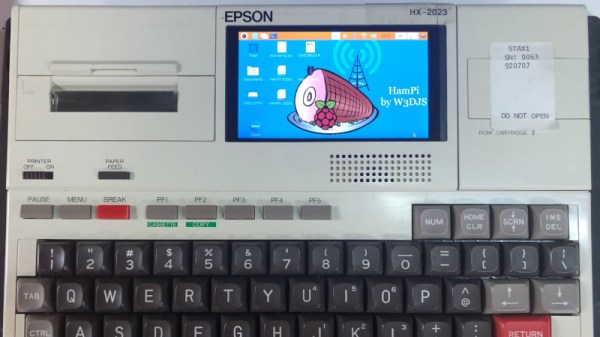
At first sight upon seeing [Don]’s HX2023 cyberdeck project one might be sad at the destruction of a retrocomputer, but in fact its classic Epson shell comes from a pile of spare parts left after restoring many other of the classic HX20 notebook computers to working order. The result stays true to the original but gives us so much more in the shape of a Raspberry Pi, and it’s worth cracking it open to see what components make this happen.

The first impression from the pictures is how tidy it all is, with the various USB-based boards contained on a large piece of perfboard spanning the whole case. As well as a USB hub and UPS board there’s an M.2 SSD interface and an audio board, and a DSI color TFT screen neatly fitted in place of the original monochrome item. Finally, there’s an Adafruit keyboard matrix interface board, allowing the use of the Epson’s original keys.

We like this conversion, because it manages to preserve a lot of what the original Epson had that made it great. We’re reminded of a cyberdeck inspired by the other great 8-bit notebook, the TRS-80 model 100.

There’s Always Room For Another Cycle Accurate PC Emulator

While many Hackaday readers will have their own pieces of classic hardware lovingly preserved, it still remains that most of us get our fix of retro goodness through emulation. And while there are emulators aplenty for almost every platform imaginable, the world of emulation is never complete. Thus we’re happy to encounter a new player in the form of MartyPC, a cycle-accurate 8088 PC emulator written in Rust.

It’s a project that started only in April 2022, but alongside such in-depth processor support it has the full range of PC and XT peripherals including CGA and VGA cards to the extent that it will run even the most hardware-demanding demos. Below the break you can see it running the fiendishly hardware-specific PC demo Area 5150 — thought to be the first time an emulator has managed this task.

If there’s a snag it’s that the releases are so far Windows-only, though it’s claimed that it should also compile on other major platforms. There’s also a WebAssembly version, though sadly the link to it doesn’t work. We look forward to this emulator maturing, because we’re sure it will become a PC standby. After all, not everyone managed to snag one of the recent batch of new hardware.

Continue reading “There’s Always Room For Another Cycle Accurate PC Emulator”