Power Over Ethernet, Explained

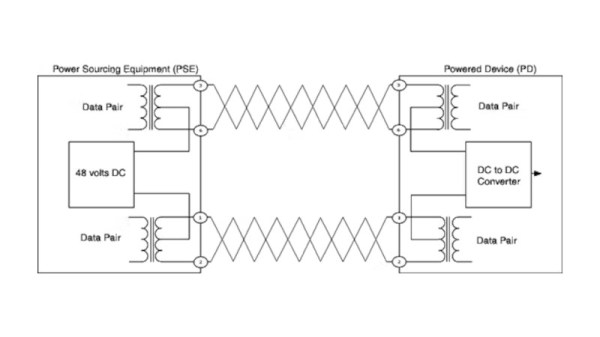
Most readers will be familiar with Ethernet networks in some form, in particular the Cat5 cables which may snake around the back of our benches. In a similar vein, we’ll have used power over Ethernet, or PoE, to power devices such as webcams. Buy a PoE router or switch, plug in a cable, and away you go! But what lies behind PoE, and how does it work? [Alan] has written a comprehensive guide, based on experience working with the technology.

What we get first is a run-down of the various topographies involved. Then [Alan] dives into the way a PoE port polls for a PoE device to be connected, identifies it, and ramps up the voltage. Explaining the various different circuits is particularly valuable. The final part of the show deals with the design of a PoE module, with a small switching power supply to give the required 48 volts.

All in all, this should be required reading for anyone who works with Ethernet, because it’s one of those things too often presented as something of a black box. If you’re thirsty for more, it’s a subject Hackaday have touched on too in the past.
A Very Tidy ATX Bench PSU

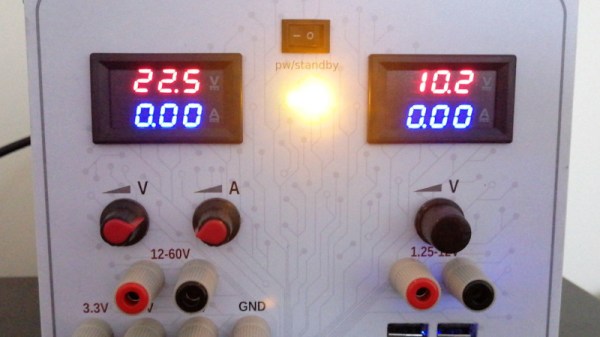
If there’s one thing that for decades of desktop PCs have given us, it’s a seemingly endless supply of relatively capable power supplies. If you need 5 volts or 12 volts at a respectable current they’re extremely useful, so quite a few people have used them as bench power supplies. Some of these builds box up the mess of wires into a set of more useful connectors, but [Joao Pinheiro] has taken his to the next level with a very neat 3D printed case and a set of variable switching regulators to make a variable bench supply with a top voltage of 60 volts.

In many ways it’s a straightforward wiring job to build, but there’s an unexpected power resistor involved. It’s sinking the 5 volt line, and we’re guessing that some current is required here for the PC power supply to run reliably. The thought of a high power resistor dumping heat into a 3D printed case leads us to expect that things might become a little melty though.

ATX power supplies are so numerous as to be expendable, so it’s always worth regarding them as a source of parts as well as a power supply.

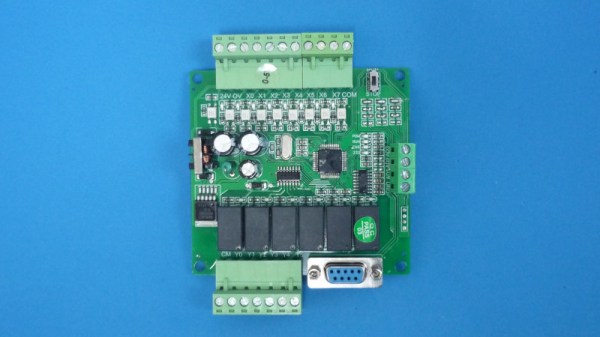
An Affordable And Programmable PLC

We’re all used to general purpose microcontroller boards such as the Arduino or its many imitators, but perhaps we don’t see as much of their industrial cousins. A programmable logic controller (PLC) is a computer designed to automate industrial machinery, and comes with protected interfaces and usually a specific PLC programming environment. Thus [Galopago]’s work with an inexpensive Chinese PLC clone is especially interesting, providing a route forward to using it within the Arduino IDE ecosystem.

Opening it up, the processor is identified as an STM32F103, and the connection needed to place it in bootloader mode is identified. Then it can be programmed from the Arduino IDE, even though its bootloader can’t be changed. Then to complete the process it’s necessary to identify the various different inputs and outputs by old-fashioned hardware reverse engineering.

This PLC may not be quite as robust as some products costing much more money, but it still represents a cost-effective way to access a microcontroller board with much of the interface circuitry already installed that would normally be required for controlling machinery. We expect that we’ll be seeing it appear on these pages over the coming months, and perhaps there might even be another comparison in the air.

A Wheatstone Bridge Matches Your Pots

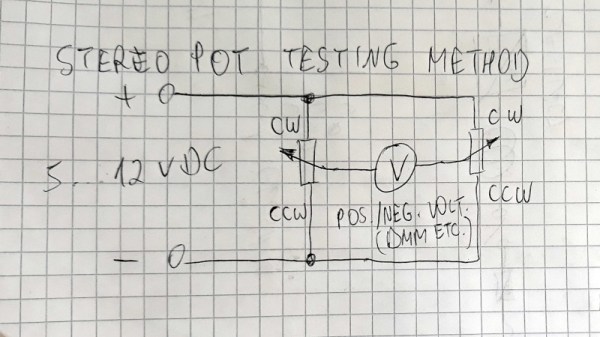
Sometimes the simplest hacks can be the most useful or ingenious, and such is the case with [Keri Szafir]’s method of ensuring that potentiometers used in audio devices are matched. If you consider a typical stereo amplifier for a moment, you’ll see two amplifiers in one box with a single volume control. Two channels, one knob? Volume knobs are ganged stereo potentiometers.

All potentiometers are not created equal, and particularly in the cheaper devices they may not have a consistently matched resistance across both pots and across their travel. This messes up the stereo balance, so naturally it’s worth selecting a part with good matching. [Keri] selects them not with his golden ears, but by wiring both pots together as a Wheatstone bridge. A meter between the two wipers would detect any current due to a mismatch.

A Wheatstone bridge is one of those handy circuits that has plenty of uses in both AC and DC measurements. We probably see them most often in a strain gauge.

A Tiny RISC-V Emulator Runs Linux With No MMU. And Yes, It Runs DOOM!

It’s something of an article of faith, that to run Linux your computer must include a hardware memory management unit, or MMU. To an extent it’s true, in that for a Linux-based system to shine it must have that hardware, but in fact there has been support for MMU-less Linux for many years now. Prolific hacker [cnlohr] has created an emulated simple RISCV processor without an MMU, and not only does it run Linux, it also runs DOOM.

The videos below the break go into significant depth on writing and debugging an emulator not to mention the inner workings of DOOM, but fear not if it’s not your thing. Everything can be found in a GitHub repository, and there are straightforward instructions should you wish to try it yourself.

All this is entertaining stuff, but it becomes of much more interest when viewed as part of an ongoing chain of projects working on no-MMU Linux for low-end RISC-V microcontrollers. Imagine the prospect of running Linux on a CPU costing relative pennies, and you can see why that’s an interesting prospect. Even if it’s not the most unexpected way to run Linux without an MMU.

Continue reading “A Tiny RISC-V Emulator Runs Linux With No MMU. And Yes, It Runs DOOM!”

Love AI, But Don’t Love It Too Much

The up-and-coming Wonder of the World in software and  information circles , and particularly in those circles who talk about them, is AI. Give a magic machine a lot of stuff, ask it a question, and it will give you a meaningful and useful answer. It will create art, write books, compose music, and generally Change The World As We Know It. All this is genuinely impressive stuff, as anyone who has played with DALL-E will tell you. But it’s important to think about what the technology can and can’t do that’s new so as to not become caught up in the hype, and in doing that I’m immediately drawn to a previous career of mine. Continue reading “Love AI, But Don’t Love It Too Much”

How On-Frequency Are Those Cheap Radar Modules?

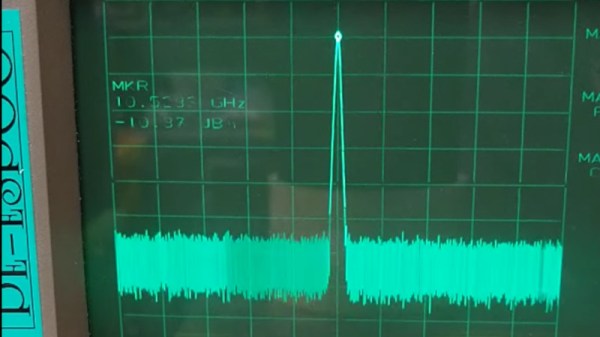
If you’re partial to browsing AliExpress, Banggood, or eBay for unusual hardware, you may have seen the HB100 Doppler Radar modules. These are a PCB with a metal can on board, and their reverse side has a patch antenna array. They work on a frequency of 10.525 GHz, and [OH2FTG] has characterized a few of them to see how close they lie to that figure.

These devices have a superficially very simple circuit that makes extensive use of PCB layout for creating microwave inductors, capacitors, and tuned circuits. There’s a FET oscillator and a diode mixer, and a dielectric resonator coupling the output and input inductors of the FET. This component provides the frequency stability, but its exact frequency depends on what lies within its electric field. Thus the screening can does more than screening, and has a significant effect on the frequency and stability of the oscillator.

The higher quality HB100s have a small tuning screw in the top of the can which in turn adjusts the frequency. This should be tweaked in the factory onto the correct point, but is frequently absent in the cheaper examples. In this case he has a pile of modules, and while surprisingly some are pretty close there are outliers that lie a significant distance away.

If you use an HB100 then the chances are nobody will ever bother you if it’s off-frequency, as its power output is tiny. But it’s worth knowing about their inner workings and also how to adjust them should you ever need to. Meanwhile if you’re interested in Doppler radar, here’s how to design one for a lower frequency.

Continue reading “How On-Frequency Are Those Cheap Radar Modules?”