The Hunt For A Rare Version Of IBM’s OS/2

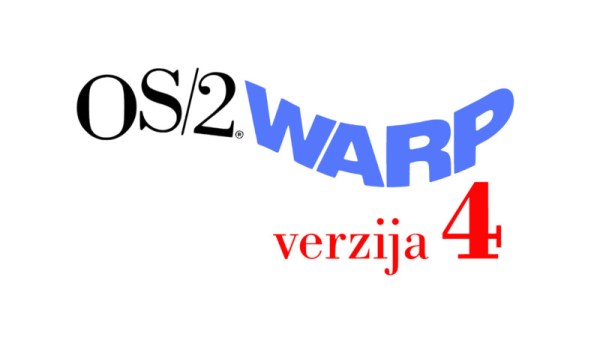
Slovenian OS/2 Warp 4 was a popular OS choice in that European country back in the day, but could the Slovenian Computer Museum lay their hands on a copy? In that question lies a bit of detective work and some luck.

There’s an old gag, about how this is finally the year of the Linux desktop. But oddly back in the ’90s it almost seemed possible, because alongside Microsoft Windows there were a host of other players that just might have become challengers. Foremost among them was IBM’s OS/2, a desktop PC operating system that could very much give Windows a run for its money. It could even run 16-bit Windows applications thanks to the code-sharing deal between the two companies dating back to the DOS days. Big Blue were so anxious to take their OS into new markets that they localized it into languages which Microsoft hadn’t touched, of which Slovenian was one.

But a couple of decades later, could a copy of this rare operating system version be found? While it may still lurk on a dusty shelf in an IT office somewhere it’s proved elusive, and online sources have dried up. The quest for it makes interesting reading for anyone with an interest in that period of retrocomputing, and finally ended up at the Slovenian company which had performed the localisation. This resulted in a copy of the OS, but not of the media, box, or paperwork. It yielded the fascinating discovery that IBM had localized the Windows 3.1-derived components as well as their own code, something that Microsoft had never done.

So do you have a boxed Slovenian OS/2 Warp 4 on a dusty shelf? Someone at the Slovenian Computer History Museum might like to see it. Meanwhile it’s a surprise to find that OS/2 is still supported.
Finally We Can Watch The Deere Cracking Def Con Talk

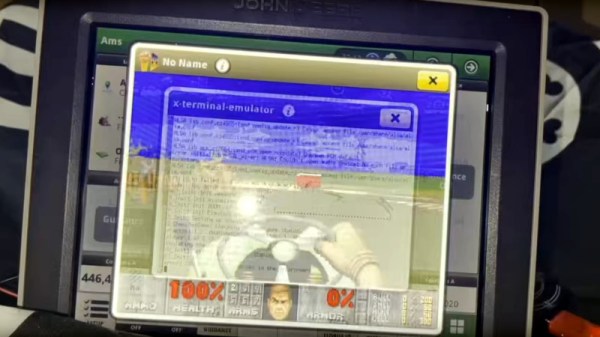
A few weeks ago, some tantalizing social media posts emerged from a Def Con talk, in which [Sick Codes] broke into the screen control unit for a John Deere tractor live on stage, and proceeded to play a special Deere-themed DOOM level upon it. At the time there was nothing more to go on, but we’re pleased to find out that the whole talk has been put online.

The talk starts with an introduction to the topic, to the basics of the control units within the machine and to the various different ages of Deere screen unit. We find that the earlier machines, which are still at work on farms worldwide, rely on outdated Windows CE versions, though the very latest screens run a Linux variant.

It’s one of these last screens to which he turns his attention, and we’re treated to an in-depth look at some of its secrets. After a lot of dead ends and learning exercises the final result is distilled into a pogo pin adapter for the hardware part, and a simple enough cron job to bypass one of Deere’s defenses by keeping the filesystem writable so a file can be updated. There’s a bit more detail about the special DOOM level too, as a special bonus.

You can see our original mention of this talk, or read some of our past Deere coverage.

Continue reading “Finally We Can Watch The Deere Cracking Def Con Talk”

London Bridge Has Fallen — By Radio

One of the global news stories this week has been the passing of the British monarch, Queen Elizabeth II. Since she had recently celebrated 70 years on the throne, the changing of a monarch is not something that the majority of those alive in 2022 will have seen. But it’s well known that there are a whole suite of “London Bridge has fallen” protocols in place for that eventuality which the various arms of the British government would have put in motion immediately upon news from Balmoral Castle. When it became obvious that the Queen’s health was declining, [Hackerfantastic] took to the airwaves to spot any radio signature of these plans. [Update 2022-09-11] See the comments below and a fresh Tweet to clarify, it appears these were not the signals they were at first suspected to be.

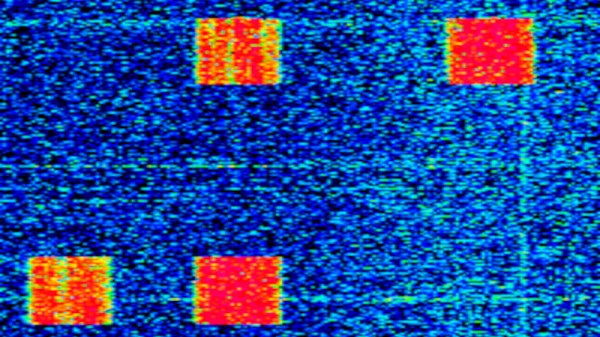
What he found in a waterfall view of the 4 MHz military band was an unusual transmission, a set of strong QPSK packets that started around 13:40pm on the 8th of September, and continued on for 12 hours before disappearing.  The interesting thing about these transmissions is not that they were a special system for announcing the death of a monarch, but that they present a rare chance to see one of the country’s Cold War era military alert systems in action.

It’s likely that overseas embassies and naval ships would have been the intended recipients and the contents would have been official orders to enact those protocols, though we’d be curious to know whether 2022-era Internet and broadcast media had tipped them off beforehand that something was about to happen. It serves as a reminder: next time world news stories happen in your part of the world, look at the airwaves!

2022 Cyberdeck Contest: The Folding Mini-Deck

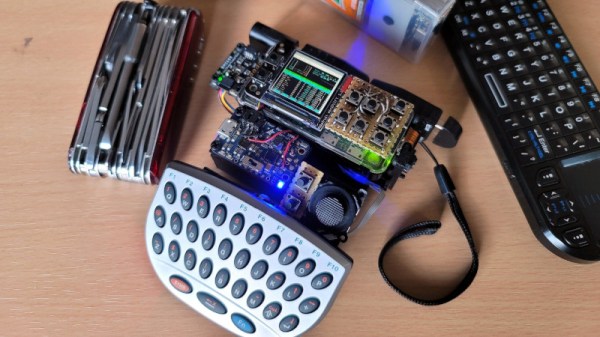
The trend for cyberdecks has brought us many takes on the home-made portable computers, but it’s fair to say that some of them can be rather unwieldy. This is not an accusation you can point at [Smeef] with the Mini-Deck though, because its Raspberry Pi Zero, Adafruit miniature display, and tiny keyboard make the whole unit able to fit in the palm of a hand. We’re not sure we’ve seen one so compact!

The most obvious feature is the keyboard, it’s a DreamGear MiniKey miniature USB keyboard. It doesn’t have all the useful buttons a PC board has, so there’s also a separate set of buttons to cover those. Then there’s an analog stick connected to an Arduino Pro Micro that takes the functionality of a mouse, and an Adafruit Mini PiTFT 1.3″ Display. While a fully-functional display for the Pi, we do wonder if this tiny screen might actually be a bit too tiny to be practical. Power for the unit comes via an 18650 battery, which also functions as a pin for a folding mechanism.

The result is something that looks, feels, and works like a cyberdeck, but all in miniature. It might be a stretch to write a Hackaday piece on a machine like it, but we’re guessing that merely having built something like this is cool enough in itself. Certainly it’s considerably smaller than previous contenders for the smallest build.

Apple’s Satellite Emergency Texts, How Do They Work?

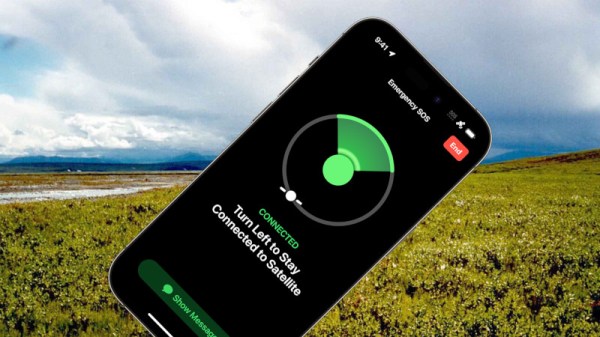
There is always some hype surrounding an Apple product announcement, and while maybe it’s not in the same league as those for the original iPod or iPhone, their iPhone 14 model will include emergency texting by satellite has generated quite a bit of coverage. It’s easy to find a lot about the system from the software end in terms of its interface and even Apple’s use of compression, but what about the radio side? Whose satellite constellation are they using, and how does it work?

As has been widely reported, their communication partner for the service is Globalstar, a provider of satellite data services that like their competitor Iridium have their origins in the 1990s when satellite phones were briefly seen as the Next Big Thing. They have a 24-satellite constellation, and they sell a range of off-the-grid voice, data, paging, tracking, and IoT connectivity services. The Apple emergency texting looks a lot like Globalstar’s Spot texting service. It’s only available in North America for now, we’re guessing because the satellites aren’t smart relays but straightforward transponders, and the network lacks sufficient ground station coverage outside that region.

With all the talk about low-earth-orbit connectivity surrounding services such as SpaceX’s Starlink it’s a bit unexpected to find ourselves back with a satellite constellation using 1990s technology. But we can see that as well as a major win for Globalstar as their service begins to look outdated by comparison to Starlink, it’s a perfect match for Apple in not requiring a complex ground station for low-bandwidth text messages. We expect that there will be some form of exclusivity in the deal, so it will be interesting to see how the larger Android vendors respond.

It’s worth noting, we’ve looked at satellite IoT services before.

Wilderness image: U.S. Fish and Wildlife Service, Public Domain.

Your Car Gets Hot When Left In The Sun. Hot Enough To Cook?

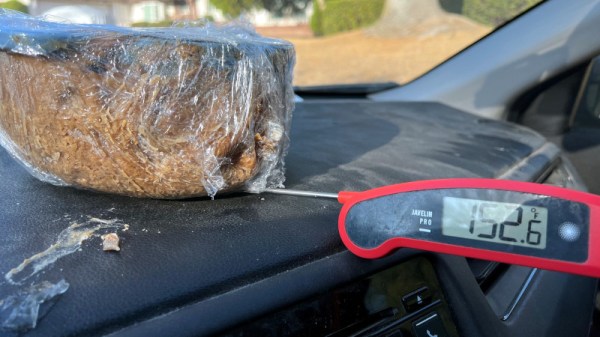
In hot weather, those of us who drive are familiar with the sensation of getting into the car and having it feel like an oven inside. A car is a essentially sealed metal box with large windows, thus on a sunny summer day it has more in common with a greenhouse, and in a heatwave this can become unbearable. But does it get hot enough for cooking? [Julian Lozos] aimed to find out, by cooking Icelandic rúgbrauð using only a 2016 Honda and the California sunshine.

Rúgbrauð is a traditional Icelandic rye bread that’s traditionally cooked by geothermal energy buried in the ground for around a day in proximity to a hot spring. A car dashboard gets pretty hot in a California heatwave, so it’s not unreasonable to expect that it might replicate this environment. He parked the Honda on a street in the sun, placed a pot full of dough on the dashboard, and waited.

The maximum temperature measured was 86.5 C (187 F), but unfortunately the sun didn’t stay high enough to maintain that temperature for the required time. After two days in the car the crust was cooked but the interior was still gooey, so the experiment can’t be said to have been successful. He does make the point though that a less traditional and much thinner loaf using a wide and flat tray might have delivered a better result.

We’re intrigued by this experiment, almost enough to try something like it ourselves were the summer not beginning to wane in these more northerly climes. Have any of you tried cooking in a hot car, or would we need a solar oven? Give us your views in the comments.

The MOS 7600 Video Game Chip Gives Up Its Secrets

A good chip decapping and reverse engineering is always going to capture our interest, and when it comes from [Ken Shirriff] we know it’s going to be a particularly good one. This time he’s directed his attention to the MOS 7600 all-in-one video game chip (Nitter), a mostly forgotten device from the 6502 chipmaker which we featured a few weeks ago when it was the subject of a blogger’s curiosity. The question then was whether it contained a microprocessor or not and even whether it was another 6502 variant, and the answer revealed in the decapping answers that but will disappoint the 6502 camp.

On the chip is a mixture of analog and digital circuitry, with some elements of a more traditional game chip alongside a ROM, a PLA, and a serial CPU core. The PLA stores pixel data while the ROM stores the CPU code, and the CPU serves to perform calculations necessary to the games themselves. He hasn’t fully reverse-engineered either, but the two areas of the chip are mask-programmed to produce the different games with which the chip could be found.

So the answer to the original question is that there is a CPU on board, but it’s not a 6502 and the operation is a hybrid between dedicated game chip and CPU-controlled chip. What we find interesting is that this serial CPU core might have as we mused in the previous piece made the heart of a usable 1970s microcontroller, was this a missed opportunity on the part of MOS? We’ll never know, but at least another piece of early video game history has been uncovered.