Supersized Power Bank Built From An EV Battery

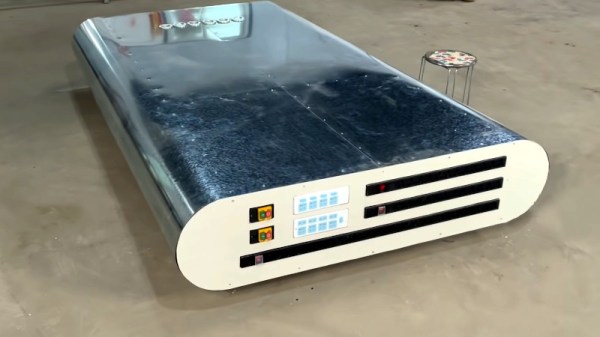
Perhaps one day in the future when our portable electronics are powered by inexhaustible dilithium crystals, we’ll look back fondly on the 2020s when we carried around power banks to revive our flagging tech. Oh how we laughed as we reached for those handy plastic bricks only to find them drained already of juice, we’ll say. [Handy Geng] won’t be joining us though, because he’s made the ultimate power bank, a 27,000 AH leviathan that uses an electric car battery for storage and supplies mains power through a brace of sockets on its end.

The vehicle battery is mounted on a wheeled trolley along with what appears to be either the in-car charging unit or a mains inverter. The whole thing is styled to look like a huge version of a pocket power bank, with a curved sheet metal shell and white hardboard end panels. The demonstration pushes the comedy further, as after charging a huge pile of phones he replenishes an electric scooter before settling sown by a chilly-looking river for a spot of fishing — along with his washing machine, TV, and electric hotpot for a spot of cooking. We appreciate the joke, and as we know him of old we’re looking forward to more.

Continue reading “Supersized Power Bank Built From An EV Battery”
Know Audio: A Mess Of Cables

We’ve now spent several months in this series journeying through the world of audio, and along the way we’ve looked at the various parts of a Hi-Fi system from the speaker backwards to the source. It’s been an enjoyable ride full of technical detail and examining Hi-Fi myths in equal measure, but now it’s time to descend into one of the simplest yet most controversial areas of audio reproduction. Every audio component, whether digital or analogue, must be connected into whatever system it is part of, and this is the job of audio cables, sometimes referred to as interconnects. They are probably the single component most susceptible to tenuous claims about their performance, with audiophiles prepared to spend vast sums on cables claimed to deliver that extra bit of listening performance. Is there something in it, or are they all the same bits of wire with the expensive ones being a scam? Time to take a look.

What Makes A Nearly Good Cable

In a typical domestic audio system with digital and analogue signals you might expect to find two types of cable, electrical interconnects that could carry either analogue or digital signals, and optical ones for digital signals. We’re here to talk about the electrical cables here as they’re the ones used for analogue signals, so lets start with a little transmission line theory. Continue reading “Know Audio: A Mess Of Cables”

A Portable Projecting Pi For Education

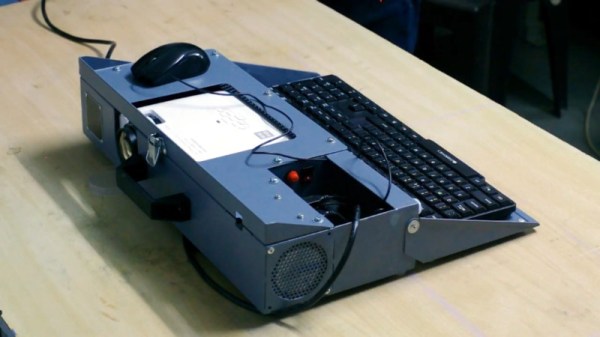
We cover a lot of cyberdeck projects here at Hackaday, custom portable computers often built around the Raspberry Pi. It’s not often that we cover a computer that perfectly achieves and exceeds what a cyberdeck is trying to do without being a cyberdeck in any way, but that’s what [Subir Bhaduri] has done. In addressing the need for Indian schoolchildren to catch up on two years of COVID-disrupted schooling he’s created the pπ, a Raspberry Pi, projector, and keyboard all-in-one computer in a neat sheet-metal case that looks as though it might be just another set of spanners or similar. At a stroke he’s effortlessly achieved the ultimate cyberdeck, because this machine is no sci-fi prop, instead it has a defined use which it fulfills admirably.

All the files to build your own can be found in a GitLab repository. The case is laser-cut sheet metal, and he’s put in a cost breakdown which comes out at a relatively healthy 17200 Indian rupees, or around 230 US dollars. We hope that it serves its purpose well and provides a rugged and reliable teaching aid for a generation from whom COVID has taken so much. You can see more in the video below the break.

Continue reading “A Portable Projecting Pi For Education”

Radio Amateurs & Skywatchers Rejoice, Sat Operators Worry: Solar Storm Incoming

How do you look back over your life and divide it up? Maybe by decades, cultural moments, or geopolitical events. For radio amateurs with older callsigns there’s a temptation to do so by solar cycles, as the roughly 11-year period of the Sun’s activity had a huge effect on radio propagation through the charge it creates in the upper atmosphere. We’re now in solar cycle 25, numbered since the 18th century when the science of solar observation began, and as never before we’re surrounded by information from experts such as [Dr. Tamitha Skov], the so-called [Space Weather Woman]. When she says something is on the way we listen, so a recent Tweet predicting a direct hit from a solar storm with a good probability of auroras in lower latitudes is very much worth sharing.

We must extend our commiserations to readers in equatorial climes and ever through the lower half of the USA, southern Europe, the Middle East, India, Japan, and China. You won’t see the aurora we’ll catch in Europe along with our friends in New Zealand, Canada, Russia, and northern USA. But even then to those of us at moderate latitudes an aurora is a pretty rare event, so we’re hoping for clear skies on the 2nd of February and would advise you to look out too if you’re in the likely zone even if they won’t be quite as impressive as those in our header picture. Meanwhile radio amateurs everywhere don’t have to see pretty lights in the sky to reap the benefits in terms of propagation, so happy DX hunting! The Tweet is embedded below the break, so you can play the timeline for yourselves.

Continue reading “Radio Amateurs & Skywatchers Rejoice, Sat Operators Worry: Solar Storm Incoming”

Planar PCB Coils As An Alternative To Winding Transformers

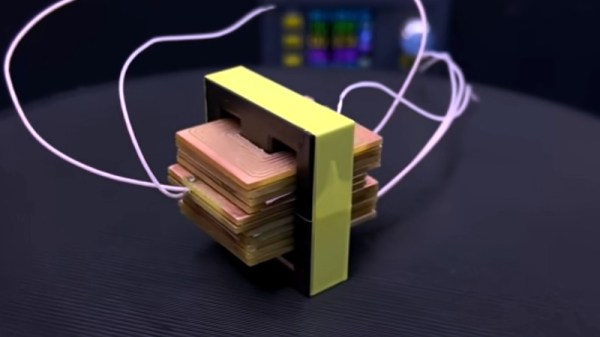
Those readers who have experimented with winding their own inductors will know that it’s not an easy task, and when those inductors are handling high voltages it can be especially tricky to maintain adequate insulation between layers of windings. [Open Frime TV] has a video addressing this in a novel way, by creating the windings for a switch-mode power supply transformer using stacked PCB coils instead of wire (Russian language; you’ll have to enable YouTube’s subtitle auto-translation).

The video below the break makes for a handy primer on PCB coil construction, reminding the viewer that the turns need all to lie in the same direction as well as the importance of insulation between windings. There’s a discussion of the properties of a PCB coil in relation to the switching frequency, and once the transformer has been assembled, we see it hooked up to a power supply board for a test. What happens next may be familiar to seasoned transformer-winders; nothing works, and the transformer gets hot. In making the PCB he’s left some copper on each board which amounts to a shorted turn — cutting these allows the transformer to work perfectly.

This technique might not be the solution to all transformer woes, but makes for an interesting option if your work takes you in the direction of winding transformers. If PCB coils take your interest, how about a Tesla coil using them?

Continue reading “Planar PCB Coils As An Alternative To Winding Transformers”

The Air Multiplier Fan Principle, Applied To A Jet Engine

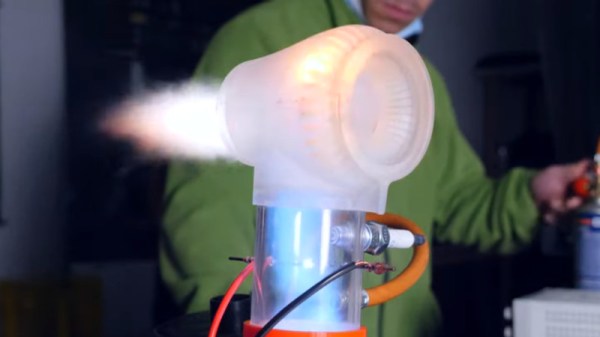
Many readers will be familiar with the Dyson Air Multiplier, an ingenious bladeless fan design in which a compressor pushes jets of air from the inside edge of a large ring. This fast-moving air draws the surrounding air through the ring, giving the effect of a large conventional fan without any visible moving parts and in a small package. It’s left to [Integza] to take this idea and see it as the compressor for a jet engine, and though the prototype you see in the video below is fragile and prone to melting, it shows some promise.

His design copies the layout of a Dyson with the compressor underneath the ring, with a gas injector and igniter immediately above it. The burning gas-air mixture passes through the jets and draws the extra air through the ring, eventually forming a roaring jet engine flame exhaust behind it. Unfortunately the choice of 3D print for the prototype leads to very short run times before melting, but it’s possible to see it working during that brief window. Future work will involve a non-combustible construction, but his early efforts were unsatisfactory.

It’s clear that he hasn’t created the equivalent of a conventional turbojet. Since it appears that its operation happens when the flame has passed into the center of the ring, it has more in common with a ramjet that gains its required air velocity with the help of extra energy from an external compressor. Whether he’s created an interesting toy or a useful idea remains to be answered, but it’s certainly an entertaining video to watch.

Meanwhile, this isn’t the first project we’ve seen inspired by the Air Multiplier.

Continue reading “The Air Multiplier Fan Principle, Applied To A Jet Engine”

An Up-To-Date Development Environment For The Nokia N-Gage

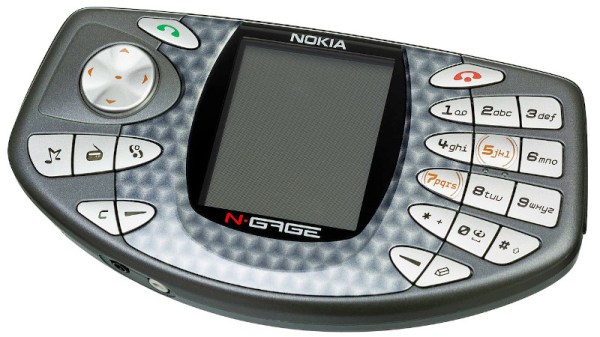
One of the brave but unsuccessful plays from Nokia during their glory years was the N-Gage, an attempt to merge a Symbian smartphone and a handheld game console. It may not have managed to dethrone the Game Boy Advance but it still has a band of enthusiasts, and among them is [Michael Fitzmayer] who has produced a CMake-based toolchain for the original Symbian SDK. This is intended to ease development on the devices by making them more accessible to the tools of the 2020s, and may serve to bring a new generation of applications to those old Nokias still lying forgotten in dusty drawers.

In much of the public imagination, the invention of the smartphone came with the release of the first Apple iPhone in 2007. Hackaday readers will of course trace the smartphone back much further than that to an original IBM prototype, and will remind any doubters that the Nokias which the iPhone vanquished were very successful smartphones without any of Cupertino’s magic in sight. Nokia’s tragedy was that they appeared not to understand what they had in Symbian, and released a bewildering array of devices intended to satisfy every possible market without recognizing that the market they needed to serve was their customers being easily able to run the apps of their choice on the things.

Symbian itself has long ago become a piece of abandonware, but during its chequered history there was a period in which an open-source version was released. It would be nice to think that projects such as this one might revive interest in this capable yet forgotten operating system, as with the passage of a decade the cost of hardware which might run it has fallen to the point of affordability. Does anyone want to relive the 2000s?

Header image: Evan-Amos, Public domain.