Render HTML And CSS On An ESP32

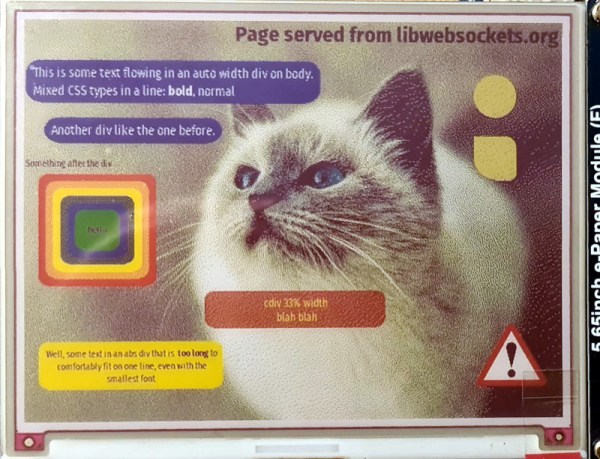
As the available computing power from affordable microcontrollers continues to increase, there is an inevitable blurring of the line between them and the lower tier of application processors capable of running Linux-based operating systems. For the most part a microcontroller busies itself with behind-the-scenes tasks, but as so many projects here have demonstrated, they can be pretty capable when it comes to user-facing applications too. Now [Andy Green] has extended the possibilities with affordable silicon, by producing a proof-of-concept HTML + CSS renderer over h2 on ESP32 for libwebsockets. Surf the web on a microcontroller without settling for a text-only experience? Why not!

He freely admits that this is far from being a complete HTML rendering engine, in that while it parses and renders HTML and CSS with JPEG and PNG image support, it does so only with a subset of HTML and is not tolerant of any malformations. There is also no JS support, which is hardly surprising given the available resources.

Even with those limitations it remains an impressive piece of work, which we hope will one day be able to make some effort at displaying Hackaday on ESP32 devices such as the badge.team European conference badges. Definitely a project to watch!

Owning A ShortWave Radio Is Once Again A Subversive Activity

An abiding memory for a teen fascinated by electronics and radio in the 1970s and 1980s is the proliferation of propaganda stations that covered the shortwave spectrum. Some of them were slightly surreal such as Albania’s Radio Tirana which would proudly inform 1980s Western Europe that every village in the country now possessed a telephone, but most stations were the more mainstream ideological gladiating of Voice of America and Radio Moscow.

It’s a long-gone era as the Cold War is a distant memory and citizens East and West get their info from the Internet, but perhaps there’s an echo of those times following the invasion of the Ukraine. With most external news agencies thrown out of Russia and their websites blocked, international broadcasters are launching new shortwave services to get the news through. Owning a shortwave radio in Russia may once again be a subversive activity. Let’s build one!

Continue reading “Owning A ShortWave Radio Is Once Again A Subversive Activity”

An Old Typewriter Speaks To The World

Typewriters are something which was once ubiquitous, yet which abruptly faded away and are now a rare sight. There was a period of a few years in which electric typewriters and computers existed side-by-side though, and it’s one of these which [Jonah Brüchert] has experimented with connecting to a computer for use as a printer or terminal.

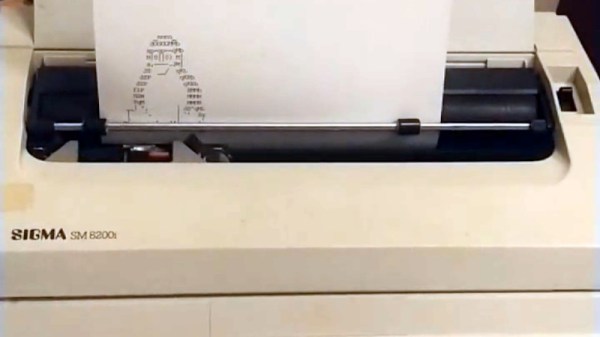
The machine in question is a SIGMA SM 8200i typewriter, which is a rebadged version of the East German Erika S3004. It has an intriguing 26-pin connector on its side which provides access to a 1200 baud serial port. It uses its own character encoding dubbed “gdrascii”, for which there is a Python library that he could port to Rust. The result is a terminal in the old style, from the days when access to a computer was through a teletype  rather than a screen. All that’s missing is a punched tape reader at its side!

We’ve featured a lot of typewriters here over the ears, but this isn’t the first that has received a terminal conversion.

Eight RS232 Ports, One Ethernet Port

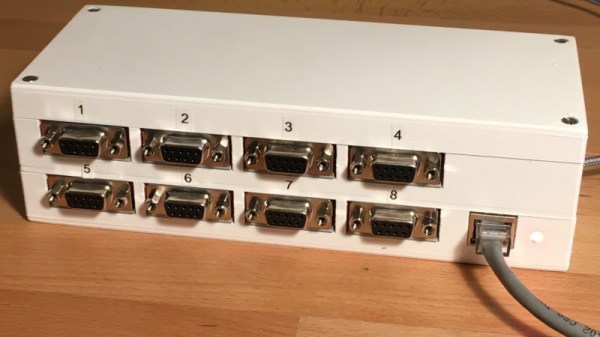
When it comes to impromptu enclosures, [Paul Wallace] is a man after our own hearts, for his serial-to-Ethernet converters allowing him to control older test equipment were housed in takeaway curry containers. Once the test equipment pile had grown it became obvious that a pile of curry containers was a bit unwieldy, even if the curry had been enjoyable, so he set about creating an all-in-one multiway serial to Ethernet box.

Reminiscent of the serial terminal access controllers that were found in dumb terminal sites back in the day, it’s a box with eight DB-9 connectors for serial ports and a single RJ45 Ethernet port. Inside is a Teensy 4.1 which packs a PHY and eight hardware serial ports, and a pile of MAX232 level converter modules. These have a small modification to wire in the CTS and RTS lines, and the whole is clothed in a custom 3D printed case.

The result is a very neat, almost commercial standard box that should save him quite a bit of space. Not everyone has eight devices to drive, so if you have just one how about using an ESP8266?

The Nine Dollar Laser Bed

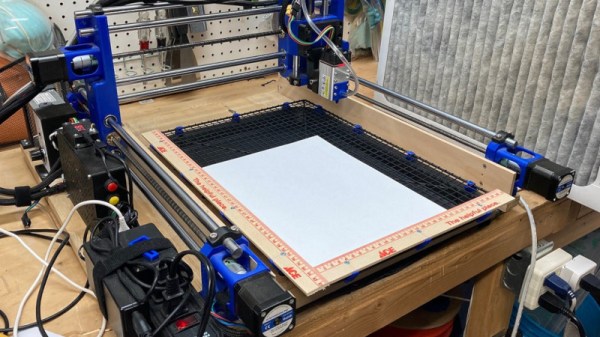
A laser cutter bed has to be robust, fireproof, and capable of adequately supporting whatever piece of work is being done on the machine. For that reason they are typically a metal honeycomb, and can be surprisingly expensive. [David Tucker] has built a MultiBot CNC machine and is using it with a laser head, and his solution to the problem of a laser bed is to turn towards the kitchen ware store.

The answer lay in an Expert Grill Jerky Rack, a wire grille with a baking tray underneath it. Perfect lasering support but for its shininess, so it was painted matte back to reduce reflections and a handy set of clips were 3D printed to secure the grille to the tray.

We like this solution as it’s both effective and cheap, though we can’t help a little worry at the prospect of any laser cutter without adequate enclosure for safety. Having been involved in the unenviable task of cleaning an encrusted hackerspace laser cutter bed, we also like the idea that it could be disposed of and replaced without guilt. Do you have any tales of laser cutter bed cleaning, or have you found a cheap substitute of your own? Let us know in the comments!

A Sinclair ZX81 Clone Still Has The Power To Fascinate

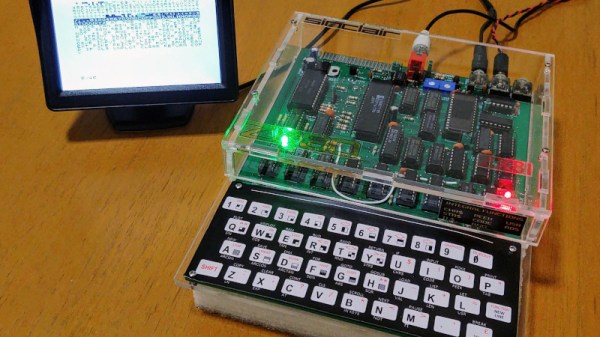
The golden age of 8-bit computing brought us pixelated graphics in bright colours, accompanied of course by chiptune music. This aesthetic is strong enough to define a collective image of a generation’s youth, even if the 1980s reality had much more of the tired 1970s leftovers about it.  The truth was that not all popular 8-bit machines had colour, sound, or good graphics, and among these limited-capability machines was Sir Clive Sinclair’s ZX81. With a Z80, 1k of RAM, a membrane keyboard, and not much else, it helped set the stage for the hugely popular ZX Spectrum which followed it. The fun’s not over though, as [Augusto Baffa] demonstrates with his modern recreation of a machine that can switch between the ’81 and its less-popular ZX80 predecessor.

Rather than a Eurocard-sized mainboard and membrane keypad, this clone copies the ZX80 with a full-sized mainboard the front of which carries the keyboard contacts. It also eschews the ULA found in the ’81 for discrete TTL. It’s based upon the venerable Grant Searle design for a homebuilt Sinclair computer, and all of the files for this version can be found in a GitHub repository.

There is a lot to be said for the ZX81 as a model for retrocomputer experimentation, because of its extreme simplicity. It may have been no great shakes in the computing department compared to many of its competitors, but it remains possibly one of the easiest of the bunch whose operation to completely understand. Also we like it for that paltry 1k of memory, teaching kids about memory constraints is a good thing in our book.

We’ve featured the diminutive ZX more than once, including a couple of years ago in our April Fools coverage.

The Noble Effort To Put OpenSCAD In The Browser

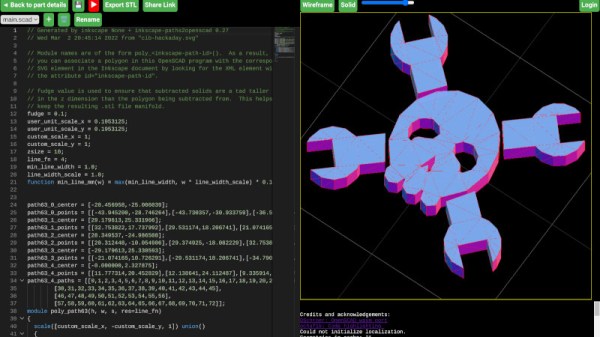
In a world of CAD packages with arcane or unfriendly interfaces there’s a stand-out player that’s remarkable because it has no interface. OpenSCAD is a CAD package for coders, in which all design elements are created in a scripting language rather than graphically. It’s maybe not for everyone but it has a significant following, and its reach has been extended further as you can now run it from within a modern web browser.

The origins of this project can be tracked back to August of 2021, when when Autodrop3D’s [mmiscool] offered a sizable bounty for anyone willing to port the parametric CAD modeler to web assembly. Developer [Dominick Schroer] ultimately answered the call with openscad-wasm, which implements the core of OpenSCAD as a JavaScript ES6 module. From there, it just needed to get paired with a user interface, and off to the cloud we go.

Opening it up and giving it a go, we found it to be a very usable OpenSCAD version, albeit a little slower to render than the desktop equivalent on a mediocre laptop. We didn’t try exporting and printing an STL, but so far it has given us no reason to believe it wouldn’t be every bit as useful as the version you’re used to.

But wait, there’s more! Parallel to this effort, [Olivier Chafik] has also been working on his own idea of what OpenSCAD in the web should be. He’s using the same core developed by [Dominick], but has combined it with the Monaco editor from Microsoft and a Javascript STL viewer. Despite being very similar, we’re happy to report there’s no rivalry here; in fact, according to the video after the break, it sounds like two the projects have already swapped a bit of code.

The move among desktop applications to move into the browser and often into a pay-to-play cloud has seemed relentless over recent years, so it’s pleasing to see a rare example of a browser migration that’s open-source. It has the handy effect of bringing the CAD package to platforms such as tablets or Chromebooks which wouldn’t normally be an OpenSCAD platform, and this we like, a lot.

Continue reading “The Noble Effort To Put OpenSCAD In The Browser”