ESP32 Dashboard Is A Great Way To Stay Informed

The original ESP32 may be a little long in the tooth by now, but it remains a potent tool for connected devices. We were drawn to [Max Pflaum]’s ESP32 Dashboard as a great example, it’s an ESP32 hooked up to an e-paper display. The hardware is simple enough, but the software is what makes it interesting.

This is deigned as a configurable notification tool, so to make it bend to the user’s will a series of widgets can be loaded onto it. The device runs MicroPython, making it easy enough to write more than the ones already on place. The screen is divided into four zones, allowing for a range of widgets to be used at once. All the details can be found in a GitHub repository.

We like it for its configurability and ease of programming, and because it delivers well on the promise of a useful device. An ESP32 and e-ink combination with MicroPython apps is something we’ve seen before in the world of badges.

Capturing Screenshots Using A Fake Printer

If you have very old pieces of analogue test equipment with CRTs on your bench, the chances are they will all have surprisingly similar surrounds to their screens. Back when they were made it was common to record oscilloscope screens with a Polaroid camera, that would have a front fitting for just this purpose.

More recent instruments are computerized so taking a screen shot should be easier, but that’s still not easy if the machine can’t save to a handy disk. Along comes [Tom] with a solution, to hook up a fake printer, and grab the screen from a print.

Old instruments come with a variety of ports, serial, IEE-488, or parallel, but they should usually have the ability to print a screen. Then capturing that is a case of capturing an interpreting the print data, be it ESC/P, PCL5, Postscript, or whatever. The linked page takes us through a variety of techniques, and should be of help to anyone who’s picked up a bargain in the flea market.

This isn’t the only time we’ve touched on the subject of bringing older computerized equipment into the present, we’ve also shown you a disk drive emulator.

Thanks [JohnU] for the tip.

The PCB Router You Wish You Had Made

The advent of cheap and accessible one-off PCB production has been one of the pivotal moments for electronic experimenters during the last couple of decades. Perhaps a few still etch their own boards, but many hobbiest were happy to put away their ferric chloride. There’s another way to make PCBs, though, which is to mill them. [Tom Nixon] has made a small CNC mill for that purpose, and it’s rather beautiful.

In operation it’s a conventional XYZ mechanism, with a belt drive for the X and Y and a lead screw for the Z axis. The frame is made from aluminium extrusion, and the incidental parts such as the belt tensioners are 3D printed. The write-up is very comprehensive, and takes the reader through all the stages of construction. The brains of the outfit is a Creality 3D printer controller, but he acknowledges that it’s not the best for the job.

It’s certainly not the first PCB router we’ve seen, but it may be one of the nicer ones. If you make a PCB this way, you might like to give it professional-looking solder mask with a laser.

Taking A One Handed Keyboard To The Next Level

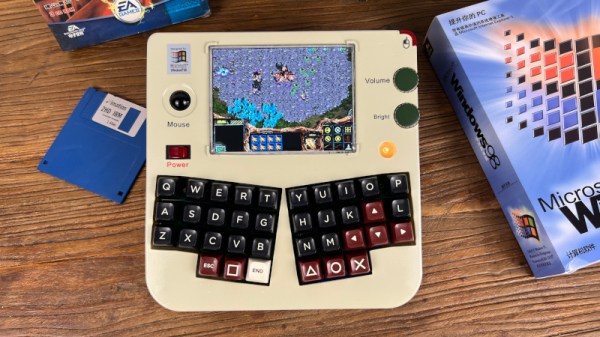
When a wrist mounted keyboard floated past in the Hackaday feed, a mental image surfaced, perhaps something like a Blackberry keyboard mounted on a wrist cuff, maybe with some kind of display. It’s impressive indeed then to open the link and see [AdamLeBlanc]’s Schist01. It’s a wrist mounted keyboard, but with its bracket curving in front of the had to support a custom ergonomic chording keyboard, it’s definitely a break from the norm.

The wrist mount has clearly taken a lot of thought, and despite looking something like the arm of a Star Trek Borg, appears comfortable. It’s extremely adjustable, and can be demounted into several different parts. Meanwhile the keyboard itself has been formed to his hand by a trial and error process involving keycaps and a clay model. there’s even a thumb-operable touchpad.

We like this peripheral a lot, for the huge attention to detail that has gone into its design, for its boldness, and because we can’t help seeing ourselves using it as the input device for a futuristic head-mounted display. For now though we don’t have any futuristic silver clothing in the wardrobe, so that will have to wait. If you’d like to see more, there’s a video.

Continue reading “Taking A One Handed Keyboard To The Next Level”

The Billionth Repository On GitHub Is Really Shitty

What’s the GitHub repository you have created that you think is of most note? Which one do you think of as your magnum opus, the one that you will be remembered by? Was it the CAD files and schematics of a device for ending world hunger, or perhaps it was software designed to end poverty? Spare a thought for [AasishPokhrel] then, for his latest repository is one that he’ll be remembered by for all the wrong reasons. The poor guy created a repository with a scatalogical name, no doubt to store random things, but had the misfortune to inadvertently create the billionth repository on GitHub.

At the time of writing, the 💩 repository sadly contains no commits. But he seems to have won an unexpectedly valuable piece of Internet real estate judging by the attention it’s received, and if we were him we’d be scrambling to fill it with whatever wisdom we wanted the world to see. A peek at his other repos suggests he’s busy learning JavaScript, and we wish him luck in that endeavor.

We think everyone will at some time or another have let loose some code into the wild perhaps with a comment they later regret, or a silly name that later comes back to haunt them. We know we have. So enjoy a giggle at his expense, but don’t give him a hard time. After all, this much entertainment should be rewarded.

This Relay Computer Has Magnetic Tape Storage

Magnetic tape storage is something many of us will associate with 8-bit microcomputers or 1960s mainframe computers, but it still has a place in the modern data center for long-term backups. It’s likely not to be the first storage tech that would spring to mind when considering a relay computer, but that’s just what [DiPDoT] has done by giving his machine tape storage.

We like this hack, in particular because it’s synchronous. Where the cassette storage of old just had the data stream, this one uses both channels of a stereo cassette deck, one for clock and the other data. It’s encoded as a sequence of tones, which are amplified at playback (by a tube amp, of course) to drive a rectifier which fires the relay.

On the record side the tones are made by an Arduino, something which we fully understand but at the same time can’t help wondering whether something electromechanical could be used instead. Either way, it works well enough to fill a relay shift register with each byte, which can then be transferred to the memory. It’s detailed in a series of videos, the first of which we’ve paced below the break.

If you want more cassette tape goodness, while this may be the slowest, someone else is making a much faster cassette interface. Continue reading “This Relay Computer Has Magnetic Tape Storage”

Let’s Buy Commodore! Well, Somebody Is.

When a man wearing an Atari T-shirt tells you he’s buying Commodore it sounds like the plot for an improbable 1980s movie in which Nolan Bushnell and Jack Tramiel do battle before a neon synthwave sunset to a pulsating chiptune soundtrack. But here on the screen there’s that guy doing just that, It’s [Retro Recipes], and in the video below he’s assembling a licensing deal for the Commodore brand portfolio from the distant descendant of the Commodore of old.

It’s a fascinating story and we commend him for tracing a path through the mess that unfolded for Commodore in the 1990s. We tried the same research path with a friend a few years ago and ended up with an anonymous Dutch paper company that wouldn’t answer our calls, so we’re impressed. In conjunction with several other players in the Commodore retrocomputing world he’s trying to assemble a favourable percentage deal for manufacturers of new parts, computers, and other goodies, and we’re pleased to see that it’s for the smaller player as much as for the industry giant.

When looking at a story like this though, it’s important not to let your view become clouded by those rose tinted glasses. While it’s great that we’re likely to see a bunch of new Commodore-branded Commodore 64s and parts, there are many pitfalls in taking it beyond that. We’ve seen the Commodore logo on too many regrettable licensed products in the past, and we fear it might be too tempting for it to end up on yet another disappointing all-in-one video game or just another budget PC. If something new comes out under the Commodore brand we’d like it to be really special, exploiting new ground in the way the Amiga did back in the day. We can hope, because the alternative has dragged other famous brands through the mud in recent years.

If you want an insight into the roots of the original Commodore’s demise, have a read of our Hackaday colleague [Bil Herd]’s autobiography.

Continue reading “Let’s Buy Commodore! Well, Somebody Is.”