New BBC Micro:bit Adds Microphone And Speaker

There’s an old tale that TV companies only need to make a few years of kids’ TV shows, because their audience constantly grows out of their offerings and is replaced by a new set with no prior knowledge of the old shows. Whether it’s true or not is up for debate, but does the same apply to single board computers aimed at kids? The original BBC micro:bit was first announced back in 2015 and must be interesting its second generation of kids by now, but that hasn’t stopped them bringing out a second version of the little educational computer. How do you update such a simple device? Time to take a look.
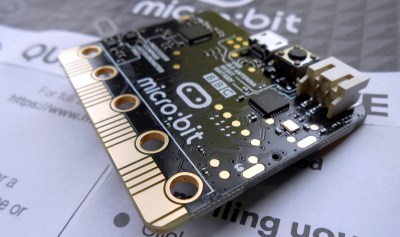
Edge connector shown on the original micro:bit design

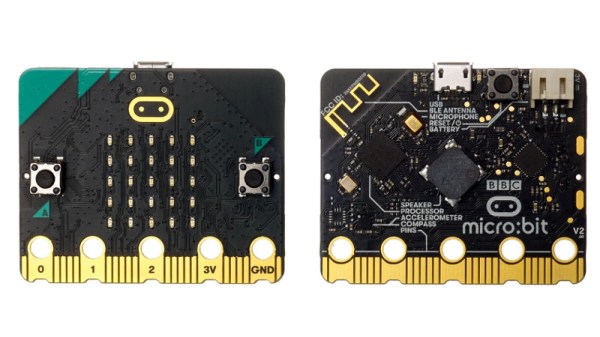
The form factor of the new board is substantially the same as its predecessor, with the same edge connector and large connection pads, and the familiar LED matrix display. The most obvious additions are a small speaker and MEMS microphone allowing kids to interact with audio in their code, but less obvious is a new touch button in the micro:bit logo. The original had it in the silk screen layer, while the new one has it as copper for a capacitive sensor.

The silicon has an upgrade too, now sporting a Nordic Semiconductor nRF52833 running at 64 MHz and sporting 512k of ROM and 128k of RAM with built-in Bluetooth Low Energy. Binaries are incompatible with the original, however all the development environments can recompile code for a new universal binary format capable of running the appropriate software for either version.

The micro:bit has been more of a hit in schools than it has in our community, perhaps because it has the misfortune to have arrived alongside so many strong competitors. However it remains a powerful contender whose easy programming alongside the power of more traditional toolchains make it a good choice for kids and grown-ups alike.  We took a look at the original back in 2016, if you are interested.
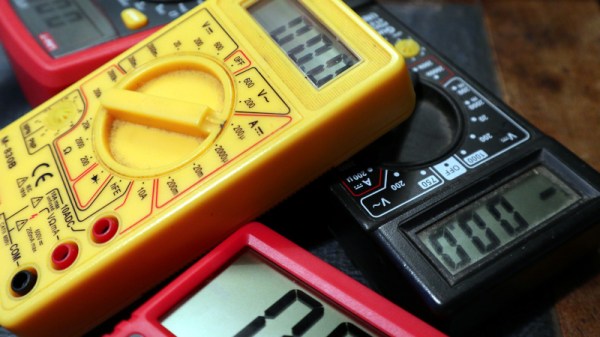
In Praise Of The DT830, The Phenomenal Instrument You Probably Don’t Recognise For What It Is

If we had to make a guess at the single piece of electronic bench equipment owned by the highest proportion of Hackaday readers, it would not be a budget oscilloscope from Rigol, nor would it be a popular portable soldering iron like the TS100. Instead we’re guessing that it’s a multimeter, and not even the most accomplished one.

The DT830 is a genericised Chinese-manufactured 3.5 digit digital multimeter that can be had for an astonishingly low price. Less than a decent hamburger gets you an instantly recognisable plastic case with a chunky rotary range selector switch, and maybe a socket for some kind of transistor or component tester. Make sure that there is a 9 volt battery installed, plug in the pair of test leads, and you’re in business for almost any day-to-day electrical or electronic measurement. They’ve been available in one form or another for decades and have been the subject of innumerable give-aways and loss-leader offers, so it’s a reasonsble guess that you’ll have one somewhere. I have three as far as I know, they make great on-the-go instruments and have proved themselves surprisingly reliable for what they are. Continue reading “In Praise Of The DT830, The Phenomenal Instrument You Probably Don’t Recognise For What It Is”

The ZX Microdrive: Budget Data Storage, 1980s Style

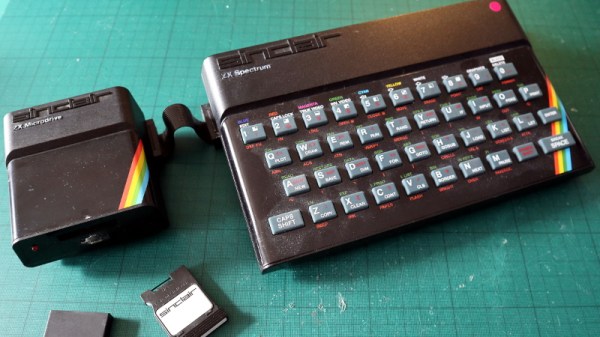
An enduring memory for most who used the 8-bit home computers of the early 1980s is the use of cassette tapes for program storage. Only the extremely well-heeled could afford a disk drive, so if you didn’t fancy the idea of waiting an eternity for your code to load then you were out of luck. If you had a Sinclair Spectrum though, by 1983 you had another option in the form of the unique Sinclair ZX Microdrive.

This was a format developed in-house by Sinclair Research that was essentially a miniaturized version of the endless-loop tape carts which had appeared as 8-track Hi-Fi cartridges in the previous decade, and promised lightning fast load times of within a few seconds along with a relatively huge storage capacity of over 80 kB. Sinclair owners could take their place alongside the Big Boys of the home computer world, and they could do so without breaking the bank too much.

Continue reading “The ZX Microdrive: Budget Data Storage, 1980s Style”

A Tentacle That’s A Work Of Art

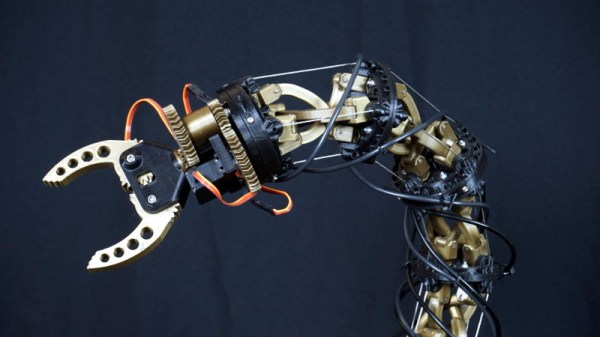
We all bring our own areas of expertise to our work when we build the projects that find their way in front of Hackaday writers, for instance a software developer brings clever brains to their microcontroller, or an electronic engineer might bring a well-designed piece of circuitry. [Yvo de Haas] is a mechanical engineer, and it’s pretty clear from his animatronic tentacle that he has used his expertise in that field to great effect.

If you think it looks familiar then some readers may recall that we saw a prototype model back in February at Hacker Hotel 2020. In those last weeks before the pandemic hit us with lockdowns and cancellations he’d assembled a very worthy proof of concept, and from what we can see from his write-up and the video below he’s used all the COVID time to great effect in the finished product. Back in February the control came via a pair of joysticks, we’re particularly interested to see his current use of a mini tentacle as a controller.

At its heart is a linkage of 3D-printed anti-parallelograms linked by gears, with cables holding the tension and controlling the movement of the tentacle from a set of winches. The design process is detailed from the start and makes a fascinating read, and with its gripper on the end we can’t wait for an event that goes ahead without cancellation at which we can see the tentacle for real.

If you’d like to see more of [Yvo]’s work, maybe you remember his wearable and functioning Pip-Boy, and his working Portal turret.

Continue reading “A Tentacle That’s A Work Of Art”

The Floppy Disk As A Portable Music Format

We remember the floppy disk as the storage medium most of us used two decades or more ago, limited in capacity and susceptible to data loss. It found its way into a few unexpected uses such as Sony’s Mavica line of digital cameras, but outside those who maintain and use older equipment it’s now ancient history.

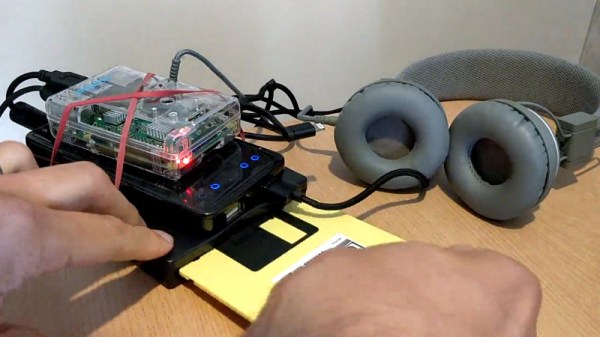
Seemingly not for [Terence Eden] though, who has made a portable audio player that uses a floppy disk as its storage medium. It came about with the realization that half an hour of extremely compressed audio could be squeezed onto a standard 3.5 inch floppy, and then that the Beatles’ A Hard Day’s Night album comes in at only a shade over that time. With some nifty manipulation of the compression command line and the judicious removal of some unnecessary metadata, the album can fit on a floppy in equivalent quality to the AM radio fans would have heard it over back in 1964.

The player would have been a major undertaking when the floppy was king, but in 2020 it’s simply a USB floppy drive, a Raspberry Pi, and a battery pack. He’s given us the full instructions, and no doubt a more permanent version could be built with a 3D-printed case.

We’re fascinated by the recent trend of storing audio on floppy disks, but despite the hipster vibe, we doubt  the idea will catch on. It’s not the first floppy-based player we’ve seen, but the previous one was more of a fake player.

Play A Game Of Multimeter

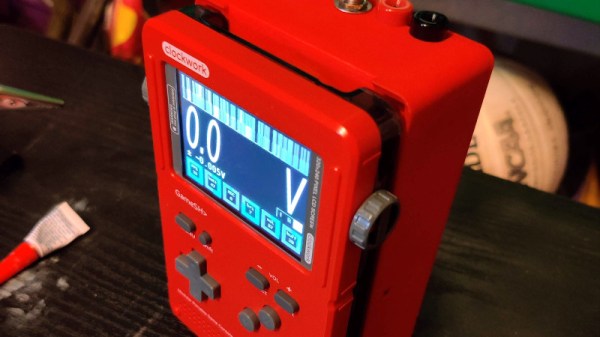
There are many different single board computers that are general purpose, but there’s another breed targeted at specific applications. One such is the Clockworkpi, a handheld Game Boy-style games console, which may be aimed at gamers but has just as much ability to do all the usual SBC stuff. It’s something [UncannyFlanigan] has demonstrated, by turning the Clockworkpi into a multimeter. And it’s not just a simple digital multimeter either, it’s one that sports graphing as well as instantaneous readings.

At its heart is an Arduino board that supplies the analogue to digital conversion, with opto-couplers for isolation between the two boards. A simple three-way switch selects voltage, current, and resistance ranges, and the ClockworkPi interface is written in Python. We can see that this could easily be extended using the power of the Arduino to deliver more functionality, for which all the code is handily available in a GitHub repository. It’s not a perfect multimeter yet because it lacks adequate input protection, but it shows a lot of promise.

If you’re intrigued by this project then maybe you’ll be pleased to know that it’s not the first home made multimeter we’ve featured.

Retrotechtacular: Forging In Closed Dies

It is the norm for our Retrotechtacular series to concentrate on a technology that has passed out of use but is still of interest to Hackaday readers, so it is perhaps unusual now to feature one that is very much still with us. Drop forging is a technique for forming hot metal in dies under huge force, and while it is still a current technique the 1950s educational film we are featuring is definitely retro.

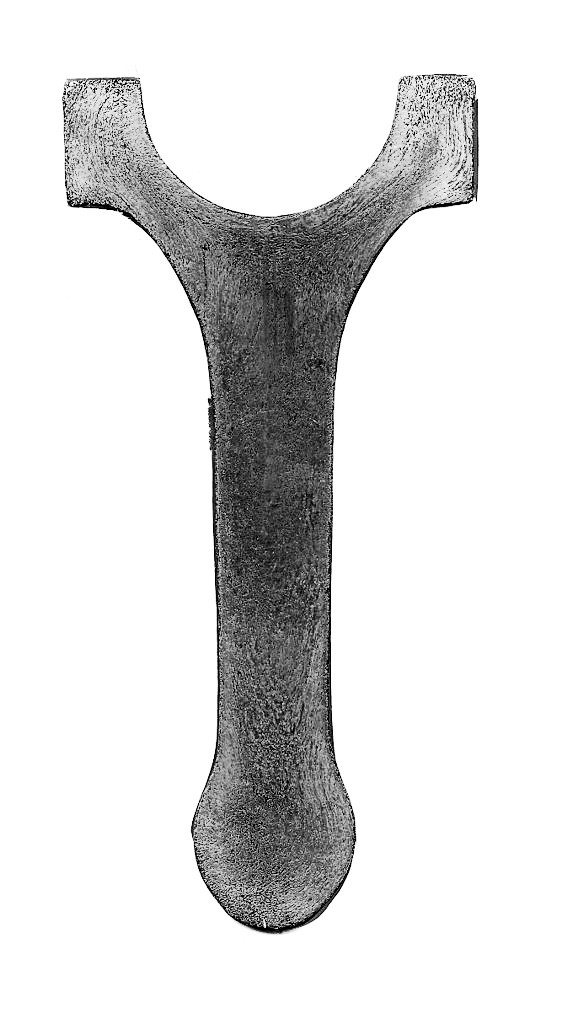
An automotive connecting rod, sectioned and acid treated to show the grain structure. (CC BY-SA 2.5)

If you have followed our occasional series on blacksmithing, you’ll be familiar with the process of forming metal by heating it to a temperature at which it becomes malleable enough to deform under pressure, and using a hammer to shape it against an anvil. This process not only shapes the metal, but also forms its inner grain crystal structure such that with careful management the forging process can impart significant resistance to fatigue in the finished item. Think of drop forging as automation of the manual blacksmithing process, with the same metallurgical benefits but in which the finished product is shaped in a series of dies rather than by the blacksmith’s hammer. It loses the craft of the smith over the process, but delivers an extremely consistent result along with a high production turnover.

The film that we’ve placed below the break is an in-depth introduction to the industry in a very period style and with components for the automotive, aerospace, and defense industries of the day. It takes the viewer through the different types of press and examines the design of dies to produce in stages the required grain structure and shapes.

Of particular interest is the section on upset forging, a technique in which a piece of steel stock is forged end-on rather from above. The components themselves make the video worth watching, as we see everything from jet turbine blades to medical forceps in production, along with many parts from internal combustion engines. The smallest piece shown is a tiny carburetor part, while the largest is a huge aircraft carrier catapult part that requires a special vehicle to load it into the press.

Drop forging is generally the preserve of a large metalworking factory due to the size of the presses involved. But it’s not entirely beyond the capabilities of our community given the resources of a well-equipped hackerspace or blacksmith’s shop. My father made simple forging dies by assembling a basic shape in weld and pieces of steel stock before grinding it to his requirements and heat treating. Mounted in a large rotary fly press for repetitive small scale shaping and forming tasks in ornamental ironwork, I remember bumping them out from red hot steel bar in my early teens.

This is one of those techniques that’s useful to know about in our community, because while the need to manufacture significant quantities of ornamental ironwork may not come your way too often, it’s still worth having the capability should you need it. Meanwhile the video below the break should serve to provide you with enough heavy machinery enjoyment to brighten your day.

Continue reading “Retrotechtacular: Forging In Closed Dies”