Chasing A Long-Obsolete Tube

Regular readers will know that here at Hackaday we have a penchant for poking fun at the more silly end of the audiophile world, with its dubious accessories and purple prose. It’s worth remembering though that this is not representative of the whole discipline of audio design, indeed the quest for perfect audio reproduction contains plenty of complex engineering problems.

We’re indebted to [macsimski] then for sending us a link to a page from Phaedrus Audio from a year or two ago, in which they discuss the history of an unusual pentode tube used as an impedance converter in a series of legendary post-war microphones. It’s unlikely that you’ll have a Neumann U47 or U48 broadcast microphone on your bench, but even so the story behind their design is one that should fascinate anyone.

It takes us back to the period immediately following the Second World War, when German electricity supplies were varied and unreliable, and radio receivers designed for them required new tubes from the manufacturers. Among these was the VF14, with an unusual high-voltage heater designed such that two of them could be connected in series across the supply. This and its compact shape prompted its selection for the professional microphones, even though its performance was so poor that only  a third of the production passed the performance test.

Since it passed out of production in the early 1950s the remaining components are extremely rare, and the majority of those surviving do not meet the performance characteristics of the microphone. The Phaedrus write-up goes into significant technical detail which should be of note to anyone with an interest in tubes, and ends up with their reason for it all, a plug-in hardware simulation of the original tube’s properties. Vintage capacitor microphones may be out of the ordinary for Hackaday, but it’s still a good read.

For a bit more on capacitor microphones it’s worth a look at our dive into electrets.

Header image: JacoTen / CC BY-SA 3.0

Key That Morse With Little More Than Your Laptop

If you look at the computer in front of you, it will have an array of input devices. A keyboard and mouse, a touch screen, maybe a microphone, or even a gamepad. Each of them will have its moment to shine, and you’ll probably have put some effort into their selection. But when it comes to a computer, almost anything connected to it can be an input device in some form, as long as it provides some form of machine readable parameter.

Consider your laptop: it knows when its lid is closed such that it can put itself to sleep. Even that can be used as an input device with a little ingenuity, as [veggiedefender] has done with “open and shut“, a Morse keyer using opening and closing the laptop lid as its key.

The software for GNU/Linux distributions is a surprisingly accessible set of shell scripts that attach themselves to ACPI events surrounding the lid switch. In use it seems a little cumbersome, but we suspect its real value is not in repeatedly slammin the lid to produce Morse text input. Instead with many lid switches being magnetic reed switches an operator could simply wear a ring with a magnet and tap out their text every bit as quickly as they could using a traditional key.

We like the idea, and could see it being popular among radio amateurs. It’s a theme we’ve visited before with a more traditional key, and if you’d love to try but don’t know any Morse then perhaps this may help you learn.

Thanks [Kickaxe] for the tip.

Header image: Raimond Spekking / CC BY-SA 4.0.

Justice For The Gatwick Two: The Final Chapter In The British Drone Panic Saga

At the end of 2018, a spate of drone sightings caused the temporary closure of London Gatwick Airport, and set in train a chain of events that were simultaneously baffling and comedic as the authorities struggled to keep up with both events and the ever widening gap in their knowledge of the subject.

One of the more inept actions of the Sussex Police was to respond by arresting the first local drone enthusiast they could find on Facebook, locking up a local couple for 36 hours and creating a media frenzy by announcing the apprehension of the villains before shamefacedly releasing them without charge.

In a final twist to the sorry saga, the couple have sued the force for wrongful arrest and false imprisonment, for which the cops have had to make a £200,000 ($250,117) payout including legal fees.

We reported extensively on the events surrounding the case 18 months ago, and then on a follow-up event at London Heathrow airport. The mass media at the time were full of the official line that drone hobbyists must be at fault, but then as now we were more interested in seeing some hard evidence. As we said then: Show us the drone.

So how has the new drone law progressed, since it was decided that Something Must Be Done? Enthusiasts have continued as before, and the multirotor community is as technically creative as ever. We were fortunate enough to host the Lets Drone Out podcast at MK Makerspace back in those halcyon days before the pandemic and see the state of the art in sub-250g craft, and with those and commercial offerings such as the DJI Mavic Mini all requiring no registration there is increasingly little need for an enthusiast to purchase a larger machine. The boost to the British drone industry we were promised has instead been a boost for the Chinese industry as we predicted, and of course we’re still waiting for the public inquiry into the whole mess. Something tells us Hell will freeze over first.

If you’d like the whole backstory in a convenient and entertaining video format, can we direct you to this talk at CCCamp 2019.

Thanks [Stuart Rogers] for the tip.

Keystone Kops header image: Mack Sennett Studios [Public domain].

Surviving The Pandemic As A Hacker: Take Care Of Your Mental Health

As we’ve looked at the subject of face masks in the first two parts of this series, our emphasis has been on a physical step to aid your chances of making it through the COVID-19 pandemic in one piece. But given that the upheaval caused by all the social changes enacted to protect the population are likely to leave an indelible mark on those who live through them, there are significant aspects of surviving all this that go beyond the physical.

This will be a once-in-a-lifetime event for many people, a significant number will find it traumatic in some way, and for many of those people there will be an immediate and then ongoing effect on mental health. If anyone is in doubt as to from what position this is coming, I count myself among that number.

The Pressure Of A Once In A Lifetime Event

Piccadilly Circus, London, during the COVID-19 lockdown. Normally this is packed.
Piccadilly Circus, London, during the COVID-19 lockdown. Normally this is packed. Kwh1050 / CC BY-SA 4.0

Different countries have placed their own public health restrictions on their populations, but it’s likely that many of you are in some form of lockdown situation, with social or communal  activities and locations closed or curtailed, going out restricted, and with all around you in the same situation. A perfect storm of having social outlets removed while simultaneously being stuck at home perhaps with family or housemates you’d prefer not to spend too much time with is not ideal. Add to that the multiple stresses from the pandemic itself as well as other news stories from our turbulent world, and it’s hardly a surprising that it’s taking a toll. Continue reading “Surviving The Pandemic As A Hacker: Take Care Of Your Mental Health”

Lonnie Johnson, Prolific Engineer And Hero To Millions Of Kids (Even If They Don’t Know It)

The current generation Super Soaker XP30. (Hasbro)

To be a child in the 1970s and 1980s was to be of the first generations to benefit from electronic technologies in your toys. As those lucky kids battled blocky 8-bit digital foes, the adults used to fret that it would rot their brains. Kids didn’t play outside nearly as much as generations past, because modern toys were seducing them to the small screen. Truth be told, when you could battle aliens with a virtual weapon that was in your imagination HUGE, how do you compete with that.

How those ’80s kids must have envied their younger siblings then when in 1990 one of the best toys ever was launched, a stored-pressure water gun which we know as the Super Soaker. Made of plastic, and not requiring batteries, it far outperformed all squirt guns that had come before it, rapidly becoming the hit toy of every sweltering summer day. The Super Soaker line of water pistols and guns redefined how much fun kids could have while getting each other drenched. No longer were the best water pistols the electric models which cost a fortune in batteries that your parents would surely refuse to replace — these did it better.

You likely know all about the Super Soaker, but you might not know it was invented by an aerospace engineer named Lonnie Johnson whose career included working on stealth technology and numerous projects with NASA.

Continue reading “Lonnie Johnson, Prolific Engineer And Hero To Millions Of Kids (Even If They Don’t Know It)”

Plot And Visualise Brain Data In An Artwork

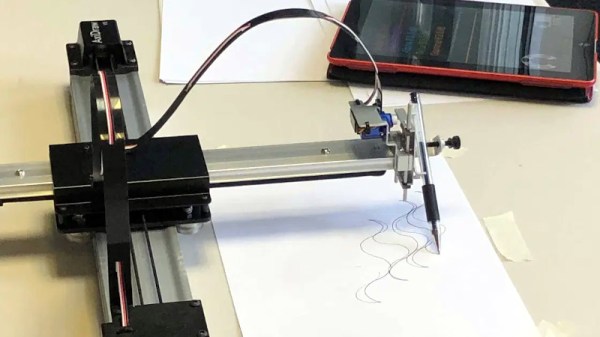
One of the most interesting streams through which we receive new projects to write about here at Hackaday comes from the intersection between technologists and artists. Those artists who straddle both disciplines bring creativity that those of us without their backgrounds can only dream of. The artist [Rosa Francesca] produced a piece called Cinematica, in which she monitored her brain waves with an EEG and from them produced on-paper visualizations with a pen plotter.

The hardware in use is an Interaxon Muse EEG headband read through the Muse Monitor app, and some code to drive an Evil Mad Scientist AxiDraw V3 plotter via its serial port. The write-up goes in some depth into the different types of brain waves, explaining her choice of monitoring gamma and theta waves for her source data. The result is a series of repeating shapes that vary with the brain waves of the wearer, creating drawings that are both pleasing and unique.

If you’re interested by the Muse headset used in this artwork, you might find a teardown we covered a few years ago to be of interest. And if you’re tempted by the plotter, you can always try making your own.

Thanks, @tanurai for the tip!

Mini Computer Brings Starfleet To Your Desk

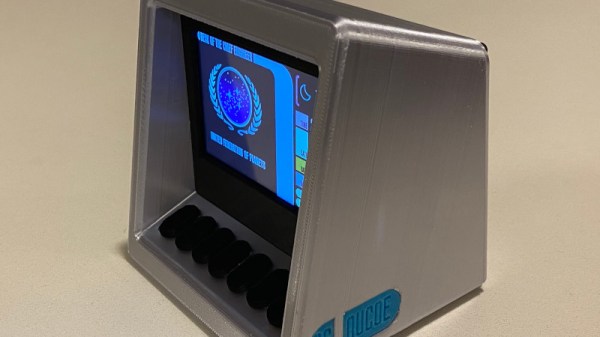
It could be said that there are two types of people: those for whom the actor LeVar Burton is the host of Reading Rainbow, and those for whom he is Geordi LaForge, Chief Engineer of Star Trek TNG‘s Enterprise NCC1701-D. For those of us engineers who lie in the second camp, we can at least feel a little closer to the action thanks to a project from [Darian Johnson], a Star Trek TNG mini-computer which functions as a desktop information display.

Inside the 3D-printed case is an ESP32 version of the Adafruit Feather, talking to cloud services to pull in and aggregate the information on the TFT screen. It combines weather data, environmental sensor readings, his fitness tracker readings, and his schedule, with two useful applications. There’s a resistor colour code chart, and an LED series resistor calculator. He’s made a video showing it in operation which we’ve placed below the break, and in it, he’s captured the aesthetic of the LCARS interface perfectly. We can’t speak for a fictional future spacecraft officer, but we suspect that Geordi would be right at home with it.

We may not be able to bring you Geordi LaForge, but we can bring you a real Starfleet officer. She even shares something with LeVar Burton, in that she’s (much more) famous for something else.

Continue reading “Mini Computer Brings Starfleet To Your Desk”