The 19th Century, When Gravity Battery Meant Something Different

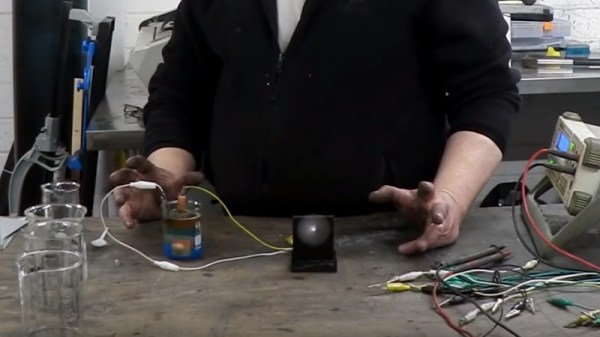
The internet is full of dubious content promoting “free energy” devices and other ideas that stretch credibility, so [Robert Murray-Smith] prefaces his demonstration of a gravity battery with a warning to look elsewhere if you are in search of such things. Instead he’s showing us a pair of cells from The Model Engineer and Amateur Electrician, a printed periodical that sounds to us something like an equivalent of Hackaday from the 1890s. (Video embedded below.)

The cells are termed gravity batteries because their constituents settle out into layers not unlike a tequila sunrise under the influence of gravity, something that made them especially suitable for the home constructor in the late 19th century when there were no handy wall outlets from which to snag a bit of power.

The chemistry of each is not unexpected if you spent any time in your high school’s lab, a zinc-copper primary cell with a zinc sulphate/copper sulphate electrolyte and a secondary zinc-carbon cell with a zinc bromide electrolyte and a layer of bromine forming on charging. The construction in large glass vessels is archaic though, and it’s this that’s prompted his video. He poses the question whether this type of cell might be revived using 21st century techniques to produce something of use today. The video is below the break, and even if you are not about to try your hand at electrochemistry it’s an interesting watch.

Thanks [Blaubär] for the tip! Continue reading “The 19th Century, When Gravity Battery Meant Something Different”

Electric Vehicles Continue The Same Wasteful Mistakes That Limit Longevity

A while back, I sat in the newish electric car that was the pride and joy of a friend of mine, and had what was at the time an odd experience. Instead of getting in, turning the key, and driving off, the car instead had to boot up.

The feeling was of a piece of software rather than a piece of hardware, and there was a tangible wait before the start button could be pressed. It was a miracle of technology that could travel smoothly and quietly for all but the longest journeys I could possibly throw at it on relative pennies-worth of electricity, but I hated it. As a technologist and car enthusiast, I should be all over these types of motor vehicles. I live for new technology and I lust after its latest incarnations in many fields including automobiles.

I want my next car to have an electric motor, I want it to push the boundaries of what is capable with a battery and I want it to be an automotive tour de force. The switch to electric cars represents an opportunity like no other to deliver a new type of car that doesn’t carry the baggage of what has gone before, but in that car I saw a future in which they were going badly astray.

I don’t want my next vehicle to be a car like my friend’s one, and to understand why that is the case it’s worth going back a few decades to the cars my parents drove back when when jumpers were goalposts, and the home computer was just a gleam in the eye of a few long-haired outsiders in California.

Continue reading “Electric Vehicles Continue The Same Wasteful Mistakes That Limit Longevity”

A Transmission Line Speaker With The Design Work To Back It Up

We love the world of audiophiles here at Hackaday, mostly for the rich vein of outrageous claims over dubious audio products that it generates. We’ve made hay with audiophile silliness in the past, but what we really like above that is a high quality audio project done properly. It’s one thing to poke fun at directional oxygen free gold plated USB cables, but it’s another thing entirely to see a high quality audio project that’s backed up by sound design and theory to deliver the best possible listening. [Davide Ercolano]’s transmission line speakers are a good example, because he’s laid out in detail his design choices and methods in their creation.

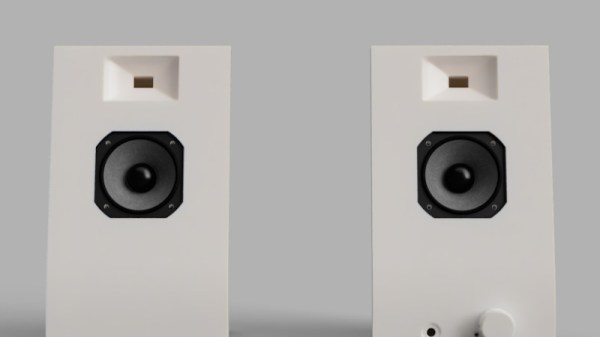
Starting with the Thiele-Small parameters of his chosen driver, he simulated the  enclosure using the Hornresp software. As a 3D-printed design he was able to give it paraboloid curves to the convoluted waveguide, making it a much closer approximation to an ideal waveguide than a more traditional rectangular design. In the base is a compartment for an amplifier module, with additional Bluetooth capability.

We’d be curious to know how well 3D printed plastic performs in this application when compared for example to something with more mass. However we like these speakers a lot; this is how a high quality audio project should be approached. We’ve delved into speakers more than once in the past, but if you’re looking for something really unusual then how about an electrostatic?

TEMPEST Comes To GNU Radio

As we use our computers, to watch YouTube videos of trucks hitting bridges, to have a Zoom call with our mothers, or even for some of us to write Hackaday articles, we’re unknowingly sharing a lot of what we are doing with the world. The RF emissions from our monitors, keyboards, and other peripherals can be harvested and reconstructed to give a third party a view into your work, and potentially have access to all your darkest secrets.  It’s a technique with origins in Government agencies that would no doubt prefer to remain anonymous, but for a while now it has been available to all through the magic of software defined radio. Now it has reached the popular GNU Radio platform, with [Federico La Rocca]’s gr-tempest package.

He describes it as a re-implementation of [Martin Marinov]’s TempestSDR, which has a reputation as not being for the faint-hearted. The current version requires GNU Radio 3.7, but he promises a 3.8-compatible version in the works. A YouTube video that we’ve placed below the break has a range of examples running, though there seems to be little information on the type of antenna employed. Perhaps a log-periodic design would be most appropriate.

Continue reading “TEMPEST Comes To GNU Radio”

The DOOM Chip

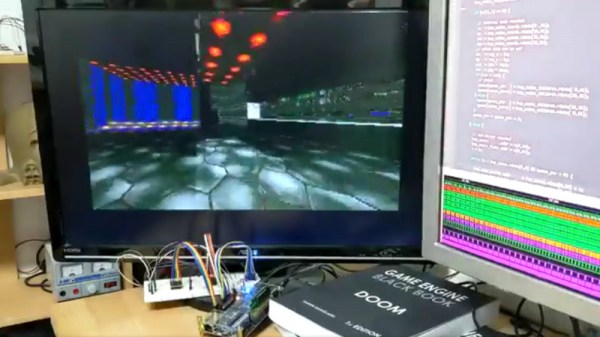
It’s a trope among thriller writers; the three-word apocalyptic title. An innocuous item with the power to release unimaginable disaster, which of course our plucky hero must secure to save the day. Happily [Sylvain Lefebvre]’s DOOM chip will not cause the world to end, but it does present a vision of a very 1990s apocalypse. It’s a hardware-only implementation of the first level from id Software’s iconic 1993 first-person-shooter, DOOM. As he puts it: “Algorithm is burned into wires, LUTs and flip-flops on an #FPGA: no CPU, no opcodes, no instruction counter. Running on Altera CycloneV + SDRAM”. It’s the game, or at least the E1M1 map from it sans monsters, solely in silicon. In a very on-theme touch, the rendering engine has 666 lines of code, and the level data is transcribed from the original into hardware tables by a LUA script. It doesn’t appear to be in his GitHub account so far, but we live in hope that one day he’ll put it up.

“Will it run DOOM” is almost a standard for new hardware, but it conceals the immense legacy of this game. It wasn’t the first to adopt a 1st-person 3D gaming environment, but it was the game that defined the genre of realistic and immersive FPS releases that continue to this day. We first played DOOM on a creaking 386, we’ve seen it on all kinds of hardware since, and like very few other games of its age it’s still receiving active development from a large community today. We still mourn slightly that it’s taken the best part of three decades for someone to do a decent Amiga port.

Understanding A Bit About Noise Can Help You Go A Long Way

There are many ways in which one’s youth can be misspent, most of which people wish they’d done when they get older and look back on their own relatively boring formative years. I misspent my youth pulling TV sets out of dumpsters and fixing them or using their parts in my projects. I recognise with hindsight that there might have been a few things I could have done with more street cred, but for me, it was broken TVs. Continue reading “Understanding A Bit About Noise Can Help You Go A Long Way”

Iron Pipe Makes A Great Workbench

It’s a frequently encountered problem in any workshop; how do you make a bench? And once you’ve made a bench, how do you put it on wheels to move it about? [Eric Strebel] needed a cart for his laser cutter, so he designed his own in an unexpected material: malleable iron pipe.

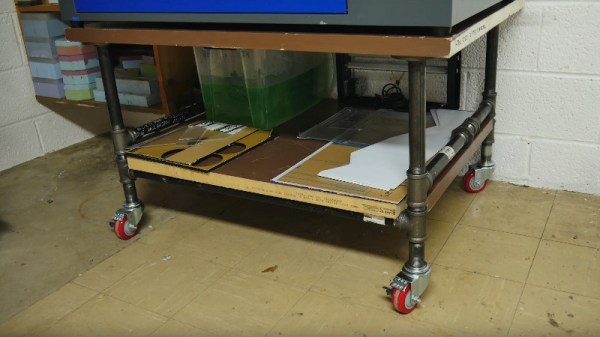
The attraction of iron pipe is its ready availability and ease of assembly. [Eric] created a sturdy table complete with a worktop made from a solid door in a very short time. T pieces and joiners were used, along with a hefty set of flanges for the tabletop itself. The casters are the expanding stem variety, with a compressed rubber insert expanding to hold them securely in place.

The result as can be seen in the video below is a really neat trolley for the cutter, followed quickly by another workbench. It would be interesting to know more about this material, parameters such as its wall thickness and lateral strength, because in a table without any cross-bracing it becomes important to avoid an untimely collapse.

The most common material for benches seems still to be wood, indicating that for such a technophile community we can be surprisingly conservative in our choices. Sometimes though, benches are made from the most surprising things.

Continue reading “Iron Pipe Makes A Great Workbench”