That Retro Video Look, Without The Tapes

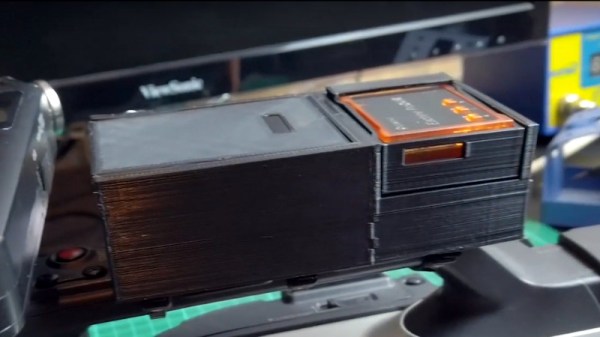
We’re lucky to live in an age of rapid technological advancement, lucky in more ways than one because as well as receiving a constant supply of new things, we have the benefit of the older tech that once we lusted over, at knock-down prices. [Luke Baker] spent his youth as a skateboarder, and the cameras of desire in that community were the high-end MiniDV models. They may not have high definition but their output has a Millennial aesthetic that captures the period, so he’s brought one into the 2020s by adding a digital SD card recorder designed for a multirotor to it.

On the face of it this is a pretty straightforward job of coupling an off-the-shelf recorder to a battery and the camera’s analogue output terminals. But the resulting spaghetti on what is supposed to be a portable device is hardly attractive, so he’s created an all-in-one 3D-printed enclosure that is attached to the camera’s handle with a set of cable ties. It’s shaped to fit the recorder and has a sliding lid over the battery compartment, and he’s added a handy on-off switch. Whether or not he takes it to the skate park in a bid to roll back the decades, as you can see int he video below the break it’s a well-executed piece of work that should serve to remind that there’s still life in some of this easily-available old tech if you’re prepared for a bit of lateral thinking.

This isn’t the first vintage video hack we’ve seen, back in 2016 we were treated to the grainy period feel of a vintage 8mm camera through the eye of a Raspberry Pi.


Continue reading “That Retro Video Look, Without The Tapes”

An 8085 Retrocomputer From The Heart

The world of 8-bit retrocomputing splits easily into tribes classified by their choice of processor. There are 6809 enthusiasts, 6502 diehards, and Z80 lovers, each sharing a bond to their particular platform that often threads back through time to whatever was the first microcomputer they worked with. Here it’s the Z80 as found in the Sinclair ZX81, but for you it might be the 6502 from an Apple ][. For [Craig Andrews] it’s the 8085, and after many years away from the processor he’s finally been able to return to it and recreate his first ever design using it. The SBC-85 is not wire-wrapped as the original was, instead he’s well on the way to creating an entire ecosystem based around an edge-connector backplane.

The CPU board is an entire computer in its own right as can be seen in the video below the break, and pairs the 8085 with 8k of RAM, a couple of 2732 4k EPROMs, and an 8155 interface chip. This last component is especially versatile, providing an address latch, timer, I/O ports, and even an extra 256 bytes of RAM. Finally there is some glue logic and a MAX232 level shifter for a serial port, with no UART needed since the 8085 has one built-in. The minimal computer capable with this board can thus be slimmed down significantly, something that competing processors of the mid 1970s often struggled with.

Craig’s web site is shaping up to be a fascinating resource for 8085 enthusiasts, and so far the system sports that backplane and a bus monitor card. We don’t see much of the 8085 here at Hackaday, perhaps because it wasn’t the driver for any of the popular 8-bit home computers. But it’s an architecture that many readers will find familiar due to its 8080 heritage, and could certainly be found in many control applications before the widespread adoption of dedicated microcontrollers. It would be interesting to see where Craig takes this next, with more cards, and perhaps making a rival to the RC2014 over in Z80 country.

Continue reading “An 8085 Retrocomputer From The Heart”

Vanquish Your Foes With Lego Playing Card Machine Gun

There was something exceptionally satisfying about those playground games of cops and robbers when we were young, but they were missing something in that a pretend gun made with your fingers lacks a certain Je ne sais quoi. Our youthful blood-lust demanded something a bit more real, and though the likes of NERF and other toys could supply it their lost projectiles came at a price not all parents could sustain. We’d have given anything for [Brick Experiment Channel]’s rapid-firing Lego playing card gun! (Video, embedded below.)

The principle is simple enough, one of the larger Lego road wheels is spun up to a respectable speed through a gear train from a pair of motors, it’s positioned over a channel through which playing cards are fed, and it picks each one up and accelerates it to a claimed 20 miles per hour. The card is fired off into the distance, ready to take down your Lego figure or plastic drinking cup enemies with maximum prejudice.

It’s clear some significant thought has gone into the firing platform design, with the cards sliding along smooth rails and the wheel sitting in a gap between the rails so that the natural springiness of the card can engage with it. The cards also emerge with a spin, due to the wheel being offset. The mechanism is completed with a third motor which acts as a feeder pushing individual cards from the deck into the main firing platform. This achieves an astonishing six cards per second, as can be seen in the video below the break.

We can see that this is a huge amount of fun, and we hope should any youngsters get their hands on it that there are not lurid tales of kids with playing card injuries. It’s not the first novelty projectile gun we’ve brought you, there have been numerous rubber band guns but our favourite is the automatic paper plane folder and launcher.

Continue reading “Vanquish Your Foes With Lego Playing Card Machine Gun”

From Hacker Hotel 2020: Badges, Sharks, Tentacles, Old-School Hacking, And Much More

The North Sea in a winter storm is a spectacular sight, one of foam-crested waves and squalls driven on the gale. It’s not a place to spend a lot of time if you are a land-lubber, so to cross it twice in a few weeks must mean there is something very much worth seeing on its other side.

More of that exotic cruise ship lifestyle.

But one of the best antidotes to February weather in the European hacker community was Hacker Hotel 2020. Around 350 people came from all the countries of the northwest of the continent to the comfort and hospitality of the Westcord Hotel de Veluwe in the eastern Netherlands, to experience a hacker camp with all the convenience and luxury of a resort hotel rather than a muddy field.

Three days in this environment results in a camp that’s just a bit special, and one that’s very much worth a visit if your range extends this far.

An Upscale Hotel Gets The Hacker Treatment

The Hacker Hotel badge 2020 has many hidden depths

Our small party of Brits arrived a day early, on a damp Thursday morning ready to lend a hand with the set-up. Slowly an upscale business conference centre was transformed into a hacker camp venue, with conference rooms turned into lecture halls, lighting and video equipment in place and 3-phase power cables snaking along the skirting boards. A large hardware hacking area was set up in one wing of the building, then the EventInfra people came in and laid out a hacker-camp-grade wireless and wired network that delivered connectivity everywhere. The contrast between the two worlds is significant, but together they make for a unique experience.

One by one, hackers arrived from all points of the compass, bearing crates of the usual cool stuff. An amateur TV satellite earth station, a brace of oversized delta 3D printers, a coin-pushing game that’s familiar from other camps. And smaller projects; little roving robots, indoor-sized multirotors, and several crates of outdated Chinese photo-frames that it’s said can be hacked to run a Linux distro.

This is the lifeblood of a hacker camp, but of course the signature piece of hardware for any hacker camp is its badge. In this Hacker Hotel 2020 didn’t disappoint, with a beautifully designed Ancient Egyptian-themed badge that concealed an array of puzzles across multiple levels. We’ll cover the badge in detail in a separate piece, but suffice to say that it is something of a tour de force. For now let’s jump into all of people and activities on offer at the con.

Continue reading “From Hacker Hotel 2020: Badges, Sharks, Tentacles, Old-School Hacking, And Much More”

Blister Pack With Jet Fighter Toy Is A Business Card

In the world of business cards, it seems that for some people a white rectangle of card just doesn’t cut it any more. A card isn’t simply a means to display your contact details, instead it can be a way to show off your work and demonstrate to the world your capabilities. For [agepbiz] those are the skills of a 3D design specialist, so what better way to proceed than by distributing a 3D-printed example of his work? How to render that into a business card? Put it in a retail-style blister pack, of course. Take a look at the video below the break.

It’s an interesting process to follow, because  there are certainly readers who will have toyed with the idea of selling their work, and this makes an attractive way to display a small assembly while still keeping it safe from damage. The toy – a small 3D-printed jet fighter with working swing wings that’s a masterpiece in itself – is laid on a backing card and a custom blister is glued over it. The manufacture of the printed backing card with a CNC card cutter is shown, followed by that of the blister with a custom SLA-printed mould being used to vacuum-form a sheet of clear plastic. Surprisingly the whole is assembled with just a glue stick, we’d have expected something with a bit more grab. The result is a professional-looking blister packed product of the type you wouldn’t bat an eyelid over if you saw it in a shop, and one of those things that it’s very useful to have some insight into how one might be made..

It’s possible this card might be a little bulky to slip in your wallet, but it’s hardly the only novelty card we’ve brought you over the years. Some of our most recent favourites run Linux or play Tetris.

Continue reading “Blister Pack With Jet Fighter Toy Is A Business Card”

Just When You Thought There Was Nothing New In Nixie Clocks…

Nixie clocks have become such a staple in our community as to have become mundane. They’re pretty, but show us something new! It seems [Marcin Saj] has done just that with his offering, because with a bank of 18 IN-2 Nixie tubes he’s telling the time –  but in binary rather than the usual decimal.

The tubes are arranged in three banks of six, the upper registering hours, the middle minutes, and seconds on the lowest. Each one only uses two digits, as you might expect from a binary device they are 0 and 1. Behind is a large PCB with the Nixie sockets, and on the back of that in sockets are a pair of Nixie driver boards, a real-time clock module, temperature sensor module, PSU module, and either a Particle Photon or an Arduino Nano IoT.  This two-option set-up for the choice of dev board is unusual, and there is code for both of them in the GitHub repository.

The result is eye-catching and unusual, and certainly a departure from the usual Nixie digital clock. Hackaday readers are probably more likely than the average Joe or Jane to be able to read binary at a glance, watching it in action in the video below the break is an interesting exercise in testing one’s binary-aptitude.

Meanwhile if binary Nixies are too commonplace, how about binary neon lamps?

Continue reading “Just When You Thought There Was Nothing New In Nixie Clocks…”

Generate Power As You Ride With A Bicycle Planar Alternator

For most riders, bicycle lighting consists of an array of LED lamps and flashing gizmos, usually powered by lithium-ion batteries, or coin cells for the smaller ones. Some people though prefer to dispense with batteries and generate their own power, and that’s what [Thomas D] has done by fitting his bike with an alternator. But this is no off the shelf unit that rubs the tire or sits in a wheel hub. Instead, he’s built his own planar alternator that attaches to the spokes.

The design is inspired by those used in some wind generators, a central disk holding a set of planar coils sits between two rotating disks holding magnets. The stator holding the coils is made from laser-cut acrylic, and the rotors holding the magnets are sheet steel. One rotor is attached to the rear wheel spokes of the bicycle in close proximity to the stator which is attached to the rear frame. The second rotor sits on the other side of the stator while attached to the first rotor by its edge.

The coils are wired as two parallel groups in series in a ring with a single-phase output that feeds a rectifier and DC to DC converter. It would be interesting to see the effect of the same alternator with different winding arrangements or multiple phases.

This is the first time we’ve seen one of these on a bicycle, but this type of alternator has appeared here in more than one wind generator.

Continue reading “Generate Power As You Ride With A Bicycle Planar Alternator”