Electrification Of A Cheap Bead Roller

We all have old projects which maybe didn’t quite deliver knocking about, sometimes they gather dust for years. They have a use though, in that when you *really* need that part you can lift it from that forgotten project. That’s what [Mustie1] did with a forgotten electric bicycle project, he took its motor and used it to automate his bead roller.

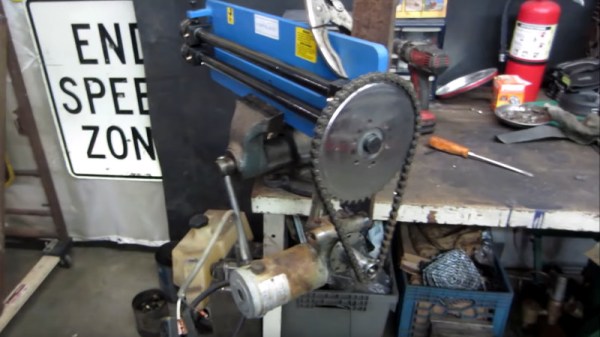
A bead roller is a tool used in the world of automotive bodywork to press a bead — a continuous depression — into a piece of sheet metal. The inexpensive roller he had fitted in a bench vice, and was operated by means of a handle. Unfortunately the size of the tool meant that it was difficult to operate at the same time as rolling a precise bead, so improvement was required.

He first considered using a cordless drill, but then remembered the electric bicycle project. Its geared motor had come from an electric wheelchair and certainly possessed the right speed, but he needed a suitable sprocket. This was supplied from a scrap engine-assisted bicycle that he’d acquired, and proved to be perfect for the job. The final automated roller used the trigger controller from a cordless drill mounted in a foot switch, and the roller mounted on a stand repurposed from a piece of gym equipment. The result is a useful, and above all controllable, tool that can run a perfect bead in any shape desired on a piece of sheet metal.

Surprisingly this is the first bead roller we’ve featured here, but sheet metal work is a constant in hardware hacker projects. Read our guide to sheet metal bending, for a start.
Continue reading “Electrification Of A Cheap Bead Roller”

Closed Ham Radio Peripheral Reveals Its Windows Secrets

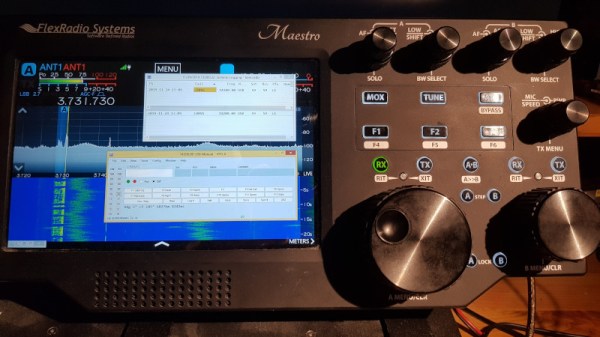
The student radio society in Trondhjem owns a Flex 6500-radio, with its associated Maestro panel peripheral. This is a software defined radio, and the Maestro is a computer containing just enough of an embedded version of Windows to run its front-end software. Unfortunately for our Norwegian radio amateur friends it runs very little else, even to the extent of being unable to connect to public WiFi that requires a web log-in. This was particularly annoying as the student network does this and they’d had to create their own hotspot, so they’ve provided some details on how they were able to open it up a little to do a bit more.

At first they were cagey about the exact nature of the exploit they used to penetrate the device’s defenses, but since then they’ve published a second installment with full details. It involved gaining access to the filesystem and a terminal through a right-click menu from a web browser screen within the Maestro software, then using that access to change configuration such that it could be exposed across the network. From there they were able to treat it much as they would a normal Windows installation, including putting other software such as SmartSDR onto it.

This piece of work provides a fascinating insight into an embedded Windows device, and leaves us as usual surprised by the ease of the exploit. We’d say it’s something of a brave move for a company to ship a feature-limited product to radio amateurs of all people, a community that has been experimenting and finding whatever means  to extend the capabilities of their equipment for over a hundred years. Perhaps Flexradio’s eyes are on greater things.

DIY Dispenser Places Solder Paste Without The Mess

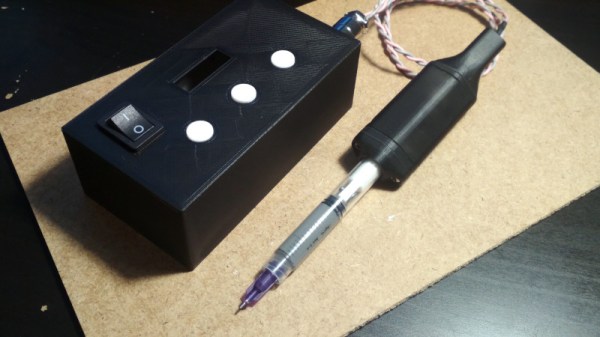
When doing surface-mount assembly you can certainly use a soldering iron in the traditional way, but it’s far more convenient to cover the pads with solder paste, place the components, and bake the board in a reflow oven. If you’re lucky enough to have a precut stencil this can be done in one go, otherwise a tiny blob of paste must be laboriously placed on each pad by hand. [Kevarek] has made this a bit easier by designing a low-cost handheld solder paste dispenser.

The unit takes the form of a handheld 3D printed wand containing a geared motor and a threaded shaft, that engages with a syringe full of paste clamped onto its end. There’s a control box powered by an STM32 microcontroller that not only allows adjustment of flow rate, but provides advanced features such as performing a slight retraction at the end of dispensing to avoid excess paste. There’s a push-button on the wand for control, as well as a set on the control box to adjust its parameters.

If you’ve ever handled solder paste, you’ll know it can be a uniquely annoying and finicky substance. Either it’s too stiff and clumps together, or too runny and spreads out. No doubt some readers are lucky enough to always have fresh paste of the highest quality to hand, but too often a hackerspace will have a tub of grey goop with uncertain provenance. We like this tool, and while it won’t make up for poor quality or badly stored paste, at least it’ll make applying paste a breeze.

We’ve covered paste dispensers quite a few times in the past, but you might also wish to read our in-depth guide to the subject.

Make A Set Of Headphones From Scratch

There are a variety of ways to enjoy your audio, of which headphones are one. Making a set of headphones is a straightforward enough project, but [madaeon] has taken the art to a new level by building the headphone drivers from scratch rather than using an off-the-shelf pair.

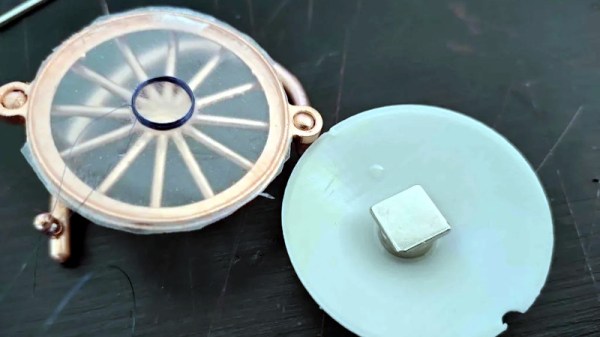
The result is a set of moving coil drivers with a construction technique involving using the semi-opaque thin window from an envelope as a diaphragm and as a former for the coil. Cyanoacrylate adhesive holds everything in place. The diaphragm is suspended across the mouth of a cardboard tube with the coil positioned above a magnet, resulting in the minimum moving mass necessary for as good a sound reproduction as possible. Judge for yourself, there’s a video that we’ve placed below the break.

The drivers are placed in a set of 3D-printed on-ear holders, and while they probably won’t match an expensive set of commercial headphones, we’d hazard a guess that they won’t have too bad quality. At the very least, it’s an interesting design to base further experimentation on.

Surprisingly few home made speaker or headphone drivers have made it onto these pages, probably because of the ubiquity of the ready-made article. An exception is this flexible PCB speaker, and of course we’ve also talked about home made electrostatic speakers. Continue reading “Make A Set Of Headphones From Scratch”

AAA Powered LoRa Mailbox Sensor Goes The Distance

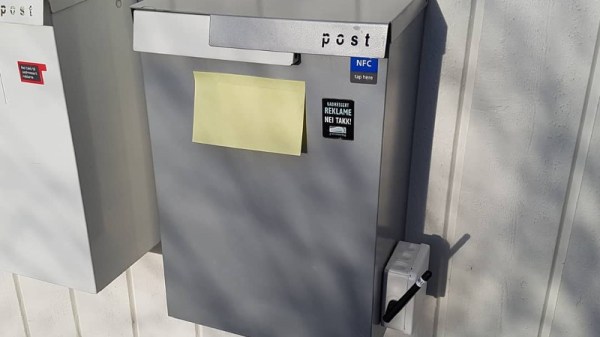
As more of the world’s communication moves into the electronic realm, a casualty has come in the physical mail. Where once each new day might have brought with it a bulging mailbox, today it’s not uncommon for days to pass with not even so much as a bill or a coupon book. For [Eivholt] this presents a problem: he doesn’t want to miss a parcel but most visits to the mailbox are futile. His solution is a LoRa-connected mailbox monitor that sips power from a pair of AAA batteries to the extent that so far it’s run for over two years on a single set.

At its heart is a single board, a Talk2 Whisper Node. This packs a low-power version of the ATmega328 microcontroller alongside a LoRa radio and an efficient power regulator allowing it to draw only 8.70 uA in standby mode, waking up only for extremely short periods to check for mail and report via LoRa to The Things Network. The sensor is simply a microswitch, selected after finding a reed switch problematic to install. Finally an SDR was used to debug the operation of the radio.

The write-up also provides an introduction to extreme low power projects, including some tips on measuring such tiny currents. Even if you have no interest in a mailbox, any tricks that can help maximize power efficiency are always worth taking a look at. Check out the video after the break to see this radio-equipped mailbox in action.

Continue reading “AAA Powered LoRa Mailbox Sensor Goes The Distance”

Gravity-Defying Cosmetics Explained By Science!

There probably comes a point in every female technical journalist’s career at which she covers her first make-up story and wonders aloud whether this is what her life has come to. But this make-up story involves some physics, and follows a series of viral videos in the TikTok community in which specialist cosmetics vloggers were surprised to see lip gloss apparently levitating — defying gravity — from the ends of its applicators. This caught the attention of [Steve Mould], who followed up on his hunch that static electricity might be responsible. What follows in the video below the break are a variety of attempts to recreate and characterise the phenomenon.

The tried-and-trusted approach of rubbing feet on the carpet failing to cause any movement in the damp atmosphere of a British January, he’s off to try a Van de Graaff generator Even the hefty electrostatic charge from that failed to produce more than a tiny blip, but did at least give a suggestion that the effect might be electrostatic.

Finally he was able to replicate the beauty vloggers’ results using the FunFlyStick electrostatic toy, with satisfying threads of lip gloss heading off into the air. The FunFlyStick is an interesting device in its own right, being a Van de Graaff generator in toy form and capable of generating significant quantities of charge. The flying lip gloss is an interesting phenomenon, but speaks further about just how much electrostatic charge can accumulate on mundane objects in a dry climate. Those of in damper climes would do well to take note before we travel.

Continue reading “Gravity-Defying Cosmetics Explained By Science!”

The Red Dwarf Talkie Toaster Made Real

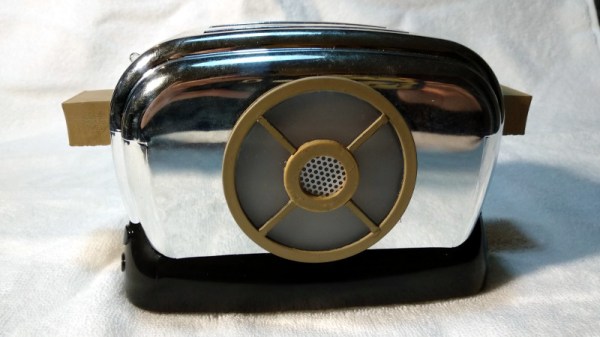
It’s cold outside, there’s no kind of atmosphere, you’re all alone, more or less. More or less meaning that you share the gigantic mining ship that is your home on the other side of the galaxy with an ineffectual android, a humanoid descended from your cat, a holographic representation of your dead colleague who’s a complete smeghead, and a really annoying sentient toaster that’s obsessed with bread products. If all this rings a bell, then maybe you’re familiar with the cult BBC TV series, Red Dwarf.  It’s a show that evidently [Bill Dudley] has spent too much time watching, because he’s created a really convincing replica of that talking toaster.

The base toaster is a toy appliance with a little clockwork ejector for toy toast, that comes with plenty of space inside and is easy to accessories for the classic Talkie Toaster look. Inside is an off-the-shelf MP3 player board and a home-made PCB which drives a set of LEDs behind the speaker grille in time with the audio. The result won’t make any toast, waffles, or even crumpets, but it will delight any Red Dwarf fans who might be passing, whether someone has smoked them a kipper or not.

Surprisingly this is not the first Talkie Toaster build we’ve seen. If they met, would they have a harmonious conversation about bagels?