Not-Quite-So-Hot Stuff: A Thermal Exam On The Latest Raspberry Pi

When the Raspberry Pi 4 was first launched, one of its few perceived flaws was that it had a propensity to get extremely hot. It’s evidently something the Pi people take very seriously, so in the months since they have addressed the problem with a set of firmware updates. Now they’ve taken a look at the effect of the fixes in a piece on the Raspberry Pi web site, and it makes for an interesting comparison.

The headline figure is that all updates together remove about a watt of power from the load, a significant quantity for what is still a board that can run from a capable phone charger. Breaking down the separate parts of the updates is where the meat of this story lies though, as we see the individual effects of the various USB, memory, power management and clocking updates. In temperature terms they measure an on-load drop from 72.1 °C to 58.1 °C, which should be a significant improvement for any Pi 4 owner.

There is a debate to be had over in what role a computer such as a Pi should serve. As successive revisions become ever more desktop-like in their capabilities, do they run the risk of abandoning the simplicity of a cheap Linux box as a component that makes us come back for more? It’s a possibility, but one they have very well addressed by developing the Pi Zero. They have also successfully avoided the fate of the Arduino — inexorably tied to its ATmega powered original line despite newer releases. As we have frequently said when reviewing Raspberry Pi competitors, it’s the software support that sets them apart from the herd, something this power-draw story demonstrates admirably.

Don’t Forget The Baby!

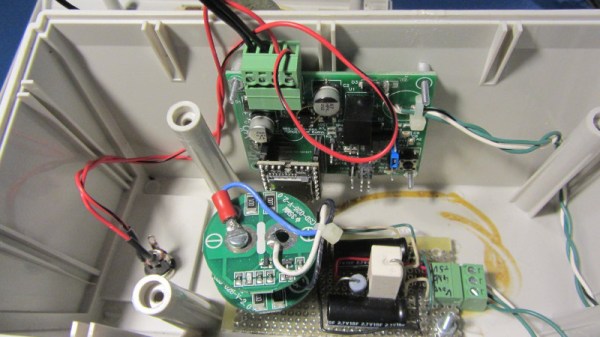
It must be a common worry among parents, that they might forget their offspring and leave them in the car where they would succumb to excessive heat. So much so that [Matt Meerian] has produced an alarm that issues a verbal reminder to check for the youngster when the vehicle is turned off.

It’s a simple enough device, with an ATmega328, an off-the-shelf MP3 module, and a power supply regulator to deliver 5 V into a pair of supercapacitors from the vehicle accessory socket’s 12 V. The idea is that the  power is cut when the vehicle ignition is turned off, and that the supercaps have enough energy within them to play the reminder sample for the driver to check for forgotten children.

We can’t help remarking that a percentage of cars leave their accessory sockets turned on all the time, so it would be interesting to ponder how one might detect the car being turned off in that case. He muses about using a surplus cell phone instead of his ATmega328, perhaps the MEMS sensor on a phone could also be used to detect the vibrations of the engine stopping as it was turned off. Such cars notwithstanding, this unit is a straightforward solution to the problem in hand.

A Mini Vending Machine To Ramp Up Your Sales

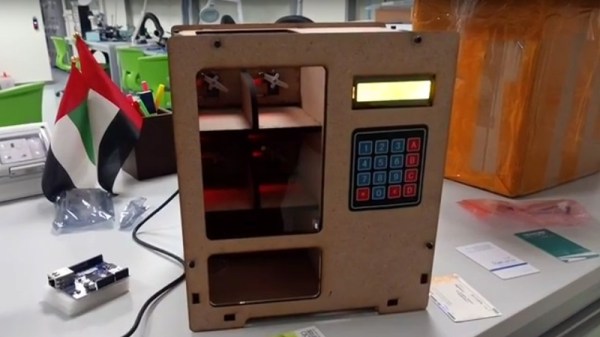
A common sight in the world of hackerspaces is an old vending machine repurposed from hawking soda cans into a one-stop shop for Arduinos or other useful components. [Gabriel D’Espindula]’s mini vending machine may have been originally designed as an exercise for his students and may not be full sized, but we can see it or machines like it taking away some of the demand for those surplus models.

Its construction mimics that of some older 3D printers in using laser-cut ply to form the components of a box. Behind a clear lockable door are the shelves containing the products, at the back of which are continuous rotation servos that will drive the spiral Archimedes screws that eject the products. To the side is a membrane keypad and display, and the whole is drawn together with an STM32 board and an Arduino. It supports both RFID card login and keyboard login, and though it’s not finished we can see it forming the basis of a very useful system.

He’s posted the most recent progress in the form of a video that we’ve placed below the break. All the various files are available for download, so should you fancy one yourself then you have a good chance of success.

Continue reading “A Mini Vending Machine To Ramp Up Your Sales”

Landbeest, A Single Servo Walking Robot

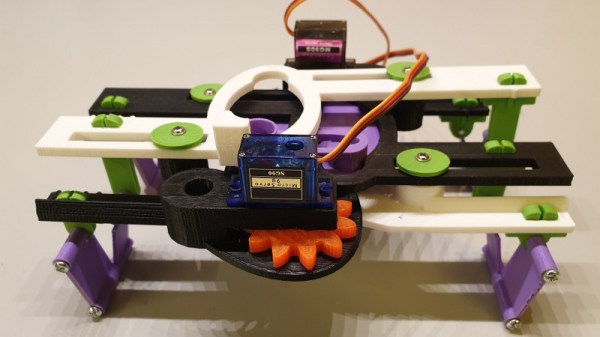
Walking robots have a rich history both on and off the storied pages of Hackaday, but if you will pardon the expression, theirs is not a field that’s standing still. It’s always pleasing to see new approaches to old problems, and the Landbeest built by [Dejan Ristic] is a great example.

It’s a four-legged walker with a gait dictated by a cam-and-follower mechanism that allows it to perform the full range of leg movement with only one motor. Each cam can control more than one leg in synchronisation, and in his most recent prototype, there are two such mechanisms that work on opposite corners of a four-legged machine. The legs are arranged in such a way that the two corner-to-corner pairs pivot at their centres in a similar manner to a pair of scissors; allowing a servo to steer the robot as it walks.

The result certainly isn’t as graceful as [Theo Janssen]’s Strandbeest, from which it evidently takes inspiration for its name, but it’s no less capable for it. After the break you can see a video he’s posted which clearly illustrates its operation and demonstrates its ability to traverse obstacles.

The only thing that’s missing are the files and software should you wish to create your own. He’s unapologetic about this, pointing out that he’d prefer to wait until he is satisfied with it before letting it go. Since he’s put a lot of work in so far and shows no sign of stopping, we’re sure he’ll reach that point soon enough.

Continue reading “Landbeest, A Single Servo Walking Robot”

That’s It, No More European IPV4 Addresses

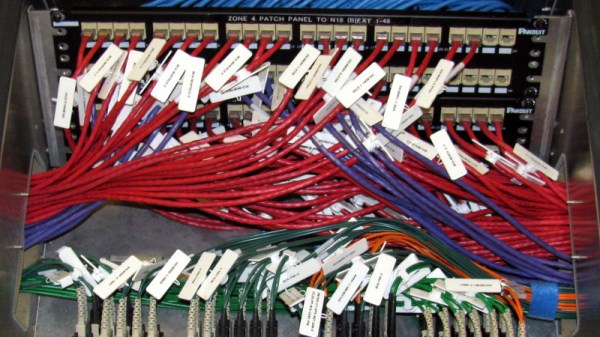
When did you first hear concern expressed about the prospect of explosive growth of the internet resulting in exhaustion of the stock of available IP addresses? About twenty years ago perhaps? All computers directly connected to the internet must have an individual unique address, and the IPv4 scheme used since the 1980s has a 32-bit address space that provides only 4,294,967,296 possibilities. All that growth now means that IPv4 addresses are now in short supply, and this week RIPE, the body which allocates them in Europe, has announced that it no longer has any to allocate. Instead of handing new address blocks they will instead now provide ones that have been relinquished for example by companies that have gone out of business, and parties interested can join a waiting list.

Is the Internet dead then? Hardly, because of course IPv6, the replacement for IPv4, has been with us for decades and has a much larger 128-bit address space. The problem is that there is a huge installed base of IPv4 infrastructure which has always been cited as the reason to delay its adoption, so the vast majority of the internet-connected world has remained with IPv4. Even in an IPv4 world there are opportunities to be more efficient in the use of addresses such as the network address translation or NAT that many private networks use to share one address between many hosts, so it’s not quite curtains for your smart TV or IoT light bulb even though the situation will not get any easier.

The mystery comes in why after so many years we still use IPv4 so much. Your home router and millions like it will pick up an IPv4 address from your broadband provider’s pool, and there seems little reason why it can not instead pick up an IPv6 address and contain a gateway between the two. The same goes for addresses outside the domestic arena, and even in out community we find that IPv6 networks at events are labelled as experimental. Perhaps this news will spur the change, but meanwhile we don’t expect to be using an IPv6 address day-to-day very soon.

We know among Hackaday’s readership there will be people close to the coalface when it comes to IPv6 adoption. As always the comments are open, and we’d like to hear your views.

Header: Robert.Harker [CC BY-SA 3.0].

Add LEDs To Your Stained Glass

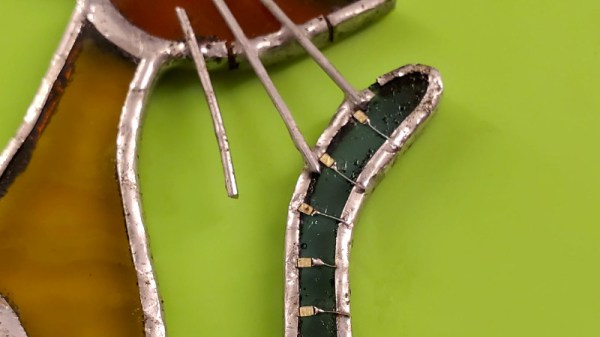
Stained glass is an art form that goes back many centuries, with the churches and cathedrals of Europe boasting many stunning examples from the mediaeval masters of the craft. You do not however have to go to York or Chartres cathedrals to experience stained glass, for it remains a vibrant and creative discipline with many contemporary practitioners. One thing the stained glass of today has in common with that of yesteryear though is that it remains static, being composed of pieces of glass held together by metal strips. This is something that [Frank Zhao] has addressed as he has evolved a technique that allows him to incorporate LEDs into static stained glass, making for a particularly eye-catching effect.

It’s likely that we join many readers in not knowing the intricacies of making a piece of stained glass, so his is a fascinating write-up for its step-by-step run-through. His stained glass cat has pieces of glass edged with copper tape, which he then solders together. Driving the LEDs is not something that should be alien to us, but his method of using the copper-and-solder stained glass joints as conductors for them by creating strategically placed cuts is very effective. The final effect is of a homogeneous piece without the cuts being particularly visible , but with a pleasing array of lights on the cat’s tail. Those of us for whom stained glass production is new have learned something of the technique, and stained glass artists have seen their craft do something completely new.

Stained glass hasn’t featured here too often, the closest we’ve come is this striking fake stained glass Iron-Man themed panel a few years ago.

Bringing The NES Cartridge Into The USB Age

An NES cartridge in its most basic form is a surprisingly simple device, it contains two ROMs hosting all the code and assets of its game, and a Nintendo code chip that provided what was a state-of-the-art consumer DRM system for the 1980s. Decades later its inner workings have been extensively reverse-engineered, and there have been quite a few custom and reprogrammable cartridge designs produced.

This hasn’t stopped [Troy Denton] and [Brad Taylor] making a cartridge of their own though, and the result of their labours is a fully USB reprogrammable cartridge for the Nintendo Entertainment System. It provides nonvolatile storage and is a simpler design than you might expect, using a pair of 1 megabit Flash chips and emulating Nintendo’s DRM with an ATtiny microcontroller.

In itself it’s an interesting enough design, but what makes the write-up stand out is the description of having the boards manufactured by a PCBA service, and their subsequent debugging. A surface-mount micro USB socket that shorted out the USB power required a bit of rework to place Kapton tape beneath it, while another clever patch uses the NES clock signal to provide a read-only line for the memory. It’s also interesting to hear about their manual “crowdfunding” approach which was to ask around if anyone else wanted one so they could bring unit cost down by producing more cartridges.

If you’re interested in the NES DRM system, it’s a subject we’ve touched on in the past.