There’s More To Designing A PCB Business Card Than Meets The Eye

A curious custom that survives from the pre-computer era is that of the business card. If you walk the halls at a trade event you’ll come a way with a stack of these, each bearing the contact details of someone you’ve encountered, and each in a world of social media and online contact destined to languish in some dusty corner of your desk. In the 21st century, when electronic contacts harvested by a mobile phone have the sticking power, how can a piece of card with its roots in a bygone era hope to compete?

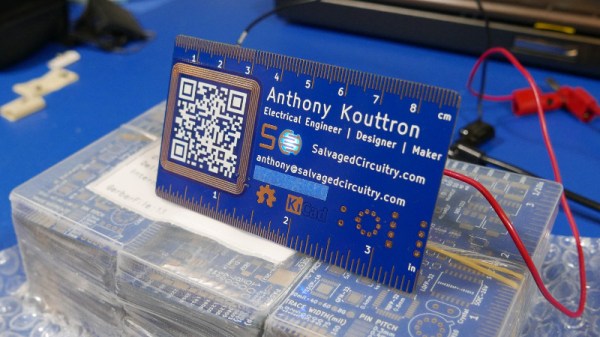
It’s a question [Anthony Kouttron] has addressed in the design of his thoroughly modern business card, and along the way he’s treated us to an interesting narrative on how to make the card both useful beyond mere contact details as well as delivering that electronic contact. The resulting card has an array of  rulers and footprints as an electronic designer’s aid, as well as an NFC antenna and chip that lights an LED and delivers his website address when scanned. There are some small compromises such as PCB pads under the NFC antenna, but as he explains in the video below, they aren’t enough to stop it working. He’s put his work in a GitHub repository, should you wish to do something similar.

There’s a rich vein of business card projects on these pages, but so far surprisingly few are NFC equipped. That didn’t stop someone from making an NFC-enabled card with user interaction though.

Continue reading “There’s More To Designing A PCB Business Card Than Meets The Eye”
Add A Bit Of PCB Badge Glamour To Your Boring ID Badge

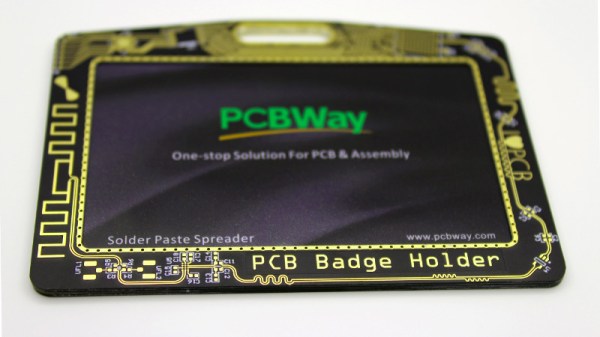
When we talk about badges and printed circuit boards, it is usually in the context of the infinite creativity of the Badgelife scene, our community’s own art form of electronic conference badges. It’s easy to forget when homing in on those badges that there are other types of badge, and thus [Saimon]’s PCB badge holder is an entertaining deviation from our norm. His workplace requires employees to carry their credit-card-sized ID pass with them at all times, but the plastic holder that came with his had broken. So he did what any self-respecting engineer would do, and designed his own holder using PCBs.

It’s a three-way sandwich with identical front and back PCBs featuring a nice design, but the clever bit is the middle PCB. It is U-shaped to slide the card in from the side, but to retain the card it has a couple of springy milled PCB arms each with a small retaining tooth on the end. This is an ingenious solution, with just enough give to bend, but not so much as to break.

The three boards are glued together, it seems his original aim was to reflow solder them but this was not successful. The result is an attractive and functional badge holder, which if Hackaday required us to have a corporate ID you can be sure we’d be eyeing up for ourselves.

UNIX Version 0, Running On A PDP-7, In 2019

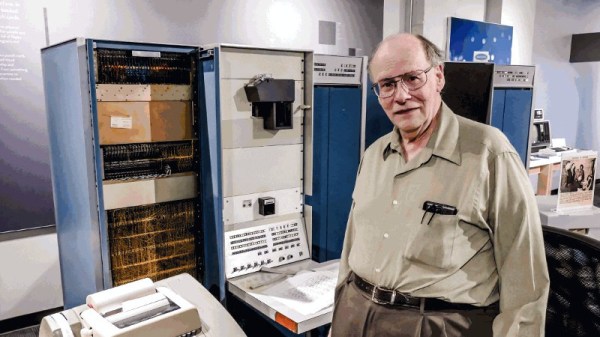
WIth the 50th birthday of the UNIX operating system being in the news of late, there has been a bit of a spotlight shone upon its earliest origins. At the Living Computers museum in Seattle though they’ve gone well beyond a bit of historical inquiry though, because they’ve had UNIX (or should we in this context say unix instead?) version 0 running on a DEC PDP-7 minicomputer. This primordial version on the original hardware is all the more remarkable because unlike its younger siblings very few PDP-7s have survived.

The machine running UNIX version 0 belongs to [Fred Yearian], a former Boeing engineer who bought his machine from the company’s surplus channel at the end of the 1970s. He restored it to working order and it sat in his basement for decades, while the vintage computing world labored under the impression that including the museum’s existing machine only four had survived — of which only one worked. [Fred’s] unexpected appearance with a potentially working fifth machine, therefore, came as something of a surprise.

To load the OS a disk emulator was connected to the machine, and for possibly the first time in many decades a new UNIX version 0 device driver was written to enable it to be used. The first login was the user “dmr”, a homage to UNIX co-creator Dennis M. Ritchie.

Continue reading “UNIX Version 0, Running On A PDP-7, In 2019”

The ESP32, Laid Bare

Most readers will be familiar with the ESP32, Espressif’s dual-core processor with integrated WiFi and Bluetooth. Few of us though will have explored all of its features, including its built-in encryption facilities and secure booting capability. With these, a developer can protect and secure their code, and keep their devices secure.

That sense of security may now be illusory though, thanks to [LimitedResults] who has developed a series of attacks on the chip that compromise its crypto core, secure boot, and flash encryption. This enables both the chance of arbitrary code execution and firmware extraction on locked-down ESP32 devices.

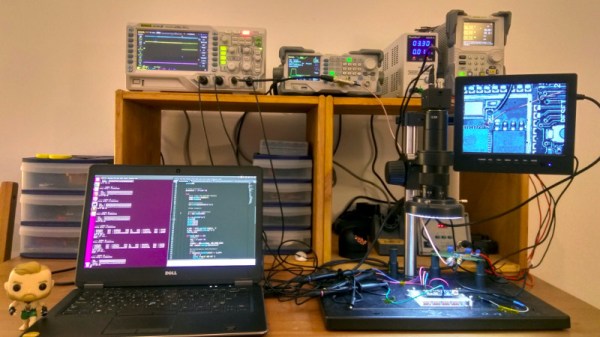
To achieve all this he used a glitching technique on the device’s power supply, inserting a carefully timed glitch in the rail to coincide with a particular instruction being executed. For those of us who are not experts in this technique, he provides a basic primer with a description of his home-made glitcher made using a CMOS switch chip.

It appears that there is no solution to this attack short of new silicon, however, it should be borne in mind that it’s something that depends upon a specialist hacker with a well-equipped bench, and is thus only likely to be a significant headache to manufacturers. But it undermines a key feature of a major line of microcontrollers, and as such it remains a significant piece of work.

The Ultimate Hacker’s Compact 4WD!

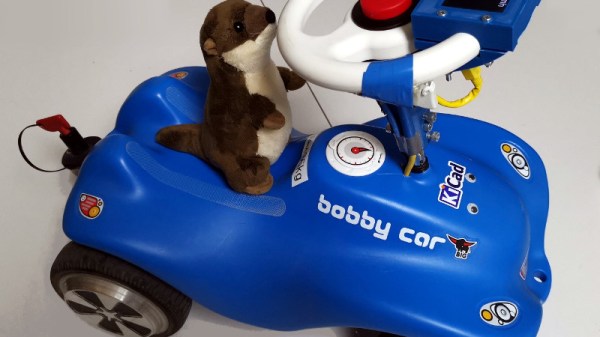
If you’ve spent any time at one of the larger European hacker camps over the last few years you’ll have seen the invasion of little electric vehicles sporting hoverboard motors as an all-in-one propulsion system. German hackers, in particular, have incorporated them into the iconic Bobby Car children’s toy, and ca be seen whizzing around looking slightly incongruous as adults perched on transport designed for five-year-olds.

[Peter Pötzi] has created just such an electric Bobby Car, and his one is particularly well-executed with a 3D-printed steering column extender and four motors for full 4WD rather than the usual two. A steering wheel-mounted display has a neat enclosure, and is fed SPI from the ESP32 that runs the show via an RJ45 patch cable. Many of these builds use hoverboard motor controllers with hacked firmware, but this one instead takes a set of off-the-shelf VESCs. Control comes via a set of Xbox 360 trigger buttons mounted to the underside of the steering wheel.

The result is typically self-contained as are all the Bobby Car builds, with the added bonus of the extra power of four motors rather than two. We’re not so sure that 4WD gives it off-road capabilities though, but having seen these vehicles perform some nifty maneuvers in the past perhaps it’ll lend extra traction on corners.

The Book Of Dreams Brings Back All Your Memories

The retro-facing side of British social media has been abuzz for the last few days with a very neat piece of marketing form the catalogue retailer Argos: they’ve digitised all their catalogues since 1975 and put them online. While this contains a cross-section of over four decades’ styles, fads, and ephemera, it also gives the browser a fascinating look at a host of retrotechnology from a contemporary viewpoint rather than through the rose-tinted glasses of 2019. It may not be a hack, but we guarantee you’ll spend a while browsing it!

Continue reading “The Book Of Dreams Brings Back All Your Memories”

Sow Your Seed Efficiently With This Multi-Way Drop Seeder

Anyone who has ever had to propagate small plants from seed will know that efficiently sowing seed can be a difficult process. Getting a consistent number of seed in each point while achieving any sort of speed is almost impossible, and as a result it becomes a tedious process. If only there were some means by which it could be automated, perhaps a way to do a whole tray at once!

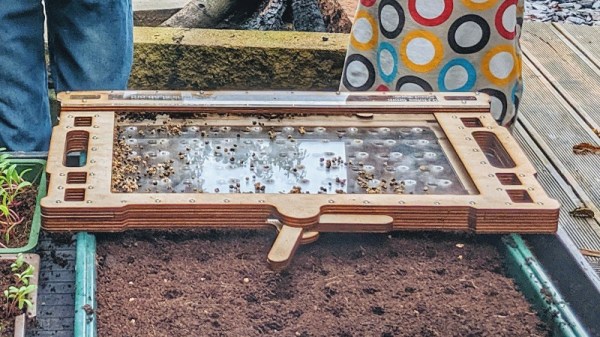
Fortunately [Michael Ratcliffe] is at hand, with his tray-sized drop seeder. It consists of two sheets of acrylic each with a grid of holes, offset from each other by able to be brought into alignment with a lever. Seed is shaken over the upper surface until all the holes contain some, and then the lever is operated allowing it to drop through into the soil below. There is a matching dibber if required to push the required grid of holes in the soil.

It’s a simple yet ingenious gadget that genuinely will make the lives of horticulturalists a lot easier, even though it might not be perfect for all types of seed. He’s created a video which we’ve placed below the break, and should you wish to create the dibber we’ve already covered it.

Continue reading “Sow Your Seed Efficiently With This Multi-Way Drop Seeder”