The Worst Piece Of Test Equipment You’ve Got To Try Hacking

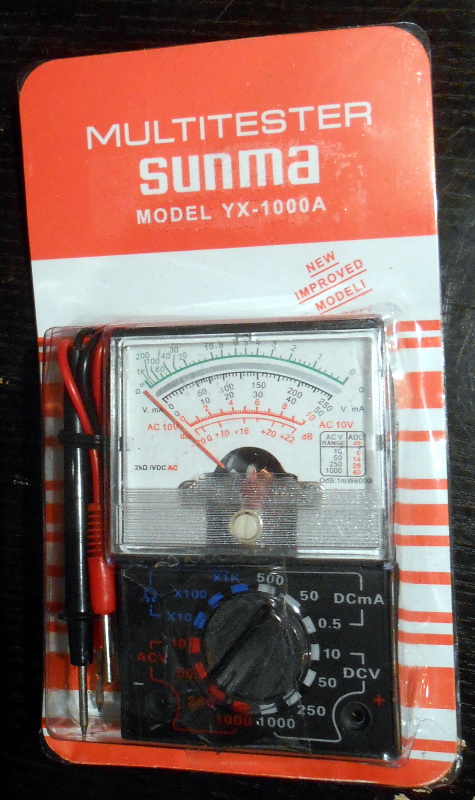
A brand new meter in its blister pack

I have a fascination with the various online vendors of electronics and other manufactured goods from China. Here are listed the latest wonders from Shenzhen or wherever, which you can have for a surprisingly reasonable price, with the mild inconvenience of a three week wait for the postage.

A particular pastime of mine is to look for the bottom end of the market. Once I’ve picked up the items I came to order I’ll trawl around with the search with low price first and see what can be had for a few dollars. Yes, I take a delight in finding absolute trash, because just sometimes that way you can find a diamond in the rough.

So when I was shopping for a multimeter recently I took a quick look to see what the cheapest model from that particular supplier was. For somewhere around £2.50 or just over $3, I could have a little pocket analogue multimeter, the kind of “My first multimeter” that one might have found in the 1980s. They weren’t too bad, I thought, and ordered one for less than a pint of beer in a British pub.

Continue reading “The Worst Piece Of Test Equipment You’ve Got To Try Hacking”

Introducing The Mobility Unlimited Challenge

If you take a walk across the centre of your city, you will find it to be a straightforward experience with few inconveniences. The occasional hold-up at a pedestrian crossing perhaps, or maybe a crowd of people in a busy shopping area. If however you take the same walk in the company of a wheelchair user you are likely to encounter an entirely different experience. The streets become a nightmare of obstacles to avoid and inaccessible areas requiring a detour, and suddenly what had been a pleasurable experience becomes a significant effort. Despite building and planning code updates to improve the situation, and millions of dollars invested in ramps, lifts, and other improvements, there remain so many problems to be addressed. Meanwhile legislators and the general public imagine that something has been done, the accessibility box has been ticked, and they can move on to the next thing that captures their attention.

The paralympian athlete [Tatyana McFadden] is an ambassador for the Toyota Mobility Foundation’s Mobility Unlimited Challenge, a global competition with the aim of improving mobility for people with disabilities. She’s written a piece introducing the challenge from her informed point of view as a wheelchair user, and makes the point that the basic design of a chair has not significantly changed since the 1930s. Her sentence: “There may be more hype around Bitcoin, but innovators could have far more impact if they turned their attention to how they can make the freedom to move available to all.” is one to make those of us with an interest in technology stop and think. To introduce the challenge they’ve released a glossy video, and we’ve placed it below the break.

As part of this year’s Hackaday Prize, we had an Assistive Technologies section that attracted some fantastic entries. That demonstrates that our community has plenty of people with the required skills, experience, and ideas to make a difference, and we hope that some of them might be among the entries for the Mobility Unlimited competition. If it excites your interest, we’d like to urge you to give it a second look.

A word of warning though – take care to avoid the Engineer Saviour Trap.

Continue reading “Introducing The Mobility Unlimited Challenge”

Protect Your TS100 Soldering Iron

The TS100 is a compact temperature-controlled soldering iron that’s long on features without too eye-watering a price. One thing it lacks as shipped though is anything to protect it from the thumps and bumps of everyday life in a toolbox, save for its elegant cardboard-and-foam retail box which requires iron and element/bit to be separated.

[Jeremy S. Cook] has a TS100, and decided to do something about it with a bit of work that may be quite simple but should be something that all TS100 owners take a look at. He made a very tough carrying container for it from a length of PVC pipe lined with the foam from the iron’s retail package. His short video which we’ve placed below the break takes us through the build, which bits of the packaging foam to cut, and uses a pair of PVC end caps to terminate the container. It’s not high-tech by any means, but enough of you will have TS100 irons to appreciate it.

You can read our review of the TS100 if you are interested, or you can marvel at the additions people have done to its software. Tetris, for example, or a working digital oscilloscope. Meanwhile [Jeremy] is an old friend of Hackaday, whose many projects include this recent unholy hybrid of fidget spinner and multirotor.

Continue reading “Protect Your TS100 Soldering Iron”

Is Your Wireless Charger Working?

It’s that time of year at which the Christmas lights are coming out of storage, isn’t it. Some modern seasonal rituals: untangling half a mile of fairy lights, and replacing a pile of CR2032 cells in LED candles.

[RobBest] had a solution to the latter, owning a set of nifty rechargeable LED candles that came with their own wireless charger. Sadly the charger wasn’t working quite as intended, as the indicator light to show when it had finished its cycle was always on. How could he indicate that the induction system was in operation?

His answer was to take a non-functioning candle and strip it down to expose its induction pick-up coil. He could have simply hooked it up to an LED for a quick result, but since the device in question was a candle it made sense to give it a candle effect. A PIC microcontroller was therefore pressed into service to drive the LED with its PWM output, giving a pleasing flickering effect.

You don’t have to own a set of electronic candles to have a go at wireless charging. Instead you could try a trip to IKEA.

Retrotechtacular: How To Repair A Steam Locomotive

Steam locomotives, as a technological product of the 19th century, are not what you would imagine as fragile machines. The engineering involved is not inconsequential, there is little about them that is in any way flimsy. They need to be made in this way, because the huge energy transfer required to move a typical train would destroy lesser construction. It would however be foolish to imagine a locomotive as indestructible, placing that kind of constant strain on even the heaviest of engineering is likely to cause wear, or component failure.

A typical railway company in the steam age would therefore maintain a repair facility in which locomotives would be overhauled on a regular basis, and we are lucky enough to have a 1930s film of one for you today courtesy of the British London Midland and Scottish railway. In it we follow one locomotive from first inspection through complete dismantling, lifting of the frame from the wheels, detaching of the boiler, inspection of parts, replacement, and repair, to final reassembly.

We see steps in detail such as the set-up of a steam engine’s valve gear, and it is impressed upon us how much the factory runs on a tight time schedule. Each activity fits within its own time window, and like a modern car factory all the parts are brought to the locomotive at their allotted times. When the completed locomotive is ready to leave the factory it is taken to the paint shop to emerge almost as a new machine, ready for what seems like a short service life for a locomotive, a mere 130 thousand miles.

The video, which we’ve placed below the break, is a fascinating glimpse into the world of a steam locomotive servicing facility. Most Hackaday readers will never strip down a locomotive, but that does not stop many of them from having some interest in the process. Indeed, keen viewers may wish to compare this film with “A Study in Steel“, another film from the LMS railway showing the construction of a locomotive.

LMS Jubilee class number 5605, “Cyprus”, the featured locomotive in this film, was built in 1935, and eventually scrapped in 1964 as part of the phasing out of steam traction on British railways.

Continue reading “Retrotechtacular: How To Repair A Steam Locomotive”

Learn About Blockchains By Building One

What do we curious Hackaday scribes do when we want to learn about something? First port of call: search the web.

When that something is blockchain technology and we’re looking for an explanation that expands our cursory overview into a more fundamental understanding of the basic principles, there is a problem. It seems that to most people blockchains equate to one thing: cryptocurrencies, and since cryptocurrencies mean MONEY, they then descend into a cultish frenzy surrounded by a little cloud of flying dollar signs. Finding [Daniel van Flymen]’s explanation of the fundamentals of a blockchain in terms of the creation of a simple example chain using Python was thus a breath of fresh air, and provided the required education. Even if he does start the piece by assuming that the reader is yet another cryptocurrency wonk.

We start by creating a simple class to hold all the Python functions, then we are shown a single block. In his example it’s a JSON object, and it contains the payload in the form of a transaction record along with the required proof-of-work and hash. We’re then taken through a very simple proof-of-work algorithm, before being shown how the whole can be implemented as very simple endpoints.

You are not going to launch a cryptocurrency using this code, and indeed that wasn’t our purpose in seeking it out. But if you are curious about the mechanics of a blockchain and are equally tired of evangelists of The Blockchain who claim it will cure all ills but can’t explain it in layman’s terms, then this relatively simple example is for you.

The wrong way to build a blockchain image: Jenny List. #FarmLife.

Teardown Of A Cheap Glue Gun

A hot glue gun is one of those standard tools of the hardware hacker’s bench, called upon to provide adhesion between an astonishing range of materials, and to provide a handy filler and strain relief in the form of blobs of polymer glue. We’ve all got one, but how many of us have taken a look inside it?

[Andrew Lorimer] bought a super-cheap eBay glue gun, and subjected it to a teardown. As you might expect, he found it to be a pretty simple device with only a trigger mechanism and a dumb heating element, but his write-up is of passing interest because he’s characterised its heating element. It has a positive temperature coefficient, which means that its resistance increases from around 2.5 kΩ at room temperature to about 7 kΩ at its 150 ºC operating temperature. This limits the current, and provides a very simple thermostat action.

The build quality is surprisingly good for such a cheap appliance, and he notes a surfeit of screws holding its shell together. But the quality of the insulation and strain relief leaves a lot to be desired, and he wonders whether it truly qualifies for its double-insulated logo. The LED pilot light is simply fed from the 240 V mains supply through a 250 kΩ resistor which he replaces with a 12 kΩ component for a brighter result.

We cover plenty of teardowns here at Hackaday. Often they are of extremely expensive and complex devices, but sometimes they are of much simpler subjects.