Hackaday Prize Entry: Hacker Calculus

Mathematics, as it is taught in schools, sometimes falls short in its mission to educate the pupils. This is the view of [Joan Horvath] and [Rich Cameron], particularly with respect to the teaching of calculus, which they feel has become a purely algebraic discipline that leaves many students in the cold when it comes to understanding the concepts behind it.

Their Hacker Calculus project aims to address this, by returning to [Isaac Newton]’s 1687 seminal work on the matter, Philosophiae Naturalis Principia Mathematica. They were struck by how much the Principia was a work of geometry rather than algebra, and they are seeking to return to [Newton]’s principles in a bid to make the subject more accessible to students left behind when it comes to derivatives and integrals. They intend to refine the geometric approach to create a series of practical items to explain the concepts, both through 3D printed items and through electronics.

We can see that this is an approach that has considerable merit, given that most Hackaday readers will have at some time or other sat through a maths lesson and come away wondering what on earth the teacher was talking about and having been baffled by further attempts to explain it through impenetrable maths-speak. If you were the kid who “got” calculus when the relationship between speed and acceleration – another thing we have [Newton] to thank for describing – was explained in your physics lessons, then you will probably understand.

The pair have some Hackaday Prize history, you may remember them from such previous entries as their 3D prints for the visually impaired project from last year.


Hackaday Prize Entry: High Speed Sampling For The Raspberry Pi

The Raspberry Pi has become a firm favorite in our community for its array of GPIOs and other interfaces, as well as its affordable computing power. Unfortunately though despite those many pins, there is a glaring omission in its interfacing capabilities. It lacks an analogue-to-digital converter, so analog inputs have to rely on an expansion card either on those GPIOs or through the USB port.

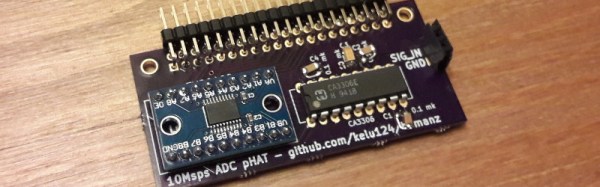
Most people remain content with simple ADCs such as Microchip’s MCP3008, or perhaps a USB sound card for low frequency moving targets. But not [Kelu124], he’s set his sights on something much faster. The original Pi is reputed to be capable of handling a 10Msamples/s ADC, so he thinks its faster successors should be able to work much faster. To that end, he’s created an ADC pHAT which he thinks should be good for twice that figure.

The choice of silicon is a CA3306E, a 6-bit device that’s rated at 15Msamples/S. It’s something of a dated device as is shown by its DIP package, and a quick look through major suppliers shows it to be no longer available. Happily though, when you look at his GitHub repo it emerges that he’s also producing a board based on the ADC08200, so his software is targetable at other chips.

Whether or not you need your Pi to serve as video digitizer or high-speed instrument, it’s useful and interesting to take a look at a board like this one in action. We often don’t use the raw power of our single board computers, and this project proves that should we ever need to, we can.

If ADCs interest you, take a look at [Bil Herd]’s series on delta-sigma ADCs.

Thanks [Fustini] for the tip.

Afroman Makes A UHF Oscillator From A Potato

If you have ever worked with simple logic gates, there is a good chance that at some point you will have built a ring oscillator from a chain of inverters. With the addition of a resistor and a capacitor, you can easily make a square wave oscillator up into the megahertz range with standard logic chips.

[Afroman] received some rather special logic chips, from an unexpectedly named company, Potato Semiconductor. They specialise in making versions of common 74 series logic that smash the usual 100+ MHz barrier of the faster conventional 74 series chips, and extend their bandwidth up to over 1 GHz. Using one of their 74GU04 parts, he made a ring oscillator relying only on the stray capacitances of its gate inputs for its timing, and while he didn’t manage to achieve a GHz he did measure it at about 373 MHz. He took a look with a spectrum analyser, and as you might expect from a logic circuit found strong harmonics in the GHz range.

Now normally there would be no news in someone making a ring oscillator with a 7404. It really wouldn’t be a hack with a run-of-the-mill 74LS or 74HC part. But this Potato part is sufficiently unusual that it deserves a bit of attention in its own right. After all, we’re not used to logic chips that can work at those kinds of frequencies.

We’ve put his video below the break. Meanwhile, the Potato Semiconductor website makes for an interesting browse, and proves that there is plenty of life left in the venerable 74 series.

Continue reading “Afroman Makes A UHF Oscillator From A Potato”

An Alien-Themed… Cuckoo Clock?

If you are a follower of the sci-fi horror film genre then it is likely that you will be familiar with the Alien series of movies. Images of Sigourney Weaver bearing a significant amount of firepower, or of John Hurt’s chest being rent asunder by an emerging creature will be brought to mind, it’s one of those franchises which seems to have entered the public consciousness.

With the release of another movie in the series fast approaching, [Keith Elliott] resolved to mark the occasion with his own Alien themed tribute. What, you might ponder, could he choose? Surely there must be plenty of iconic moments in the films that could provide fertile ground for a tribute project!

So  presumably after a significant period of reflection, he’s built an Alien themed cuckoo clock. Something of an off-the-wall choice, you might say, but he persevered with it. The main body of the clock is the torso and head of an unfortunate human crew member, the face of the clock is formed by an alien facehugger on his face, and the cuckoo is not a bird in the manner of the Alpine originals, but a chest-bursting alien that issues forth from the torso.

There is a video, which we’ve posted below. Perhaps the chestburster action needs a little more spontaneity and to be a little less rhythmic, but we’ll leave it to you to decide whether it is inspired or merely kitsch.

Continue reading “An Alien-Themed… Cuckoo Clock?”

A Home Made Air Pump From PVC Pipe

If you need a supply of low pressure air – let’s say enough pressure to ensure a constant supply but not enough to describe as “Compressed air” with a straight face – what do you do? Many people will reach for an aquarium pump, after all that represents a readily available and relatively inexpensive source of bubbles.

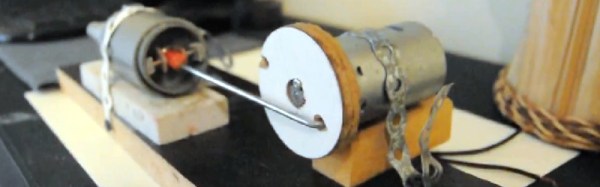
But not [truebassB], instead he built his own air pump from first principles (YouTube, embedded below) using PVC pipe. It’s a straightforward design in which the cylinder is a length of pipe with a disc of flat PVC glued to its end, and the piston is fabricated from a short piece of the same tube with a section cut out to reduce its diameter. An adequate seal is achieved using a piece of rubber cut from an inner tube, and the gudgeon pin is cut from a piece of wire. The connecting rod is another longer piece of wire, and the crank is a wooden disc with an offset hole. Power comes from a DC motor taken from a dead power tool. A couple of ball check valves are used for air input and output.

The resulting pump isn’t the prettiest of pumps, and it could probably do with a bit of balancing as it rattles somewhat. But it’s a pump, and it obviously cost next-to-nothing, so that in our eyes makes it a neat build. He’s posted a video of the build which we’ve placed below the break.

Continue reading “A Home Made Air Pump From PVC Pipe”

A Modern Day PDP-11 Front End

Hands up if you feel your spiritual home is in front of a terminal with a “DIGITAL” logo on it.  It’s a name that has long ago been subsumed into first Compaq and then by extension HP, but it’s one with a lot of history when it comes to computing.

From the start of the electronic computing age, there were the computers we’d probably now describe as mainframes. Big computers that cost the GDP of a small country, filled an entire floor of a building, and could only be found in government departments, universities, and large companies. By the 1960s, the technologies existed to build computers that broke this mould, could be bought within the budget of a smaller organisation, and for which you didn’t need a huge air-conditioned basement to house. These so-called minicomputers were the great revolution of that era because they bought the fruits of computing into everyday business, and probably the most successful of the companies that produced them was the Maynard, Massachusetts-based Digital Equipment Corporation, or DEC.

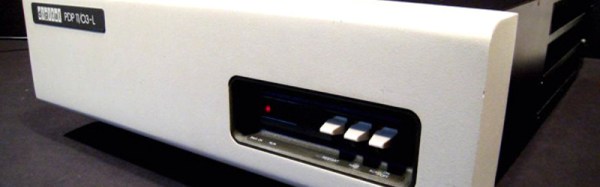
DEC produced a succession of minicomputers in their PDP line, of which the most successful was their PDP-11 series. These were 16-bit minicomputers that remained in their product line from their launch in 1970 through to the early 1990s, and were available in a succession of configurations and physical form factors. The famous view of a PDP-11 is of a set of floor-to-ceiling racks, but there were also standalone terminal models, and desktop models. One of these, a PDP-11/03 from 1975, has come into the hands of [Joerg], and he’s used it to craft his LSIbox, the PDP11/03 card frame packaged with a BeagleBone for access via a modern-day interface. It’s a build in the vein of modern tube audio amplifiers that feature the retro hardware on the top of their cases, the card frame is exposed as a feature on top of a white case that is featureless except for a genuine PDP-11/03 front panel.

You might ask why anyone would do this in order to run PDP-11 software when the BeagleBone could almost certainly emulate the vintage hardware much faster than the real thing. But to take that view is to miss the point; the PDP-11 series are a seminal part of computing history, and to have genuine PDP-11 hardware on your desk is quite an achievement.

We’ve shown you a few PDP-11 projects in the past. There was this minimalist PDP-11 implementation using one of the later integrated PDP-11 processors, and we’ve seen a faithful reproduction of an earlier PDP-11 front panel powered by a Raspberry Pi.

Hackaday Prize Entry: Brightenmacher

We have all at some point have made a flashlight. It used to be a staple of childhood electronics, the screw-in bulb in a holder, and a cycle lamp battery. If you were a particularly accomplished youthful hacker you might even have fitted a proper switch, otherwise, you probably made do with a bent paperclip and a drawing pin.

So you might think that flashlights offer no challenges, after all, how many ways can you connect a bulb or an LED to a battery? [Peter Fröhlich] though has a project that should put those thoughts out of your mind. It uses a power LED driven by a TI TPS61165 boost driver, with an ATTiny44 microcontroller providing control, battery sensing, and button interface. The result is a dimmable flashlight in a 3D printed case housing both control circuitry and a single 18650 cell which he sourced from a dead laptop. Suddenly that bent paperclip doesn’t cut it anymore.

The result is a flashlight that is the equal of any commercial offering, and quite possibly better than most of them. You can build one yourself, given that he’s published the physical files necessary, but probably because this is a work in progress there are as yet no software files.

We’ve featured a lot of flashlights over the years, but it’s fair to say they usually tend towards the more powerful. Back in 2015 we published a round-up of flashlight projects if it’s a subject that captures your interest.