SST Is A Very Tidy ESP8266 Smart Thermostat

The smart thermostat has become in a way the public face of the Internet of Things. It’s a demonstration that technological uptake by the general public is driven not by how clever the technology is, but by how much use they can see in it. A fridge that offers your recipes or orders more eggs may be a very neat idea, but at street level a device allowing you to turn your heating on at home before you leave work is much cooler. Products like Nest or Hive have started to become part of normal suburban life.

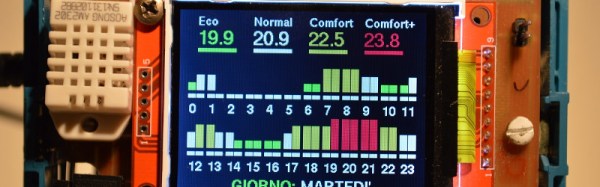
There is no reason though for an IoT thermostat to be a commercial product like the two mentioned. Our subject today demonstrates this; SST is a Wi-Fi smart thermostat using an ESP8266 that can be controlled by an app, thanks to its use of the open-source Souliss IoT Framework.

The build is very well finished, with PCBs, colour display and other components in a neat 3D-printed box. It’s a project that you could put in front of an end-user, it’s finished to such a high standard. Physical entity files are available from the hackaday.io page linked above, while its firmware is available in a GitHub repository. THere is a video showing some of the device’s capabilities, which we’ve put below the break.

Continue reading “SST Is A Very Tidy ESP8266 Smart Thermostat”
Move A Robotic Hand With Your Nerve Impulses

Many of us will have seen robotics or prosthetics operated by the electrical impulses detected from a person’s nerves, or their brain. In one form or another they are a staple of both mass-market technology news coverage and science fiction.

The point the TV journalists and the sci-fi authors fail to address though is this: how does it work? On a simple level they might say that the signal from an individual nerve is picked up just as though it were a wire in a loom, and sent to the prosthetic. But that’s a for-the-children explanation which is rather evidently not possible with a few electrodes on the skin. How do they really do it?

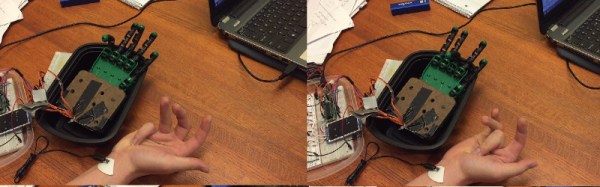
A project from [Bruce Land]’s Cornell University students [Michael Haidar], [Jason Hwang], and [Srikrishnaa Vadivel] seeks to answer that question. They’ve built an interface that allows them to control a robotic hand using signals gathered from electrodes placed on their forearms. And their write-up is a fascinating read, for within that project lie a multitude of challenges, of which the hand itself is only a minor one that they solved with an off-the-shelf kit.

The interface itself had to solve the problem of picking up the extremely weak nerve impulses while simultaneously avoiding interference from mains hum and fluorescent lights. They go into detail about their filter design, and their use of isolated power supplies to reduce this noise as much as possible.

Even with the perfect interface though they still have to train their software to identify different finger movements. Plotting the readings from their two electrodes as axes of a graph, they were able to map graph regions corresponding to individual muscles. Finally, the answer that displaces the for-the-children explanation.

There are several videos linked from their write-up, but the one we’re leaving you with below is a test performed in a low-noise environment. They found their lab had so much noise that they couldn’t reliably demonstrate all fingers moving, and we think it would be unfair to show you anything but their most successful demo. But it’s also worth remembering how hard it was to get there.

Continue reading “Move A Robotic Hand With Your Nerve Impulses”

Reflow Soldering At Another Level

We’re used to reflow soldering of our PCBs at the hacker level, for quite a few years people have been reflowing with toaster ovens, skillets, and similar pieces of domestic equipment and equipping them with temperature controllers and timers. We take one or two boards, screen print a layer of solder paste on the pads by using a stencil, and place our surface-mount components with a pair of tweezers before putting them in the oven. It’s a process that requires  care and attention, but it’s fairly straightforward once mastered and we can create small runs of high quality boards.

But what about the same process at a professional level, what do you do when your board isn’t a matchbox-sized panel from OSH Park with less than 50 or so parts but a densely-packed multilayer board  about the size of a small tablet computer and with many hundreds of parts? In theory the same process of screen print and pick and place applies, but in practice to achieve a succesful result a lot more care and planning has to go into the process.

This is being written the morning after a marathon session encompassing all of the working day and half of the night. I was hand-stuffing a row of large high-density boards with components ranging from 0402 passives to large QFPs and everything else in between. I can’t describe the board in question because it is a commercially sensitive prototype for the industrial customer of the friend I was putting in the day’s work for, but it’s worth going through the minutiae of successfully assembling a small batch of prototypes at this level. Apologies then, any pictures will be rather generic.

Continue reading “Reflow Soldering At Another Level”

Little Bobby Tables Just Registered A Company…

Sometimes along comes a tech story that diverges from our usual hardware subject matter yet which just begs to be shared with you because we think you will find it interesting and entertaining.

XKCD 327, Exploits of a Mom (CC BY-NC 2.5).

You will no doubt be familiar with the XKCD cartoon number 327, entitled “Exploits of a Mom”, but familiarly referred to as “[Bobby Tables]”. In it a teacher is ringing the mother of little [Robert’); DROP TABLE Students; –], whose name has caused the loss of a year’s student records due to a badly sanitized database input. We’ve all raised a chuckle at it, and the joke has appeared in other places such as an improbably long car license plate designed to erase speeding tickets.

It's nice to see that Companies House sanitise their database inputs.
It’s nice to see that Companies House sanitise their database inputs.

Today we have a new twist on the Bobby Tables gag, for someone has registered a British company with the name  “; DROP TABLE “COMPANIES”;– LTD“. Amusingly the people at Companies House have allowed the registration to proceed, so either they get the joke too or they are unaware of the nuances of a basic SQL exploit. It’s likely that if this name leaves Her Majesty’s civil servants with egg on their faces it’ll be swiftly withdrawn, so if that turns out to be the case then at least we’ve preserved it with a screenshot.

Of course, the chances of such a simple and well-known exploit having any effect is minimal. There will always be poor software out there somewhere  that contains badly sanitized inputs, but we would hope that a vulnerability more suited to 1996 would be vanishingly rare in 2016.

If by some chance you haven’t encountered it before we’d recommend you read about database input sanitization, someday it may save you from an embarrassing bit of code. Meanwhile we salute the owner and creator of this new company for giving us a laugh, and wish them every success in their venture.

Fail Of The Week: How I Killed The HiPot Tester

Have you ever wired up a piece of test equipment to a circuit or piece of equipment on your bench, only to have the dreaded magic smoke emerge when you apply power? [Steaky] did, and unfortunately for him the smoke was coming not from his circuit being tested but from a £2300 Clare H101 HiPot tester. His write-up details his search for the culprit, then looks at how the manufacturer might have protected the instrument.

[Steaky]’s employer uses the HiPot tester to check that adjacent circuits are adequately isolated from each other. A high voltage is put between the two circuits, and the leakage current between them is measured. A variety of tests are conducted on the same piece of equipment, and the task in hand was to produce a new version of a switch box with software control to swap between the different tests.

This particular instrument has a guard circuit, a pair of contacts that have to be closed before it will proceed. So the switch box incorporated a relay to close them, and wiring was made to connect to the guard socket. At first it was thought that the circuit might run at mains voltage, but when it was discovered to be only 5V the decision was made to use a 3.5mm jack on the switch box. Inadvertently this was left with its sleeve earthed, which had the effect of shorting out a DC to DC converter in the HiPot tester and releasing the smoke. Fortunately then the converter could be replaced and the machine brought back to life, but it left questions about the design of the internal circuit. What was in effect a logic level sense line was in fact connected to a low current power supply, and even the most rudimentary of protection circuitry could have saved the day.

We all stand warned to be vigilant for this kind of problem, and kudos to [Steaky] for both owning up to this particular fail and writing such a good analysis of it.

Our Fail Of The Week series has plenty to entertain the reader who is not of a nervous disposition. This isn’t the first fail to feature a suspect bit of connector wiring, not an unexpected short or even some magic smoke.

In Defense Of The Electric Chainsaw

Here at Hackaday we are a diverse bunch, we all bring our own experience to the task of bringing you the best of the hardware scene. Our differing backgrounds were recently highlighted by a piece from my colleague [Dan] in which he covered the teardown of a cordless electric chainsaw.

It was his line “Now, we’d normally shy away from any electric chainsaw, especially a cordless saw, and doubly so a Harbor Freight special“. that caught my eye. I’m with him on cordless tools which I see as a cynical ploy from manufacturers to ensure 5-yearly replacements, and I agree that cheap tools are a false economy. But electric chainsaws? Here on this small farm, they’re the saw of choice and here’s why.

Continue reading “In Defense Of The Electric Chainsaw”

OpenAg Is A Personal Food Computer

When a device that calls itself a personal food computer lands in your timeline, what image springs to mind? A cloud-connected diet aid perhaps, advertised on TV infomercials by improbably fit-looking Californian ladies crediting all their health to a palm-sized unit that can be yours for only 199 dollars. Fortunately that proved not to be the case, and on further reading our timeline story was revealed to be about a computerized farming device.

The OpenAg Food Computer from the MIT Media Lab Open Agriculture Initiative bills itself as:

“a controlled-environment agriculture technology platform that uses robotic systems to control and monitor climate, energy, and plant growth inside of a specialized growing chamber”

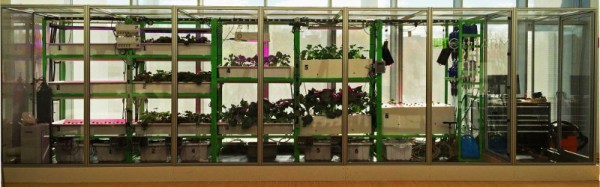
It takes the form of a tabletop enclosure in which so-called climate recipes to replicate different conditions for plant growth can be tested. It’s probably fair to say that in this most basic form it is more of an educational device than one for full-scale food production, though they are applying the same technologies at a much greater scale. Their so-called “Food servers” are banks of OpenAg environments in freight containers, which definitely could be used to provide viable quantities of produce.

The good news is that the project is open source, and their latest story is that they have released version 2.0(alpha) of the device. If you are interested, you can read the documentation, and find all the resources you need to build one on their GitHub repository. They page linked above has a video that’s very much of the slick PR variety rather than the nuts-and-bolts, so we’ve sought out their build video for you below the break instead. Continue reading “OpenAg Is A Personal Food Computer”