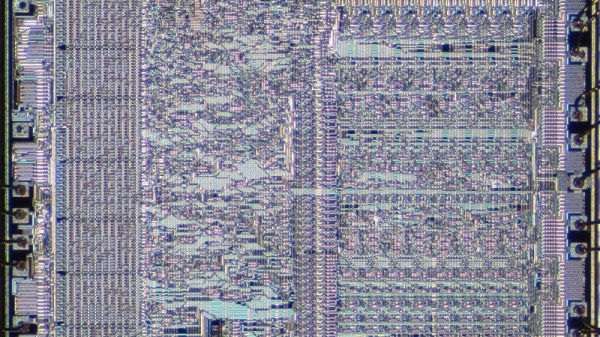
The masks with which the Intel 4004 was fabricated

Supersize Your Intel 4004 By Over 10 Times

A PCB covered in discrete transistors with light shining through it
This is quite a bit bigger than the original 12mm² die.

The Intel 4004 was among the first microprocessors and one of the first to use the MOS silicon-gate technology. In the decades long race to build bigger CPUs, it’s been mostly forgotten. Forgotten that is, until [Klaus Scheffler] supersized it over ten-fold!

The project took about 2 years to complete and re-creates it faithfully – all 2,300 transistors included – enough to run software written for the Intel 4004. But the idea for this project isn’t unique and dates all the way back to 2000, so what gives? Turning a bunch of masks for silicon fabrication into a schematic is actually harder than it seems! [Tim McNerney] originally came up with the idea to make a giant 4004 for its “35th anniversary”. [Tim] managed to convince Intel to give him schematics and other drawings and would in return make an exhibit for Intel’s museum. With the schematic straight from [Federico Faggin], software analysis tools from [Lajos Kintli] and [Klaus Scheffler] to actually build the thing, they did what [Federico] did in one year without CAD, but in two with modern tools.

The full story by [Tim] is a lot longer and it’s definitely worth a read.

Increase Your Blinkenlights With This Silicon Wafer Necklace

Necklaces aren’t often very high-tech, mostly because of the abuse they have to go through being worn. This was obviously a problem that needed solving, so [Matt Venn] decided to change that by making a necklace out of ASICs just in time for Supercon.

Although this isn’t the first time [Matt] made such a necklace, he though his previous one was “too hip-hop” and not enough “15 million dollar Nikon Lithography Stepper”. Obviously, this means designing the whole chain, art included, from scratch with the blinkenlights to match. Together with [Pat Deegan] and [Adam Zeloof], the team created a beautiful technopunk necklace with art on every chain link and of course a real silicon wafer with a RISC-V tapeout from 2022 on it.

With [Adam] doing modeling for the chain links, and [Pat] and [Matt] designing the electronics required for the mandatory blinkenlights, and some last-minute soldering and assembling the project was finished just in time for Supercon, where it fit right in with all the other blinkenlights. It even runs on one of the RISC-V cores from the same tapeout as the central wafer!

A Mysterious 6502 Apple 2 Simulator

Nice, visual simulators of CPUs such as the 6502 are usually made much later and with more modern tooling than what they simulate. But what if that wasn’t the case? What if a simulator runs on the very hardware it’s simulating?

This is what [Tea Leaves] stumbled upon when he found a mysterious disk with only “APL6502.SIM” on it. [Tea Leaves] demonstrates the simulator with a basic 6502 assembly program, revealing an animated, beautiful Apple 2 simulator that actually runs on the Apple 2! The simulator shows all the major components of a 6502 and actually animates the complete data flow of an instruction.

But why is this mysterious? It’s mysterious because – a “hello” program aside – it’s the only thing on the disk! Not so much as a single clue as to where it came from. [Tea Leaves] finds out where it comes from, including incorrectly copied disk images and a revelation at the end.

Video after the break.
Continue reading “A Mysterious 6502 Apple 2 Simulator”

An Intel 8008 On A Single-Board Computer

The last time we covered [Dr. Scott M. Baker], he made his Heathkit H8 run on a considerably older processor than it was made for. This time, apparently still not satisfied with the number of 8008 computers, he made an Intel 8008-based single-board computer.

The Mini-08, as [Scott] calls it, is based on his previous endeavour of downgrading the Heathkit H8. Its “CPU board” has even more memory than its predecessor at 128KiB RAM and ROM and an 8251 UART connected to a DB25 serial port. The entirely optional “display board” adds to that 10 digits of 7-segment displays, a backlit Cherry MX Blue hexadecimal keypad, a real-time clock and even a 4-voice sound generator!

[Scott] has also done an impressive job with the software, porting BASIC, FORTH, a clone of Star Trek and some utilities to his Mini-08. He demonstrates both BASIC and FORTH by printing “SCOTT WAS HERE” in a for loop and finishes off by showing how to use some of the display board with FORTH.

Like last time, he published design files and resources for you to enjoy. Overall, an interesting spin on the retro single-board computer concept.

Video after the break.

Continue reading “An Intel 8008 On A Single-Board Computer”

Real NES Plays Frame-Perfect For You On Twitch

Have you ever wanted to be the best Super Mario Brothers speedrunner, but you just couldn’t do the frame-perfect inputs? Fear not, because [Gregory Strike] is here to save the day with his automatic NES controller!

In his previous video, [Greg] already made an automatic controller that plays a sequence of inputs at the perfect time, but it still failed some of the frame-perfect tricks. So what gives? Deviation in the timing of the NES itself gives, as he shows how the NES doesn’t sample inputs at exactly the same time every frame. To account for this, he used the latch signal, which starts the controller reading process as a time reference, and replaced his digital “mixtape” with a more time-flexible Arduino. After the modification, he shows it pulling off frame-perfect inputs every time he plays Super Mario Brothers.

But if you have a controller that can do frame-perfect inputs and it can be connected to a computer, you can connect the controller to the internet! That’s right, [Greg] created a Twitch bot that tells the Arduino exactly what inputs to send, which then relays it to the NES. It accepts simple sequences of inputs via chat, and you can try it out right now on [Greg]’s Twitch stream.

This project shows promising results, and we think it’s possible to do much more with its internet connection. We’re certainly looking forward to what [Greg] decides to make next.

Video after the break.
Continue reading “Real NES Plays Frame-Perfect For You On Twitch”

Game Graphics: Racing The Beam

Have you ever wondered how the graphics in your favorite video games worked? This is the start of a series on game graphics, and what better place to start than how exactly the original Mario Bros. got those glorious pixely pixels onto the screen. Buckle in, because we’re “racing the beam” with systems like the NES, Commodore 64, and many other classics from the 1980s.

And to understand the 1980’s, it’s important to understand how the televisions of the time worked. Cathode Ray Tube (CRT) televisions work by precisely bombarding a phosphor layer with electrons, which excites the phosphor, which then releases visible light. The beam scans from left to right then top to bottom, giving each pixel a small fraction of a second of time. All of this effectively means that pixel data needs be sent at the same time as when the pixels are being lit up, which is why this type of graphics is often dubbed “racing the beam”.

Continue reading “Game Graphics: Racing The Beam”

A 6502-based single-board computer with a ROMulator attached

Debug Your Senile Computers With The ROMulator

Some of you may have heard of the ROMulator, a device that can emulate RAM and ROM on 6502-based computers. But how does it work? How do you use it? What computers is it compatible with? [Jeff Tranter] covers that and more in his review of the ROMulator 6502.

The ROMulator is an FPGA-based board that slots between the 6502 and its socket on whatever computer it came from. It can emulate, but not intercept, accesses to RAM and ROM, which can be used to e.g. replace a ROM that you’re swapping very often or expand the RAM available to the CPU.

In his review, [Jeff] shows the ROMulator in action many computers, notably his custom 6502-based computer, a replica of an Apple 1 and two different replicas of the SUPERBOARD 2. He shows how the ROMulator can be configured, tested, used to debug the computers and even expand their RAM. Overall, [Jeff] thinks it’s a useful 6502 debugger that would have saved him lots of time in the past and we definitely agree.

Continue reading “Debug Your Senile Computers With The ROMulator”