Process Characterization On The Cheap With A Custom Test Rig

Testing is a key part of any product development cycle. Done right, it turns up unknown bugs and problems, and allows for them to be fixed prior to shipment. However, it can be a costly and time-consuming process. The [Bay Libre] team needed to do some work on power management, but the hardware required was just a little on the expensive side. What else does a hacker do, but build their own?

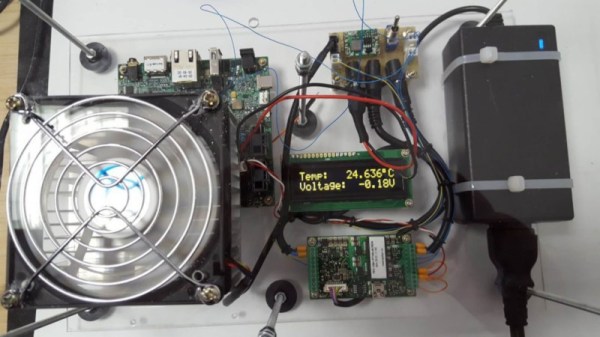
Enter the Thermo-Regulated Power Measurement Platform. It’s a device designed to control the die temperature of a chip during process characterization. This is where a chip, in this case the iMX8MQ, is run at a variety of temperatures, voltages, and frequencies to determine its performance under various conditions. This data guides the parameters used to run the chip in actual use, to best manage its power consumption and thermal performance.

The rig consists of a Peltier element with controller, a heatsink, and a fan. This is lashed up to a series of Python scripts that both control the chip temperature and run through the various testing regimes. Thanks to this automation, what would normally be a day’s work for an engineer can now be completed in just two hours.

Through a few smart component choices, the team accomplished the job at around one-tenth of the cost of commercial grade hardware. Granted, the average hacker probably won’t find themselves doing process characterization for cutting-edge silicon on a regular basis. Still, this project shows the value in building custom hardware to ease the testing process.

Testing is key to success in production. Custom jigs can make for light work when large orders come in, and we’ve run a primer on various testing techniques, too.

Ultra Benchy Is A Big Plastic Boat, Alright

The 3DBenchy, or Benchy for short, is a popular test model for 3D printers. Designed with overhanging curved surfaces, flat planes, holes, and other difficult geometry, it’s a great way to benchmark a printer or verify that everything is set up correctly. It comes in rather handy, but at this point has also become something of a meme within the 3D printer community. Thus, when NURDspace members decided to embark on a collaborative giant print, the decision was easy – and Ultra Benchy was born!

The size chosen for the print was arbitrarily set at 700mm long, or a 1166.65% scale up of the original model. The versatile LuBan software was used to split the giant model into manageable chunks that could be printed by community members. Chunks were claimed and kept track of in a spreadsheet, with contributors instructed to print with specific settings in order to ensure quality was similar across the whole build.

With all the parts collected, the final construction was done on the 31st of August in a Youtube livestream. Reportedly, build time was a marathon 10 hours. The final result is a pleasingly patchwork Benchy, that looks quite impressive in its final assembled form.

Collaborative prints are a staple of 3D printing festivals, but the technique can also be used to create large functional assemblies from smaller 3D printed components, such as [Ivan]’s gigantic Nerf gun that we covered previously.

Continue reading “Ultra Benchy Is A Big Plastic Boat, Alright”

Force Sensitive Resistor Takes The Pain Out Of Bed Leveling

How do you know if your 3D printer bed is levelled? Oh, don’t worry – you’ll know. Without a level bed, filament won’t stick properly to the build surface and you’ll run into all sorts of other problems. Knowing how tricky it can be to get the bed just right, [Antzy] built a tool to help.

The device, which he calls the FS-Touch, is based around an Arduino Pro Micro fitted with a force sensitive resistor. This allows the distance between the bed and nozzle to be measured based on the force read by the resistor when placed in between the two.

Using the tool is simple. First, the bed is brought roughly into alignment using the typical paper method. Then, a reading is taken from one corner of the bed, and the measurement saved for reference. The other corners can then be set to the same level, with the aid of LEDs to guide the user in which direction to turn the adjustment knobs.

Measuring force in this way has the potential of being more repeatable than the somewhat difficult paper method. It promises to ease the task for users that may be struggling to get their bed in proper shape. Of course, automated bed levelling makes things even easier again. Video after the break.

Continue reading “Force Sensitive Resistor Takes The Pain Out Of Bed Leveling”

Race RC Cars From Anywhere On Earth

Racing games have come a long way over the years. From basic 2D sprite-based titles, they’ve evolved to incorporate advanced engines with highly realistic simulated physics that can even be used to help develop real-world automobiles. For [Surrogate.tv], that still wasn’t quite good enough, so they decided to create something more rooted in reality.

The game is played in a web browser. Players are assigned a car and view the action from a top-down camera.

Their project resulted in a racing game based on controlling real RC cars over the internet, in live races against other human opponents. Starting with a series of Siku 1:43 scale RC cars, the team had to overcome a series of engineering challenges to make this a reality. For one, the original electronics had to be gutted as the team had issues when running many cars at the same time.

Instead, the cars were fitted with ESP8266s running custom firmware. An overhead GoPro is used with special low-latency streaming software to allow players to guide their car to victory. A computer vision system is used for lap timing, and there’s even automatic charging stations to help keep the cars juiced up for hours of play.

The game is free to play online, with the races currently operating on a regular schedule. We look forward to trying our hand at a race or three, and will be interested to see how the latency holds up from various parts of the world.

We’ve seen other remote RC builds before; usually featuring the power of the Raspberry Pi. We’ve also covered useful techniques for low latency video for real-time applications. Video after the break.

Continue reading “Race RC Cars From Anywhere On Earth”

Steampunk Radio Looks The Business

Radios are, by and large, not powered by steam. One could make the argument that much of our municipal electricity supply does come via steam turbines, but that might be drawing a long bow. Regardless, steampunk remains a popular and attractive aesthetic, and it’s the one that [Christine] selected for her radio build.

The build cribs from [Christine’s] earlier work on a VFD alarm clock, using similar tubes and driver chips to run the display. FM radio and amplification are courtesy of convenient modules. Tubes are fitted for aesthetic purposes, artfully lit with a smattering of color-changing LEDs. Perhaps the neatest touch is the use of valve handles to control tuning and volume. A stepper motor turns a series of gears, as is mandatory for any true steampunk build, and there’s even an electromagnetic actuator to make the Morse key move. To run it all, a pair of Arduino Megas are charged with handling the I/O needs of all the various systems.

It’s a fancy build that shows how far the rabbit hole you can go when chasing a particular look and feel. It’s a radio that would make a great conversation piece on any hacker’s coffee table.  If that’s not enough, consider going for a whole laptop. Video after the break. Continue reading “Steampunk Radio Looks The Business”

ReMarkable Tablet Scores A MicroSD Slot

There’s been a marked trend towards modern tablets and phones having fewer expansion options. It’s becoming rarer to find a microSD slot available, which can be particularly frustrating. For [davisr], this simply wouldn’t do, and they set about hacking their ReMarkable tablet.

A rotary tool was used to make a tidy slot for the microSD card.

The ReMarkable already has a set of pads for an SDHC interface on the main board, ready to go. Despite this, both hardware and software modifications are required to get things up and running. [davisr] started by soldering some wires to the main board, feeding them to a microSD socket, which was mounted on the edge of the tablet in a convenient nook. The case was then delicately modified to make a slot for cards to be inserted and removed. With this done, the kernel was then recompiled to enable support for the SDHC interface, and everything was up and running.

With the modification in place, [davisr] now has over 150GB of storage available, which should last for quite some time. Similar hacks are possible on other platforms, too. Even the Pi Zero can mount a second SD card with the right mods!


Measuring Particulate Pollution With The ESP32

Air pollution isn’t just about the unsightly haze in major cities. It can also pose a major health risk, particularly to those with vulnerable respiratory systems. A major part of hazardous pollution is particulate matter, tiny solid particles suspended in the air. Particulate pollution levels are of great interest to health authorities worldwide, and [niriho] decided to build a monitoring rig of their own.

Particulate matter is measured by an SDS011 particulate matter sensor. This device contains a laser, and detects light scattered by airborne particles in order to determine the level of particulate pollution in PM2.5 and PM10 ranges. The build makes use of an ESP32 as the brains of the operation, chosen for its onboard networking hardware. This makes remotely monitoring the system easy. Data is then uploaded to a Cacti instance, which handles logging and graphing of the data.

For those concerned about air quality, or those who are distrustful of official government numbers, this build is a great way to get a clear read on pollution in the local area. You might even consider becoming a part of a wider monitoring network!