Watch YouTube On A Game Boy Color With A Special Cartridge

There’s no questioning [Throaty Mumbo]’s uncanny skill at answering questions that nobody ever asked, such as whether it’s possible to watch YouTube videos on a Nintendo Game Boy Color handheld gaming system.

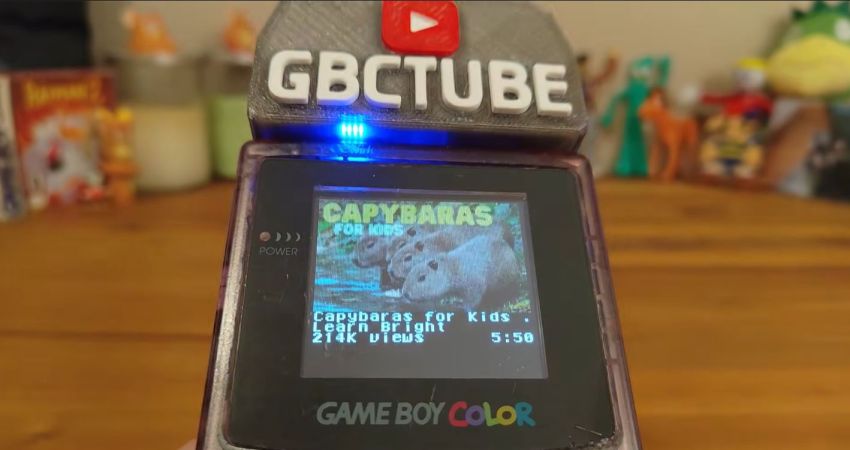
Of course the answer here is a resounding ‘sorta’, loosely defined by what you mean with ‘watch’ and ‘video’ exactly. For the impatient there’s the GitHub project page with the project summary, along with a detailed video containing hijinks and a playback demo on real Game Boy Color hardware with the cobbled-together GBCTube cartridge.

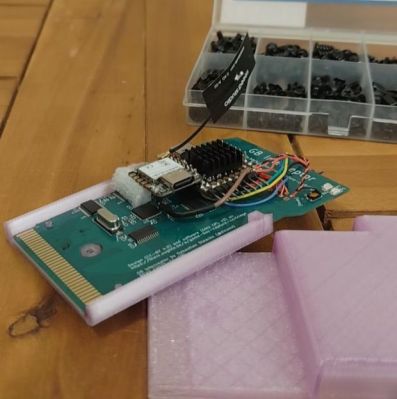
The nice thing about these cartridge-based gaming systems is that you get direct access to the system’s hardware via the cartridge bus, with for systems like the GBC a basic cartridge PCB readily available if you’re feeling that prototyping itch.

Such a cartridge breakout board for the GBC was thus used as the core of this project, with an ESP32-C6 acting solely as Wi-Fi bridge for the RP2350B MCU which handles basic player firmware and bridging duty between the GBC and the streamed video data from the host PC. It’s the latter does the heavy lifting of wrangling the YouTube experience into something that sort of works on the GBC’s amazing, very vibrant, backlight-free 160×144 resolution color LCD.

With the cartridge inserted you can search for a video title on the GBC, select a video which is then downloaded with yt-dlp on the host PC and prepared for streaming. Audio is handled by the RP2350B to free up CPU cycles on the GBC, for which a separate speaker is slapped into the cartridge for high-fidelity mostly-synced audio.

Perhaps the most fascinating question that one is left with is whether a more powerful Espressif MCU like e.g. the ESP32-S31 could combine all these tasks into a single package. Not because there’s a particular reason to do so, but more out of sheer morbid curiosity, perhaps.

Continue reading “Watch YouTube On A Game Boy Color With A Special Cartridge”

Fixing An Elgato Cam Link’s USB Current Draw Issue

Recently [Bits und Bolts] found himself in a bit of a pickle, when on boot his PC would complain about a connected USB device drawing too much power, before shutting down again. After unplugging various USB devices, the problem was narrowed down to an Elgato Cam Link 4K video capture device.



Some prodding and poking around with a thermal camera on the disassembled device while powered showed that an onboard IC had sprung a power leak. Sadly, even asking nicely, Elgato support wasn’t going to provide board-level repair help, so this was left as an exercise to the owner.

Although the markings on the chip didn’t offer much help, it turns out that this is a more common issue, with a convenient repair guide by [Uldis Melderis] identifying the part as the TI TLV62585 buck regulator.

After purchasing a couple of spares, the defective IC could then be replaced. Following this a quick test showing decidedly less angry electrons. From there it was a matter of reassembling the device in its plastic case and seeing whether the PC was happier with the now hopefully fixed device, which fortunately turned out to be the case.

Any such analysis and repair obviously raises a number of questions, such as why these buck regulators are dying, and why you’re supposed to just toss out a $100 device instead of doing a repair involving a $0.20 part and a few minutes with a hot air gun.

Increasing Photon Upconversion Efficiency With Structural Exciton Localization

In structures like photovoltaic cells there is only a limited spectrum of wavelengths that can perform useful work, with the remaining wavelengths of electromagnetic radiation effectively wasted. If the energy of such wavelengths could be coaxed into this useful spectrum, this could then correspondingly boost the performance of the devices, but doing so is not straightforward. Going from lower-energy photons to higher-energy photons is very inefficient, with a recent study by [Thilini Ishwara] et al. demonstrating a liquid triplet medium that has a conversion efficiency of about 8.2%.

Generally the absorption and emission of electromagnetic radiation involves a shift to a lower energy state, the Stokes shift, but the inverse anti-Stokes shift – the goal of photon upconversion – is decidedly less common, even if it finds uses today in for example industrial pigments that can absorb in the near-infrared and re-emit in the visible spectrum. This is practical in luminescent displays and anti-counterfeiting measures, where details like conversion efficiency aren’t paramount.

Unlike the Stokes shift, the mechanisms that underlie the anti-Stokes shift either require cooperation from the material’s lattice, or – in the case of organic molecules – what is termed triplet-triplet annihilation (TTA), also known as photochemical upconversion (PUC). This involves an absorbing species, a sensitizer and an emitting species, allowing for the summing of multiple lower-energy photons into a higher-energy photon, with this 2023 review article by [Jiale Feng] et al. providing a good primer.

In the study by [Ishwara] et al. this triplet medium is 9,10-bis(n-octyl-diisopropylsilylethynyl)anthracene (NODIPS-An), affixed to a nanostructured alumina scaffold (see top image). After characterizing the assembled device and taking internal losses due to e.g. reabsorption into account, the final conversion efficiency of 8.2% was established.

Of course, TTA isn’t the only way to do PUC, with SOMET (singlet oxygen mediated energy transfer) being an alternative approach, with [Roslyn Forecast] et al. comparing the two in a 2023 article. As noted in its conclusion SOMET is currently most suited to PUC to the red and infrared regions of the spectrum. For now research continues with no clear path to commercialization visible yet.

Fixing A Warped Paperback Spine With Gentle Heating

Although paperbacks are a much-loved aspect of the literary world, they are not really intended to last the decades the way that hardcover books are. Beyond the typical ravaged covers, paperbacks also tend to suffer from a warped spine, where the formally flat spine gets a definite inwards curve due to the ravages of moisture, temperature, failing glue and the passing of time in general. If this bothers you, then [Book Care Studio] shows a simple technique using which these spines can be flattened again.
All that you need for this approach are two cutting boards and two clamps to provide some clamping force on the book, along with a heat gun and some patience.

The book is clamped between the two boards with the spine sticking out. By putting said spine flat on e.g. a table and pushing on the opposite side while alternatingly briefly releasing the clamps, the spine can be forced into a flatter state. Without forcing this and then flipping the paperback sandwich around to heat the spine with the heat gun, the glue of the binding in the spine can then be softened sufficiently that a few of these push-heat cycles should be enough to straighten the spine.

Other than rebinding the book as for example public libraries are wont to do with a hardcover conversion of flimsy paperbacks, this simple approach should clean up a ratty-looking paperback collection. While one can definitely argue that half the charm of old paperbacks are the wrinkles, curves and intense smell of acidifying paper, it’s always good to have options like this at one’s disposal.

Continue reading “Fixing A Warped Paperback Spine With Gentle Heating”

A Look At A Gaggle Of Transputer Boards

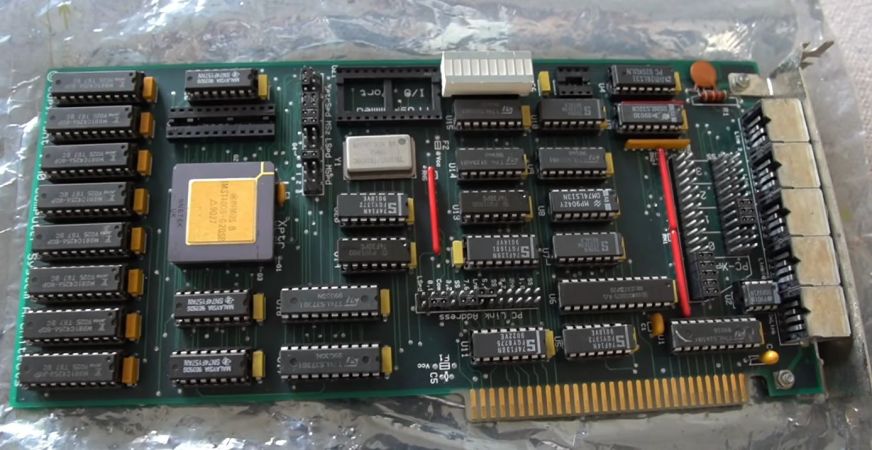
A long time before Beowulf clusters wired up with commodity Ethernet hardware became a hobbyist thing and a running joke, the transputer took a swing at a very similar architecture. This used stand-alone computers that were networked together with other transputer systems, to achieve task-level parallelism. For some people like [Lance Harvie] this is the kind of hardware that he used during his university years for a project, with him not only still having that hardware, but also recently adding to this collection with a recent eBay purchase.

The transputer story is a fascinating one, forming a major part of the UK’s semiconductor industry during the 1980s, creating a strong legacy as the computer industry awkwardly tried to figure out what types of parallelism to target. Whereas the industry largely moved to instruction-level (superscalar) parallelism alongside tightly coupled task-level parallelism along with multiple CPU cores on a single die, one could consider today’s supercomputer clusters to be one example of the transputer legacy.

Continue reading “A Look At A Gaggle Of Transputer Boards”

Raspberry Pi Locator Website To Shut Down In July

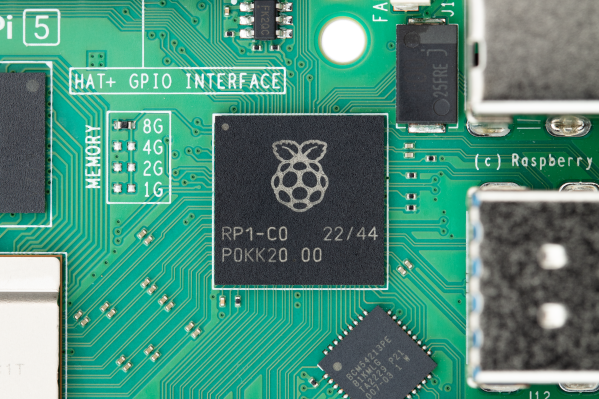
As announced by [André] on Bluesky, next month the much loved Rpilocator.com website will cease displaying the stock status and pricing of Raspberry Pi computers from various online retailers.

One of the main reasons is that the indexing bot used by the site has been blocked by most shopping sites. It’s not clear whether this blocking is on purpose or just another consequence of website owners protecting themselves from the onslaught of obnoxious ‘AI’ scraping bots. But in any event, the effort of finding workarounds that may only work for a few days or weeks was becoming too much.

According to [André] there are still about 11,000 users of the site each month, which even when accounting for the human-bot ratio is still a sizable number of visitors who’ll now have to get their fix somewhere else. He also indicates that he receives numerous emails from presumably real people about the site to point out small issues they have noticed.

Although the site may still be back in the future, it’s also important to recognize how much the single-board computer landscape and raison d’être for this tracking site have shifted since the 2020s Chip Crisis days. Currently it’s less about finding where these boards are in stock, and more about taking the hits to one’s wallet as memory prices continue to spiral out of control. Making what were once fun, cheap little hobby boards into luxury items that cut into your rent-food-and-gas budget.

Reviving MSN Messenger’s I-Buddy USB Accessory

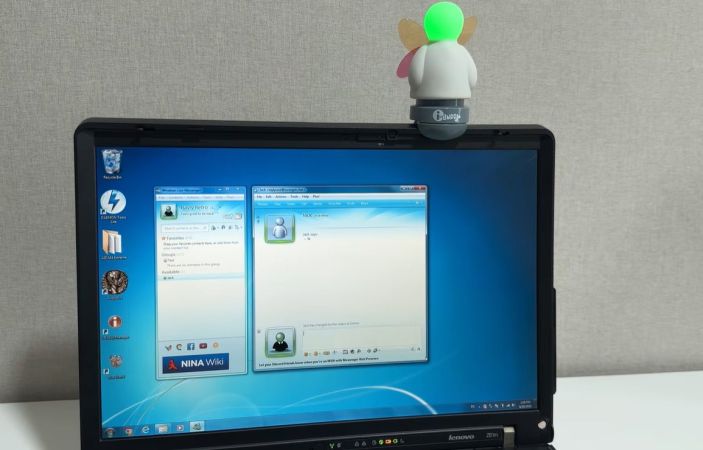
Some of our esteemed readers were not yet out of diapers back in 2013 when Microsoft decided to put MSN Messenger out to pasture, but the memories that this instant messenger’s (IM) interface and notification sounds have left are hard to erase. This also includes some of the weirdest accessories that this IM spawned, such as the USB-connected i-Buddy. Recently [Rayly Retro] got his mittens on a new-in-box one to revive alongside an era-appropriate Windows 7 PC.

What the i-Buddy gets you is the ability to light up the head in seven different colors, twist the torso and flap the butterfly wings, all of which can correspond to certain events in the MSN IM or for more general notifications, as set by software running on the connected PC. Interestingly, this i-Buddy is recognized by Windows as a USB HID, so no special driver is needed. A range of ways to program it exist too, including a .NET-based library from back when it was still being sold for around $20.

Although the MSN Messenger network’s servers have long since been dumped into an e-waste dumpster over at Microsoft HQ, an alternative exists in the form of the Escargot service using which a range of official clients can work again.

In the video it’s demonstrated how to create a user account with the Escargot site and how to patch the messenger – here Window Live Messenger 2009 – before signing in. With that step completed, getting the i-Buddy up and running is next. This took a lot of struggling, since the version of the i-Buddy software that comes with the device didn’t like Windows 7 much. Fortunately an old forum post led to a download of version 2.10, using which the gadget jumped to life, happily lighting up and flapping its wings.

Continue reading “Reviving MSN Messenger’s I-Buddy USB Accessory”