NASA JPL’s Voyager Team Is Patching Up Both Voyagers’ Firmware

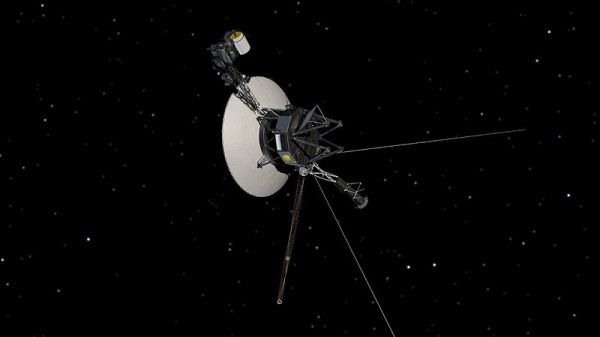
It’s not every day that you get to update the firmware on a device that was produced in the 1970s, and rarely is said device well beyond the boundaries of our solar system. This is however exactly what the JPL team in charge of the Voyager 1 & 2 missions are facing, as they are in the process of sending fresh firmware patches over to these amazing feats of engineering. These patches should address not only the attitude articulation and control system (AACS) issues that interrupted Voyager 1’s communication with Earth a while ago, but also prevent the thruster propellant inlet tubes from getting clogged up as quickly.

Voyager 2 is the current testbed for these patches, just in case something should go wrong despite months of Earth-based checking, testing and validation. As Voyager 1 is the furthest from Earth, its scientific data is the more valuable, but ideally neither spacecraft should come out worse for wear after this maintenance session.

The AACS fixes are more of an insurance policy, as the original cause of the issue was found to be that the AACS had entered into an incorrect mode, yet without a clear understanding of how this could have happened. With these changes in place, recovery should be much easier. Similarly, the changes to the use of the thrusters are relatively minor, in that they will mostly let the spacecraft drift a bit more out of focus before the thrusters engage, reducing total thruster firings and thus the build-up of material in these inlet tubes.

With these changes the antennae of both spacecraft should remain trimmed firmly towards the blue planet which they left over forty-five years ago, and enable them to hopefully reach that full half century mark before those of us who are still listening have to say our final farewells.

Electrically controlled behaviors of the lateral α-In2Se3 Fe-FET. a) Hysteresis loop of Id–Vd curve of the planar Fe-FET with 29 nm thick α-In2Se3. b) Band diagram of the ferroelectric switching mechanism. (Credit: Miao et al., 2023)

New Type Of Ferroelectric Memory Constructed Using α-In2Se3 Material

The ferroelectrical properties of materials have found a variety of uses over the years, including in semiconductor applications. Ferroelectric memory is among the most interesting and possibly world-changing as it could replace today’s fragile and (relatively) slow NAND Flash with something that’s more robust and scalable. Yet as with any good idea, finding the right materials and process to implement it is half the battle. Here is where a recently released paper in Advanced Science by Shurong Miao and colleagues demonstrates a FeFET-based memory cell design using α-In2Se3 material on platinum-based source-drain electrodes. Continue reading “New Type Of Ferroelectric Memory Constructed Using α-In2Se3 Material”

Reverse-Engineering The Mechanical Bendix Central Air Data Computer

Before the era of digital electronic computers, mechanical analog computers were found everywhere. From the relative simplicity of bomb sights to the complexity of fire control computers on 1940s battleships, all the way to 1950s fighter planes, these mechanical wonders enabled feats which were considered otherwise impossible at the time.

One such system that [Ken Shirriff] looked at a while ago is the Bendix Central Air Data Computer. As the name suggests, it is a computer system that processes air data. To be precise, it’s the mechanism found in airplanes that uses external sensor inputs to calculate parameters like altitude, vertical speed, Mach number and air speed.

Continue reading “Reverse-Engineering The Mechanical Bendix Central Air Data Computer”

Ready For The Rapture: This Wind-Up Cassette Player Can Play Anywhere

As useful as electronics are, the need to have some source of power for them can be a bit of an issue, especially for small, portable devices. One of the most low-tech but universally applicable source is human mechanical power, as demonstrated by the rugged 1980s-era Messenger II tape player in a recent [TechMoan] video. Without beating around the bush, this is indeed a device created by an evangelical organization (GRN) that missionaries would take with them to wherever their mission took them. Naturally this put the availability of power from a wall outlet in question, especially in the 1980s when this tape player was produced. Continue reading “Ready For The Rapture: This Wind-Up Cassette Player Can Play Anywhere”

A Look At A 1960s Tube-Based Magnavox Concert Grand Console Stereo

Back in presumably the early 1960s, [David]’s grandfather bought a console stereo featuring a record player, AM/FM radio and a rather astounding stereo speaker system that would be more than enough to cover a small concert hall. Having inherited this piece of auditory art after his grandfather’s passing, [David] has given the console stereo a prominent place in his living room, which is where we start the tour in a new video on the [Usagi Electric] YouTube channel.

Plentiful I/O on this 1960s vintage piece of Magnavox audio equipment.

Being a 1950s-vintage design that got produced into the 1960s in a variety of models, the Magnavox Concert Grand is an all-tube affair, with the only presence of semiconductors being the three transistors found in the ‘Phantom’ remote control. [David] unfortunately does not posses this remote control, although the receiver module is present in the unit. It appears to be similar to the 1960 1ST800F in possession by [electra225] over at the Classic HiFi Care forum, which can provide 50 Watt per channel, yet as noted in the forum post, the 44 tubes alone draw about 250 Watt, with [electra225] recording 377 Watt total with everything cranked up. Clearly a high power bill was a price one had to pay for having high-end audio back in that era.

After [David] takes his unit apart – made very easy due to the modular construction – he goes through the basic circuitry of the power supply, the amplifiers and even has a peek at the circuitry of the remote control which appears to use basic frequency modulation to transfer the intended action to the receiver. All of this is made quite easy as full schematics are available for the entire system, as was standard back in those days. Interesting is also the I/O module, which features an MPX section, for demodulating stereo FM which wasn’t standardized yet at the time. Finally, tape drive connectors are available, which would have been likely a reel-to-reel unit for maximum HiFi enjoyment.

With the only broken thing in [David]’s unit being the snapped wire on the tuner of the radio module (ironically caused by the disassembly), all that was changed before reassembly was a good clean, after which the console stereo was put back and tested. Reflecting an era when HiFi equipment was supposed to blend in with other furniture, it will likely continue to do service for [David] as the world’s fanciest TV soundbar for the foreseeable future.

Continue reading “A Look At A 1960s Tube-Based Magnavox Concert Grand Console Stereo”

LabVIEW Abandons Mac After Four Decades

When National Instruments (NI) released LabVIEW in 1986 it only targeted the Macintosh, with ports to other platforms coming later on in the 1990s. Now, NI has announced that with the next version in 2024, LabVIEW will only be released for Linux and Windows, leaving behind Apple’s software platform after nearly four decades. The news was covered by Apple Insider, which cites a forum thread on the NI website in which the details of LabVIEW for macOS are discussed. This news comes on the heels of the announcement of Valve dropping macOS support with Counter Strike 2.

In both cases the issue at hand appears to be both a combination of a low user count (less than 1% of CS:GO players) and the complexity of using proprietary APIs (Cocoa, Metal, etc.) that have led to the decision to terminate the macOS releases. Not that macOS users aren’t used to app-related bloodbaths after losing all 32-bit applications back in 2019, but the trend of more high-profile applications and games not supporting the OS does seem to be ramping up.

Perhaps the only positive news here for people who bought into the Apple hardware ecosystem here is that Windows runs on M1/M2 Macs, and there is even an experimental Linux distribution in the form of Asahi Linux to conceivably dual-boot into for those applications that just don’t want to run on Apple’s OS.

National Research Council laboratories in Ottawa

Canada Abruptly Ends Official Time Signal

In a sudden move that was noted not only by Canadian media, but also international media channels, the National Research Council Time Signal that was broadcast by Canadian Broadcasting Corporation (CBC) on CBC Radio One since November 5 1939 was turned off on October 9th, after eighty-four years, one world war, countless generations, and the rise of modern technology. Although perhaps obsolete by today’s standards, this 15 to 60 second long broadcast at 13:00 Eastern Time every single day has been a constant in the life of Canadians, whether they tuned into local radio, or (increasingly) via Internet radio.

The NRC Time Signal consisted out of a series of 800 Hz sinewave ‘beeps’ followed by a second-long signal to indicate the top of the hour. Back in the day this was extremely useful to sync one’s clocks, watches and other time-keeping devices to. Yet between the transmission delays caused by Internet radio and the increased availability of NTP and other time sources on modern-day devices, the signal’s main use appears to have become a nostalgic reminder of what once was a constant of each and every day.

In this regard the public response to the rather unceremonious decommissioning without prior announcement was rather predictable. After all, even if it wasn’t that useful, why throw out something that is more recognizable than any other radio jingle for generations of Canadians?

Top image: National Research Council laboratories in Ottawa.