Earth’s Final Frontier: Exploring The Alien Depths Of The Earth’s Oceans

Despite how hostile to life some parts of the Earth’s continents are, humanity has enthusiastically endeavored over the course of millennia to establish at least a toehold on each of them. Yet humanity has barely ventured beyond the surface of the oceans which cover around three-quarters of the planet, with human activity in these bodies of water dropping off quickly along with the fading of light from the surface.

Effectively, this means for all intents and purposes we have to this day not explored the vast majority of the Earth’s surface, due to over 70% of it being covered by water. As an ocean planet, much of Earth’s surface is covered by watery depths of multiple kilometers, with each 10 meters of water increasing the pressure by one atmosphere (1.013 bar), so that at a depth of one kilometer we’re talking about an intense 101 atmospheres.

Over the past decades, the 1985 discovery of Titanic’s wreck approximately 3.8 kilometer below the surface of the Atlantic, the two year long search for AF447’s black boxes, and the fruitless search for the wreckage of MH370 despite washed-up remnants have served as stark reminders of just how alien and how hostile the depths of the Earth’s oceans are. Yet with both tourism and mining efforts booming, will we one day conquer the full surface of Earth?

Continue reading “Earth’s Final Frontier: Exploring The Alien Depths Of The Earth’s Oceans”

Bluetooth Battery Monitors That Also Monitor Your Position, Without Asking

These days Bluetooth-based gadgets are everywhere, including for car and solar batteries. After connecting them up to the battery, you download the accompanying app on your smartphone, open it up and like magic you can keep tabs on your precious pile of chemistry that keeps things ticking along. Yet as [haxrob] discovered during an analysis, many of these devices will happily pass your location and other information along to remote servers.

The device in question is a Bluetooth 4.0 Battery Monitor that is resold under many brands, and which by itself would seem to do just what it is said to do, from monitoring a battery to running crank tests. Where things get unpleasant is with the Battery Monitor 2 (BM2) mobile app that accompanies the device. It integrates a library called AMap which is “a leading provider of digital map in China” and part of Alibaba. Although the app’s information page claims that no personal information is collected, the data intercepted with Wireshark would beg to differ.

In part 2 of this series, the BM2 app is reverse-engineered, decompiling the Java code. The personal information includes the latitude and longitude, as well as GPS, cell phone tower cell IDs and WiFi beacon data, which understandably has people rather upset. In addition to leaking your personal info, the BM2 app seems to be also good at running constantly in the background, which ironically drains your phone’s battery at an alarming rate.

Cases like these should be both a warning to not just install any app on your smartphone, as well as a wake-up call to Google and others to prevent such blatant privacy violations.

(Thanks to [Drew] for the tip)

Honda Headunit Reverse Engineering, And The Dismal State Of Infotainment Systems

These days the dozen or so ECUs in an average car are joined by an infotainment system of some type, which are typically a large touch screen on the dashboard (the headunit) and possibly a couple of auxiliary units for the rear seats. These infotainment systems run anything from QNX to (Yocto) Linux or more commonly these days some version of Android. As [Eric McDonald] discovered with his 2021 Honda Civic, its headunit runs an archaic Android dating back to roughly 2012.

While this offers intriguing options with gaining root access via decade-old exploits that the car manufacturer never fixed, as [Eric] notes, this is an advantage that anyone who can gain access to the car’s CAN buses via e.g. the headlights, a wireless access point, or even inject an exploit via ADB radio can use to their advantage. Essentially, these infotainment systems are massive attack surfaces with all of their wired and wireless interfaces, combined with outdated software that you as the vehicle owner are forbidden to meddle with by the manufacturer.

Naturally taking this ‘no’ as a challenge as any civilized citizen would, [Eric] set out to not only root the glorified Android tablet that Honda seeks to pass off as a ‘modern infotainment system’, but also reverse-engineer the system as far as possible and documenting the findings on GitHub. As [Eric] also explains in a Hacker News discussion, his dream is to not only have documentation available for infotainment systems in general as a community effort, but also provide open source alternatives that can be inspected by security researchers rather than being expected to lean on the ‘trust me bro’ security practices of the average car manufacturer.

Although a big ask considering how secretive car manufacturers are, this would seem to be an issue that we should tackle sooner rather than later, as more and more older cars turn into driving security exploits just waiting to happen.

Commodore Floppy Drive Fixing Chaos

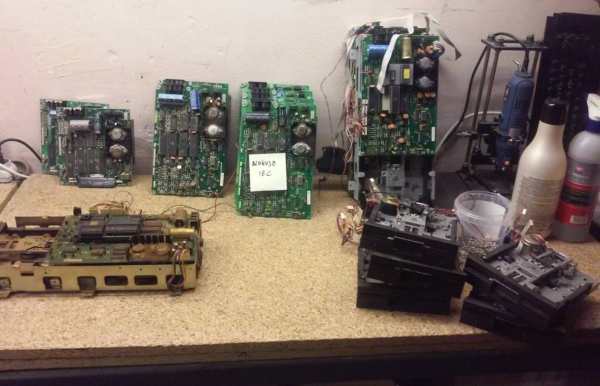
One of the best parts of retrocomputing is that you can obtain so many broken systems and peripherals for repairing and other assorted fun. This was the wholesome activity that [Drygol] embarked on recently with a gaggle of Commodore floppy disk drives that he obtained, involving a lot of cleaning, soldering, calibrating and other assorted entertainment. This follows cold on the heels of an earlier repair session of a stash of Commodore 1541 FDDs.

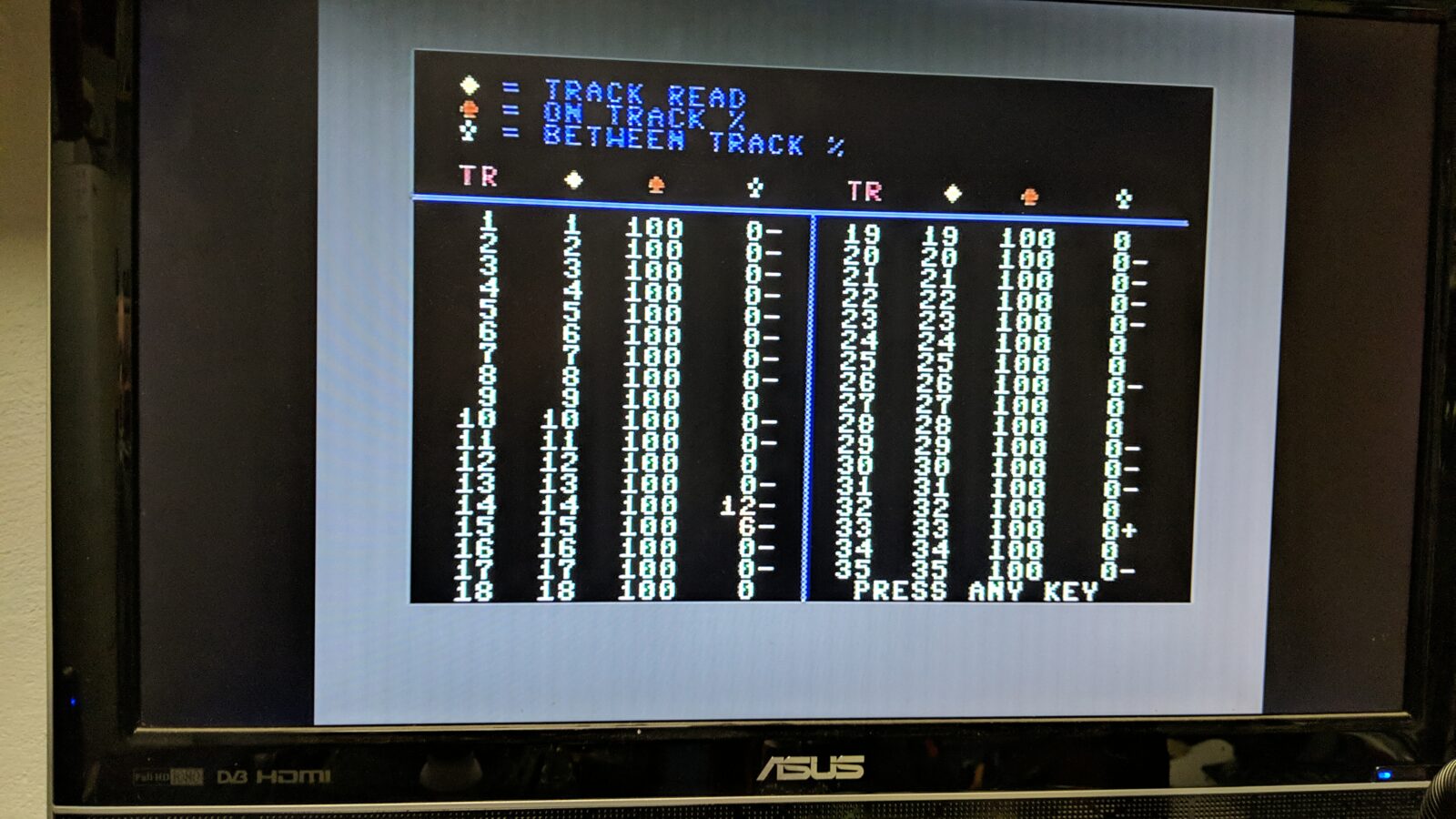
Testing Commodore FDD head alignment using the 1541 diagnostic cartridge.

As with any such devices, the first thing to do is to clean the heck out of them, to remove forty-odd years of dust and other debris, followed by testing of functionality, replacing dead ICs and the usual round of (electrolytic) capacitor replacement. Retrobrighting gives it that fresh-out-of-packaging look, which leaves just the calibrating of these drives. This procedure is essential to make sure the read/write head is aligned with the tracks on the disks, and is the most fiddly part of the process.

What helps a lot here is the 1541 diagnostic cartridge by [World of Jani] that displays real-time information on the drive while you are tweaking its speed and head alignment. All you have to do is tweak the speed potentiometer, and adjust the position of the drive motor, which takes a bit of patience and a steady hand. After this repair session a few Mitsumi drives unfortunately remained dead due to busted coils. Despite a valiant repair attempt on the heads by manually rewinding the coils, this remains a topic for a potential part III.

Will The Lilium Jet Work? A Deep-Dive Into The Physics Behind EVTOL Aircraft

The Lilium Jet is a proposed eVTOL (electric Vertical Take Off and Landing) aircraft that the German company Lilium GmbH has claimed it will bring to the market ‘soon’, which would made it the first eVTOL aircraft in the world to enter into commercial service. As anyone who has any experience with VTOL knows, it’s a tricky subject to engineer, let alone when you want to do it fully electric. In a deep-dive video on the Lilium Jet and eVTOL in general, [John Lou] goes through the physics behind VTOL take-off, landing and flight, as well as range and general performance.

It is clear that Lilium’s presented aircraft concept has many issues, some of which are due to new and unproven technologies, while others seem to be founded in over-promising and likely under-delivering. With Lilium having signed a number of contracts to deliver the first Pioneer Edition Lilium Jets and commercial service promised by 2025, it’s hard to ignore that the first full prototype of the 7-seater Lilium Jet is supposed to fly this year.

Although as [John] points out in the video, eVTOL is not an impossible concept, it is important to remain realistic about what is physically possible, and not seek to push the boundaries. When the UK introduced its first mass-produced VTOL jet in the form of the Harrier, it too faced an uncomfortable time as bugs got ironed out. As these eVTOL aircraft would be carrying real human passengers, it’s a good place to realize that although you can pick a fight with physics, you will never come out on the winning side.

Hopefully Lilium realizes this too, and these sleek, battery-powered aircraft will truly take to the skies in a few years.

Continue reading “Will The Lilium Jet Work? A Deep-Dive Into The Physics Behind EVTOL Aircraft”

The Many Robots That Ventured Into The Chernobyl NPP #4 Reactor

Before the Chernobyl Nuclear Power Plant (ChNPP, spelled ‘Chornobyl’ in Ukrainian) disaster in 1986, there had been little need for radiation-resistant robots to venture into high-risk zones.

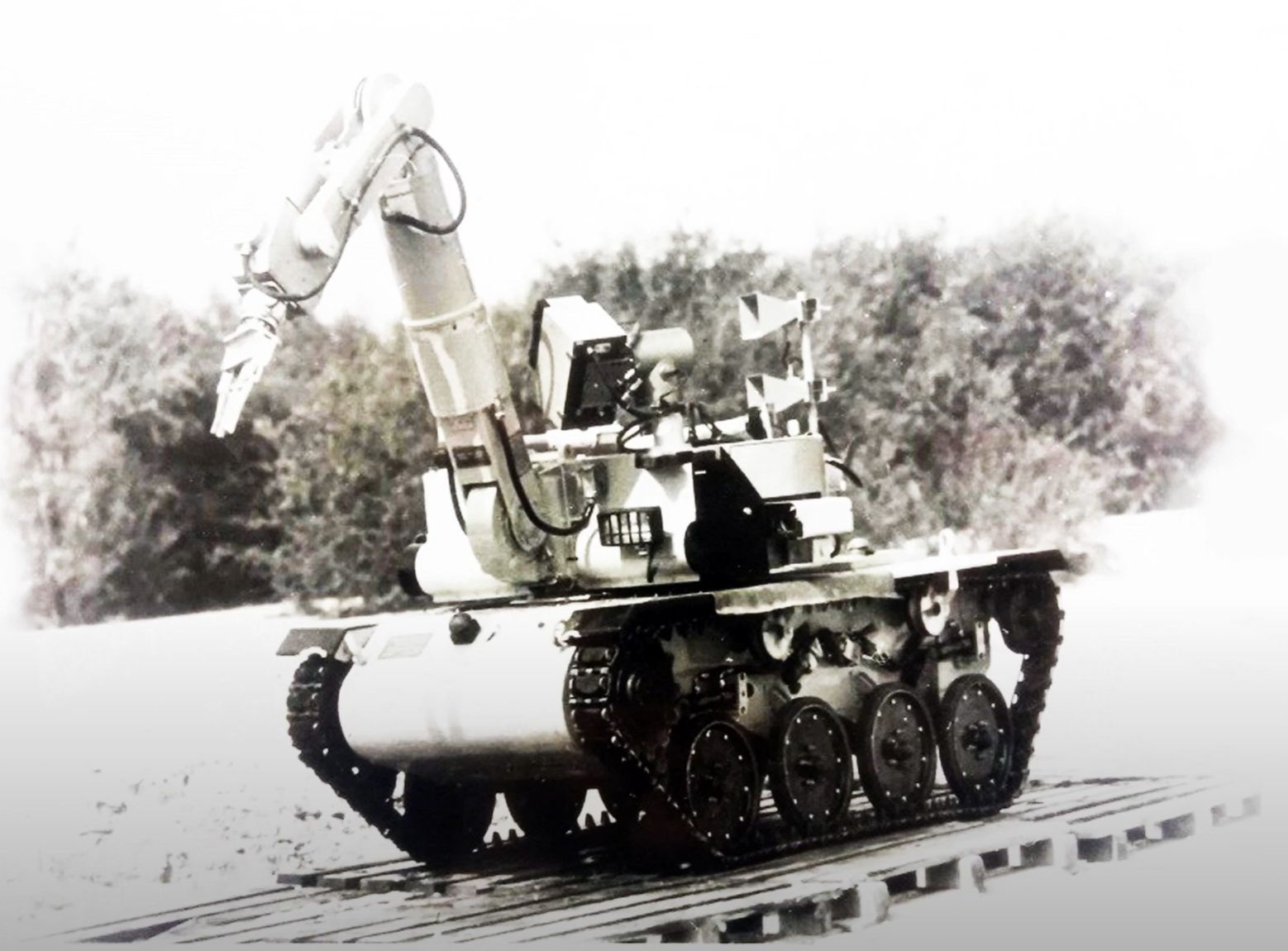
The MF-2 Joker, also used for clearing debris at the Chernobyl NPP #4 disaster site.

Yet in the aftermath of the massive steam explosion at the #4 reactor that ripped the building apart — and spread radioactive material across the USSR and Europe — such robots were badly needed to explore and provide clean-up services. The robots which were developed and deployed in a rush are the subject of a recent video by [The Chornobyl Family].

While some robots were more successful than others, with the MF-2 remote mine handling robot suffering electronic breakdowns, gradually the robots became more refined. As over the years the tasks shifted from disaster management to clean-up and management of the now entombed #4 reactor, so too did the robots. TR-4 and TR-5 were two of the later robots that were developed to take samples of material within the stricken reactor, with many more generations to follow.

The video also reveals the fate of many of these robots. Some are buried in a radioactive disposal site, others are found on the Pripyat terrain, whether set up as a tourist piece, or buried in shrubbery. What’s beyond doubt is that it are these robots that provided invaluable help and saved countless lives, thanks to the engineers behind them.

Continue reading “The Many Robots That Ventured Into The Chernobyl NPP #4 Reactor”

Cottonization: Making Hemp And Flax Fibers Into The Better Cotton

These days it’s hard to imagine that fabrics were ever made out of anything other than cotton or synthetic fibers, yet it wasn’t too long ago that hemp and flax-based fabrics — linen — were the rule rather than the exception. Cotton production has for centuries had the major disadvantages of requiring a lot of water and pesticides, and harvesting the cotton was very labor-intensive, making cotton rather expensive. In order to make separating the cotton fibers from the seed easier, improved versions of the cotton gin (‘cotton engine’) were developed, with the 19th century’s industrial revolution enabling a fully automated version.

What makes cotton attractive is the ease of processing these fibers, which are part of the seed pod. These fibers are 25 mm – 60 mm long, 12 μm – 45 μm fine fibers that can be pulled off the seeds and spun into yarn or whatever else is needed for the final product, much like wool. Hemp and flax fibers, in contrast, are extracted from the plant stem in the form of bast fibers. Rather than being pure cellulose, these fibers are mostly a mixture of cellulose, lignin, hemicellulose and pectin, which provide the plant with rigidity, but also makes these fibers coarse and stiff.

The main purpose of cottonization is to remove as much of these non-cellulosic components as possible, leaving mostly pure cellulose fibers that not only match the handleability of cotton fibers, but are also generally more durable. Yet cottonization used to be a long and tedious process, which made bast fiber-based textiles expensive. Fortunately, the steam explosion cottonization method that we’ll be looking at here may be one of the methods by which the market will be blown open for these green and durable fibers.

Continue reading “Cottonization: Making Hemp And Flax Fibers Into The Better Cotton”