Using Trash To Keep Plastic Trash Out Of Oceans By Kabooming Them

For a few years now, [Richard] of Tropical Ocean Cleanup fame has been working hard to clean the Philippines of the plastic trash that litters everything, and washes down the canals and rivers into the ocean. Using nothing but what is essentially trash – old car tires, rope and empty soda bottles – he creates ‘kabooms’ that prevent this trash  floating in the canals from polluting the beaches, kill wildlife and gather in the oceans. In a recent video he covers how he creates these systems, and the basics of how they are installed.

We previously covered [Richard]’s efforts, and although these kabooms have received a few tweaks along the way, the basic principle has remained the same. The empty bottles provides the buoyancy, while the tires are excellent structural elements that can take a beating from the weather and debris. Some of the kabooms are lashed together with rope, while for other types holes are drilled into the tires using a hole saw, all of which help to create a self-supporting trash capture system that can be installed easily with a group of volunteers.

Fetching the thus captured trash is still a bit of a struggle, requiring a fair bit of manual labor, nets and boats from local fishermen when they have some spare time, but the effect is very much noticeable on the nearby beaches. In addition to these trash capturing kabooms, [Richard] also promotes trash collecting at schools, organizes trash pick-up events and trash collecting points, to raise local awareness of the need to keep plastic trash out of the environment and burn pits.

Continue reading “Using Trash To Keep Plastic Trash Out Of Oceans By Kabooming Them” →

The FPGA board in question which was programmed to run the algorithm. (Source: iranintl)

Iran’s Military Quantum Claim: It’s Only 99.4% Ridiculous

When Iran recently announced a quantum processing algorithm (Google translation) that would help its military to detect water surface disturbances, the instant response from Western media was one of ridicule, based on the displayed hardware. The hardware in question was the Digilent ZedBoard Zynq-7000 hybrid SoC/FPGA development board, which can be yours for less than $600.

Seems absurd, and the claim about any realistic military use absolutely is. But buried deep, deep down, there may be a tiny kernel of truth: because quantum computers are inherently parallel, FPGAs can make a good fit for small-scale quantum simulations.

Does this mean that the Iranian Navy would be better off simulating quantum circuits on an FPGA board than on a GPU or even a used laptop? Probably not. Will this hardware serve the proposed military application in the forseeable future? Absolutely not! Was this a misleading and ridiculous photo op? Yup. 100%.

But is emulating qubits in FPGA fabric a real thing? Turns out it is! Let’s have a look.

Continue reading “Iran’s Military Quantum Claim: It’s Only 99.4% Ridiculous” →

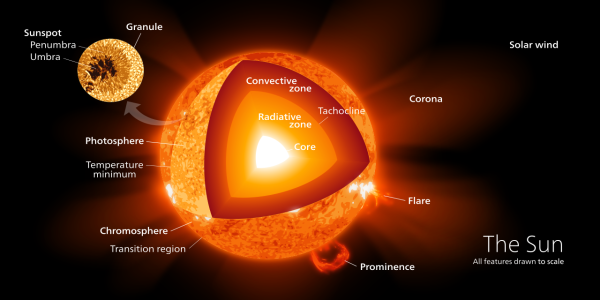
Diagram of the Sun. (Credit: Kelvinsong)

Parker Solar Probe’s Confirmation Of Interchange Reconnection Being The Source Of Fast Solar Wind

Although experimental verification is at the heart of the scientific method, there is quite a difficulty range when it comes to setting up such an experiment. Testing what underlies the formation of the fast solar winds that are ejected from coronal holes in the Sun’s corona is one of these tricky experimental setups. Yet it would seem that we now have our answer, with a newly published paper in Nature by S. D. Bale and colleagues detailing what we learned courtesy of the Parker Solar Probe (PSP), which has been on its way to the Sun since it was launched in August of 2018 from Earth.

Artist rendition of the Parker Solar Probe. (Credit: NASA)

The Sun’s solar wind is the name for a stream of charged particles which are ejected from the Sun’s corona, with generally two types being distinguished: slow and fast solar winds. The former type appears to originate from the Sun’s equatorial belt and gently saunters away from the Sun at a mere 300 – 500 km/s with a balmy temperature of 100 MK.

The fast solar wind originates from coronal holes, which are temporary regions of cooler, less dense plasma within the corona. These coronal holes are notable for being regions where the Sun’s magnetic field extends into interplanetary space as an open field, along which the charged particles of the corona can escape the Sun’s gravitational field.

These properties of coronal holes allow the resulting stream to travel at speeds around 750 km/s and a blistering 800 MK. What was unclear up till this point was exactly what powers the acceleration of the plasma. It was postulated that the source could be wave heating, as well as interchange reconnection, but with the PSP now close enough to perform the relevant measurements, the evidence points to the latter.

Essentially, interchange reconnection is the reestablishing of a coronal hole’s field lines after interaction with convection cells on the Sun’s photosphere. These convection cells draw the magnetic field into a kind of funnel after which the field lines reestablish themselves, which results in the ejection of hotter plasma than with the slow solar wind. Courtesy of the PSP’s measurements, measured fast solar winds could be matched with coronal holes, along with the magnetic fields. This gives us the clearest picture yet of how this phenomenon works, and how we might be able to predict it.

(Heading image: Diagram of the Sun. (Credit: Kelvinsong) )

Blind Camera: Visualizing A Scene From Its Sounds Alone

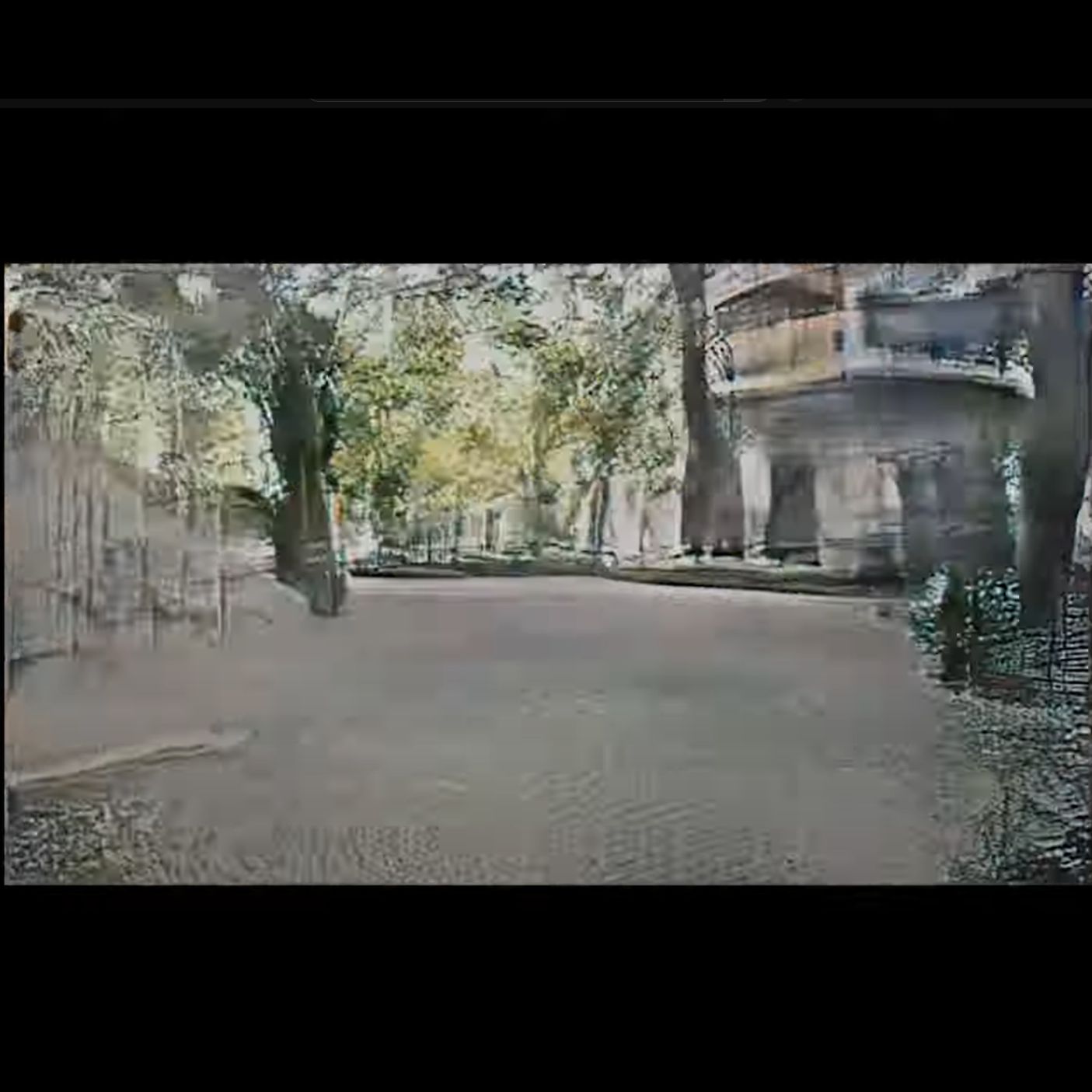
A visualization by the Blind Camera based on recorded sounds and the training data set for the neural network. (Credit: Diego Trujillo Pisanty)

When we see a photograph or photo of a scene, we can likely imagine what sounds would go with it, but what if this gets inverted, and we have to imagine the scene that goes with the sounds? How close would we get to reconstructing the scene in our mind, without the biases of our upbringing and background rendering this into a near-impossible task? This is essentially the focus of a project by [Diego Trujillo Pisanty] which he calls Blind Camera.

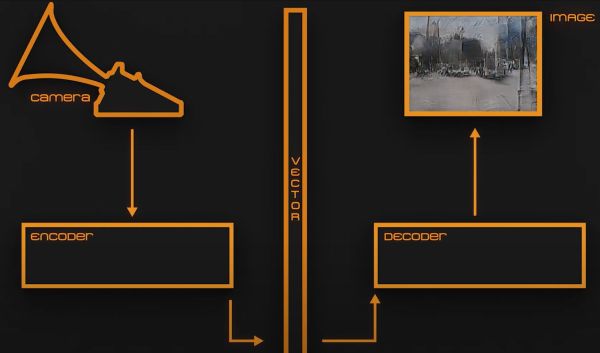
Based on video data recorded in Mexico City, a neural network created using Tensorflow 3 was trained using an RTX 3080 GPU on a dataset containing frames from these videos that were associated with a sound. As a result, when the thus trained neural network is presented with a sound profile (the ‘photo’), it’ll attempt to reconstruct the scene based on this input and its model, all of which has been adapted to run on a single Raspberry Pi 3B board.

However, since all the model knows are the sights and sounds of Mexico City, the resulting image will always be presented as a composite of scenes from this city. As [Diego] himself puts it: for the device, everything is a city. In a way it is an excellent way to demonstrate how not only neural networks are limited by their training data, but so too are us humans.

Continue reading “Blind Camera: Visualizing A Scene From Its Sounds Alone” →

Characterizing Singular Atoms Using X-Ray Spectroscopy And Scanning Tunneling Microscopy

Scanning Tunneling Microscopes (STMs) are amazing tools which can manipulate singular atoms, but they cannot characterize these atoms as they act only on the outer electron shell. Meanwhile X-ray spectroscopy is a great tool for characterizing materials, but has so far been unable to scale down to singular atoms. This is where a recent study (paywalled, see summary article) by Tolulope M. Ajayi and colleagues demonstrates how both STM and X-rays can be combined in order to characterize singular atoms.

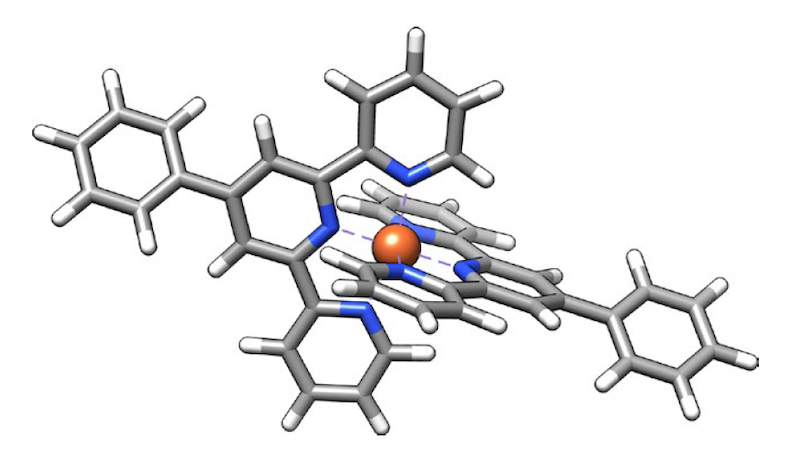
Structure of a part of the supramolecular complex used to measure the x-ray absorption spectrum of a single iron atom. The iron atom (red) is held within several ring-shaped structures. (Credit: Ajayi et al., 2023)

This research builds on previous research on synchrotron X-ray STM (SX-STM) which has been used for nanoscale imaging since 2009, but not down to the scale of a singular atom yet. Key to this achievement was to synthesize supramolecular complexes that could act as ‘tweezers’ to hold the atom under investigation in place and away from atoms of the same species. This not only allowed the atom to be identified using SX-STM, it also demonstrated that more subtle chemical properties of the atom can be analyzed in this manner, such as the way it interacts with other atoms.

The information gleaned this way matches up with what we know about the two atoms used in the study: iron and the rare earth terbium, with the latter’s lack of hybridization of its f orbitals (ℓ = 3) observable. For less well-studied atoms this method could provide a very efficient way to get a detailed overview of its properties. What is more, in future studies the researchers hope to use polarized X-rays to also obtain information about an atom’s spin state, opening interesting possibilities in areas such as spintronics and memory technologies.

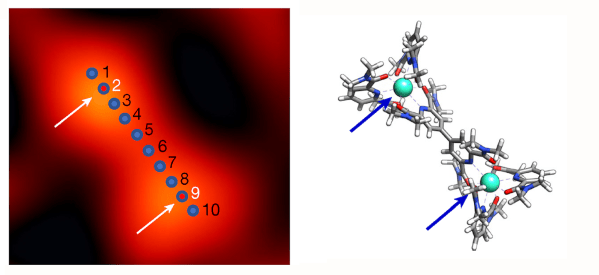
Heading image: As the tip was scanned across ten positions in a sample containing two terbium atoms, it picked a signal only from the positions (2 and 9) where terbium was located (left: STM image; right: sketch of the corresponding molecular structure). (Credit: Ajayi et al, 2023)

Hyundai Is Doomed: Porting The 1993 Classic To A Hyundai Head Unit

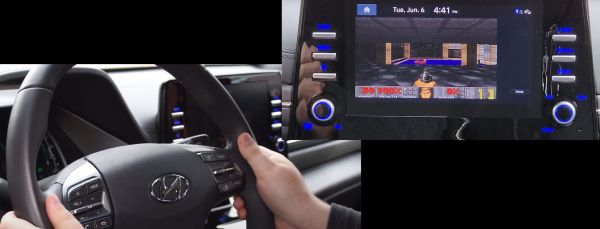
In the natural order of the world, porting DOOM to any newly unlocked computing system is an absolute given. This a rule which [greenluigi1] understands all too well, leading to presumably the first Hyundai to be equipped with this all-time classic on its infotainment system. This follows hot on the trail of re-hacking said infotainment system and a gaggle of basic apps being developed for and run on said head unit (being the part of the infotainment system on the front dashboard). Although it is a Linux-based system, this doesn’t mean that you can just recompile DOOM for it, mostly because of the rather proprietary system environment.

To make life easy, [greenluigi1] picked doomgeneric as the version to port. The main selling point of this project is that it only requires the developer to implement five functions to support a new platform, which then ‘just’ left figuring out how to do this on a head unit. Two of these (DG_SleepMs() and DG_GetTicksMS()) could be copied verbatim from the X11/xlib port, but the remaining three required a bit of sleuthing.

Where things go sideways is with keeping the head unit’s Helix window manager happy, and stick to the limited ways a GUI application can be launched, including the way arguments are passed. For the PoC, it was decided to just hardcode these arguments and only register the game with Helix using an .appconf configuration file. When it came to drawing pretty graphics on the screen, this was decidedly easier since the system uses Qt5 and thus offers the usual ways to draw to a QPixmap, which in this case maps to the framebuffer.

After a few playful sessions with the head unit’s watchdog timer, [greenluigi1] found himself staring at a blank screen, despite everything appearing to work. This turned out to be due to the alpha channel value of 0 that was being set by default, along with the need for an explicit refresh of the QPixmap. Up popped DOOM, which left just the implementation of the controls.

In order to start the game, you have to literally buckle up, and the steering wheel plus media control buttons are your inputs, which makes for a creative way to play, and perhaps wear some bald spots onto your tires if you’re not careful. If you’d like to give it a shot on your own ride, you can get the project files on GitHub.

Continue reading “Hyundai Is Doomed: Porting The 1993 Classic To A Hyundai Head Unit” →

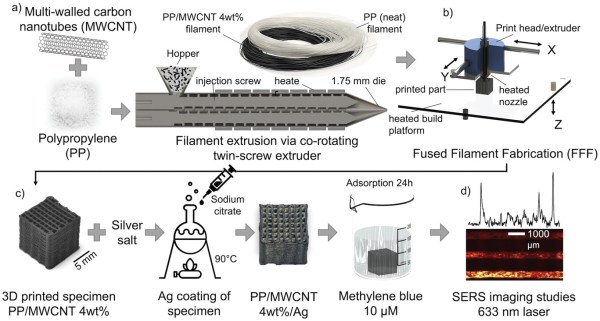
Processing of PP/MWCNT nanocomposites and coating them with plasmonic NPs. (Credit: Sara Fateixa et al., 2023)

Affordably Detecting Water Pollutants Using 3D Printed Lattices And Plasmonic Nanoparticles

Although detecting pollution in surface waters has become significantly easier over the years, testing for specific pollutants still requires the taking of samples that are then sent to a laboratory for analysis. For something like detecting pesticide run-off, this can be a cumbersome and expensive procedure. But a 3D printed sensor demonstrated by [Sara Fateixa] and international colleagues offers hope that such tests can soon be performed in the field. The most expensive part of this setup is the portable Raman spectrometer that is used to detect the adsorbed molecules on the printed test strips.

The printed structure itself forms a plasmonic structure with gold or silver as the plasmonic metals deposited on the polypropylene (PP) and multi-walled carbon nanotube (MWCNT, 4% by weight) material. The mixture of PP and MWCNTs is to use both the bio-compatible properties of the former, while using the latter to make the PP significantly easier to print with and enhancing its mechanical properties.

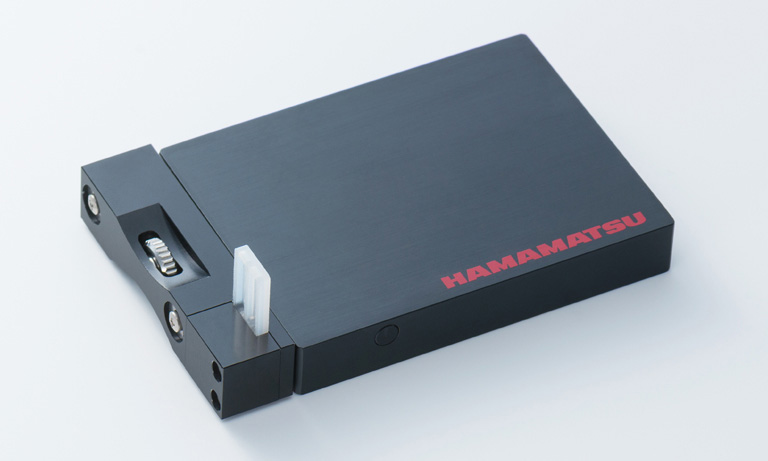
Hamamatsu Raman Spectroscopy SERS Detection Module C13560.

For the experiment, researchers used a few prepared sensors to detect herbicides, including paraquat. This herbicide is cheap, widely used, and banned in various countries. After dissolving it in low concentrations in both tap water and sea water, a 3D printed sensor with Ag coating was was exposed to each sample before being left to dry at room temperature. Afterwards a Hamamatsu C13560 portable Raman spectrometer was used to analyze the sensors using surface-enhanced Raman scattering (SERS). The combination of plasmonic structures and Raman scattering means a significantly enhanced sensitivity, on the order of singular molecules, and is what makes SERS such a useful analytical technique.

In the resulting scan results, the herbicides showed up clearly, and further long-duration testing of newly printed sensors showed them to be very stable, even after 150 days of being stored. This makes it a promising new way to affordably and quickly perform tests for pollution, requiring only minimal local infrastructure to produce and analyze the sensors.

Heading: Processing of PP/MWCNT nanocomposites and coating them with plasmonic NPs. (Credit: Sara Fateixa et al., 2023)