Fixing Noisy Measurements On An Owon XDM2041 Bench Multimeter

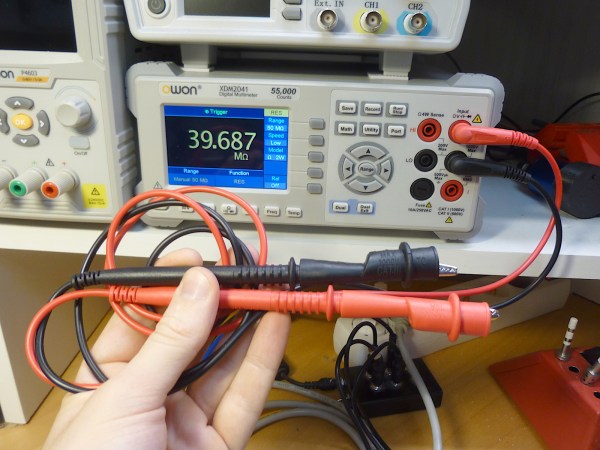
After purchasing an Owon XDM2041 bench multimeter for an automated test setup, [Petteri Aimonen] was disappointed to find that at especially the higher mega Ohm ranges, the measured values were jumping around a lot and generally very inaccurate. Since this is an approximately $170 bench multimeter and Owon support wasn’t cooperating, [Petteri] set out to fix the issue, starting with a solid teardown.
As noted by [Petteri], there’s not a whole lot inside one of these multimeters. The main board with the guts of the whole system contains a GigaDevices GD32F103CBT6 MCU coupled with the star of the show: the HYCON Technology Corporation’s HY3131 multimeter chip. After a peek at the HY3131 datasheet, the culprit was quite apparent: while sampling the presence of mains voltage noise is usually suppressed through the selection of an appropriate crystal.

Unfortunately, instead of the recommended 4.9152 MHz crystal per the reference schematic for the HY3131, Owon’s engineers had apparently opted for a 4 MHz crystal instead, and so it’s essentially aliasing the line noise.

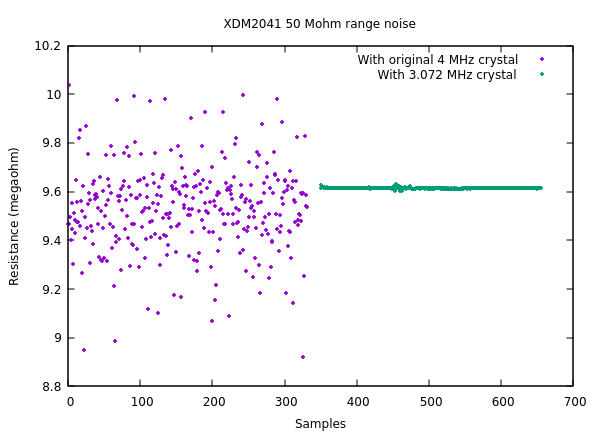
[Petteri] figured that the resulting sampling timing might work well enough with 60 Hz line frequency, but clearly with 50 Hz there was a lot of noise sneaking into the measurements. After swapping the crystal with a 3.072 MHz one, there was a marked improvement, as the plot shows.


Checking Up On Earth’s Sister Planet: NASA’s Upcoming Venus Missions

Even as we bask in the knowledge that our neighboring planet Mars is currently home to a multitude of still functional landers, a triplet of rovers and with an ever-growing satellite network as well as the first ever flying drone on another planet, our other neighboring planet Venus is truly playing the wallflower, with Japan’s Akatsuki orbiter as the lone active Venusian mission right now.

That is about to change, however, with NASA having selected two new missions that will explore Venus by the end of this decade. The DAVINCI+ and VERITAS missions aim to respectively characterize Venus’ atmosphere and map its surface in unprecedented detail. This should provide us information about possible tectonic activity, as well as details about the Venusian atmosphere which so far have been sorely missing.

Despite Venus being the closest match to our planet Earth, how is it possible that we have been neglecting it for so long, and what can we expect from future missions, including and beyond these two new NASA missions?

Continue reading “Checking Up On Earth’s Sister Planet: NASA’s Upcoming Venus Missions”

TerraPower’s Natrium: Combining A Fast Neutron Reactor With Built-In Grid Level Storage

Most new nuclear fission reactors being built today are of the light water reactor (LWR) type, which use water for neutron moderation into thermal neutrons as well as neutron capture. While straightforward and in use since the 1950s in commercial settings, they are also essentially limited to uranium (U-235) fuel. This is where fast neutron reactors are highly attractive.

Fast neutron reactors can also fission other fissile elements, covering the full spectrum of neutron cross sections. TerraPower’s Natrium reactor is one such fast reactor, and it’s the world’s first fast reactor that not only targets commercial use, but also comes with its own grid-level storage in the form of a molten salt reservoir.

The upshot of this is that not only can these Natrium reactors use all of the spent LWR fuel in the US and elsewhere as their fuel, but they should also be highly efficient at load-following, traditionally a weak spot of thermal plants.

TerraPower and its partners are currently looking to build a demonstration plant in Wyoming, at the site of a retiring coal plant. This would be a 345 MWe (peak 500 MWe) reactor.

Continue reading “TerraPower’s Natrium: Combining A Fast Neutron Reactor With Built-In Grid Level Storage”

Adding A Gentle Touch To Prosthetic Limbs With Somatosensory Stimulation

When Nathan Copeland suffered a car accident in 2004, damage to his spinal cord at the C5/C6 level resulted in tetraplegic paralysis. This left him initially at the age of 18 years old to consider a life without the use of his arms or legs, until he got selected in 2014 for a study at the University of Pittsburgh involving the controlling of a robotic limb using nothing but one’s mind and a BCI.

While this approach, as replicated in various other studies, works well enough for simple tasks, it comes with the major caveat that while it’s possible to control this robotic limb, there is no feedback from it. Normally when we try to for example grab an object with our hand, we are aware of the motion of our arm and hand, until the moment when our fingers touch the object which we’re reaching for.

In the case of these robotic limbs, the only form of feedback was of the visual type, where the user had to look at the arm and correct its action based on the observation of its position. Obviously this is far from ideal, which is why Nathan hadn’t just been implanted with Utah arrays that read out his motor cortex, but also arrays which connected to his somatosensory cortex.

As covered in a paper by Flesher et al. in Nature, by stimulating the somatosensory cortex, Nathan has over the past few years regained a large part of the sensation in his arm and hand back, even if they’re now a robotic limb. This raises the question of how complicated this approach is, and whether we can expect it to become a common feature of prosthetic limbs before long. Continue reading “Adding A Gentle Touch To Prosthetic Limbs With Somatosensory Stimulation”

Graphene lattice

How Graphene May Enable The Next Generations Of High-Density Hard Drives

After decades of improvements to hard disk drive (HDD) technology, manufacturers are now close to taking the next big leap that will boost storage density to new levels. Using laser-assisted writes, manufacturers like Seagate are projecting 50+ TB HDDs by 2026 and 120+ TB HDDs after 2030. One part of the secret recipe is heat-assisted magnetic recording (HAMR).

One of the hurdles with implementing HAMR is finding a protective coating for the magnetic media that can handle this frequent heating while also being thinner than current coatings, so that the head can move even closer to the surface. According to a recent paper by N. Dwivedi et al. published in Nature Communications, this new protective coating may have been found in the form of sheets of graphene.

Continue reading “How Graphene May Enable The Next Generations Of High-Density Hard Drives”

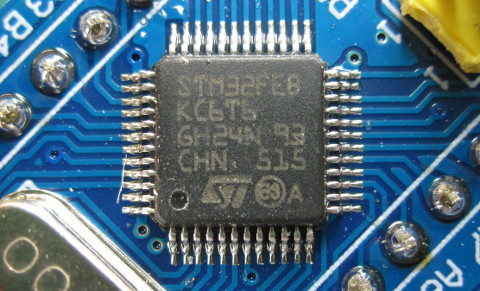
Test Your ‘Blue Pill’ Board For A Genuine STM32F103C8 MCU

With the market for STM32F103C8-based ‘Blue Pill’ boards slowly being overrun with boards that contain either a cloned, fake or outright broken chip, [Terry Porter] really wanted to have an easy, automated way to quickly detect whether a new board contains genuine STM32 silicon, or some fake that tries to look the part. After more than a year of work, the Blue Pill Diagnostics project is now ready for prime time.

We have covered those clone MCUs previously. It’s clear that some of those ‘Blue Pill’ boards obviously do not have a genuine STM32 MCU on them, as they do not have the STM32 markings on them, while others fake those markings on the package and identifying can be hard to impossible. Often only testing the MCU’s actual functionality can give clarity on whether it’s a real STM32 MCU.

These diagnostics allow one to test not only the 64 kB of Flash, but also the 64 kB of ‘hidden’ Flash that’s often found on these MCUs (rebadged 128 kB STM32F103 cores). It further checks the manufacturer JDEC code and uses a silicon bug in genuine STM32F1xx MCUs where the BGMCU_IDCODE cannot be read without either SWD or JTAG connected.

Another interesting feature of Blue Pill Diagnostics is using Mecrisp-Stellaris Forth as its foundation, which allows for easy access to a Forth shell via this firmware as well, not unlike MicroPython and Lua, only in a fraction of the Flash required by those. We have previously written about using Mecrisp-Stellaris in your projects.

The Compromises Of Raspberry Pi Hardware Documentation

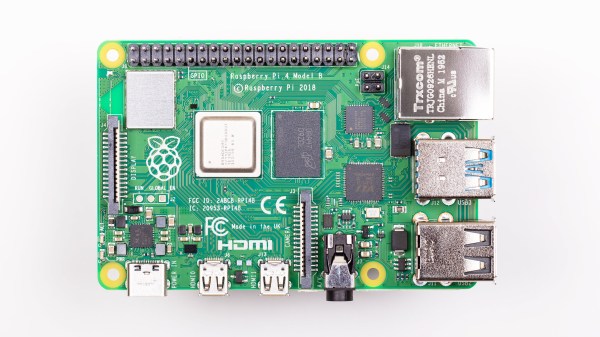
[Rowan Patterson] informed us about a recent ticket he opened over at the Raspberry Pi Documentation GitHub repository. He asked about the the lack of updates to the Raspberry Pi 4’s USB-C power schematics for this board. You may recall that the USB-C power issue was covered by us back in July of 2019, yet the current official  Raspberry Pi 4 schematics still show the flawed implementation, with the shorted CC pins, nearly two years later.

[Alasdair Allan], responsible for the Raspberry Pi  documentation, mentioned that they’re in the process of moving their documentation from Markdown to AsciiDoc, and said that they wouldn’t have time for new changes until that was done. But then [James Hughes], Principal Software Engineer at Raspberry Pi,  mentioned that the schematics may not be updated even after this change due to a of lack of manpower.

As [James] emphasized, their hardware will probably never be open, due to NDAs signed with Broadcom. The compromise solution has always been to publish limited peripheral schematics. Yet now even those limited schematics may not keep up with board revisions.

An easy fix for the Raspberry Pi 4’s schematics would be for someone in the community to reverse-engineer the exact changes made to the Raspberry Pi 4 board layout and mark these up in a revised schematic. This should be little more than the addition of a second 5.1 kΩ resistor, so that CC1 and CC2 each are connected to ground via their own resistor, instead of being shorted together.

Still, you might wish that Raspberry Pi would update the schematics for you, especially since they have updated versions internally. But the NDAs force them to duplicate their efforts, and at least right now that means that their public schematics do not reflect the reality of their hardware.