Nuclear Fusion At 100: The Hidden Race For Energy Supremacy

It’s hardly a secret that nuclear fusion has had a rough time when it comes to its image in the media: the miracle power source that is always ‘just ten years away’.  Even if no self-respecting physicist would ever make such a statement, the arrival of commercial nuclear fusion power cannot come quickly enough for many. With the promise of virtually endless, clean energy with no waste, it does truly sound like something from a science-fiction story.

Meanwhile, in the world of non-fiction, generations of scientists have dedicated their careers to understanding better how plasma in a reactor behaves, how to contain it and what types of fuels would work best for a fusion reactor, especially one that has to run continuously, with a net positive energy output. In this regard, 2020 is an exciting year, with the German Wendelstein 7-X stellarator reaching its final configuration, and the Chinese HL-2M tokamak about to fire up.

Join me after the break as I look into what a century of progress in fusion research has brought us and where it will take us next.

Continue reading “Nuclear Fusion At 100: The Hidden Race For Energy Supremacy”

Tetraethyl Lead: The Solution To One, And Cause Of Many New Problems

From the 1920s until the 1970s, most gasoline cars in the USA were using fuel that had lead mixed into it. The reason for this was to reduce the engine knocking effect from abnormal combustion in internal combustion engines of the time. While lead — in the form of tetraethyllead — was effective at this, even the 1920s saw both the existence of alternative antiknock agents and an uncomfortable awareness of the health implications of lead exposure.

We’ll look at what drove the adoption of tetraethyllead, and why it was phased out once the environmental and health-related issues came into focus. But what about its antiknock effects? We’ll also be looking at the alternative antiknock agents that took its place and how this engine knocking issue is handled these days.

Continue reading “Tetraethyl Lead: The Solution To One, And Cause Of Many New Problems”

The Barcode Revolution: Welcome To Our Automated World

Featured in many sci-fi stories as a quicker, more efficient way to record and transfer information, barcodes are both extremely commonplace today, and still amazingly poorly understood by many. Originally designed as a way to allow for increased automation by allowing computer systems to scan a code with information about the item it labels, its potential as an information carrier is becoming ever more popular.

Without the tagging ability of barcodes (and their close cousin: RFID tags), much of today’s modern world would grind to a halt. The automated sorting and delivery systems for mail and parcels, entire inventory management systems, the tracing of critical avionics and rocketry components around the globe, as well as seemingly mundane but widely utilized rapid checkout at the supermarket, all depends on some variety of barcodes.

Join me on a trip through the past, present and future of the humble barcode.

Continue reading “The Barcode Revolution: Welcome To Our Automated World”

The Story Of The Quickening: Mercurial Metal

Of all known metals, mercury is probably one of the most famous, if only for its lustrous, liquid form at room temperature. Over the centuries, it has been commonly used in a wide variety of applications, including industrial chemical processes, in cosmetics, for telescope mirrors, thermometers, fluorescent lamps, dental fillings, bearings, batteries, switches and most recently in atomic clocks.

Though hardly free from the controversy often surrounding a toxic heavy metal, it’s hard to argue the myriad ways in which mercury has played a positive role in humanity’s technological progress and scientific discoveries. This article will focus both on its historical, current, and possible future uses, as well as the darker side of this fascinating metal.

Continue reading “The Story Of The Quickening: Mercurial Metal”

RISC-V: Why The ISA Battles Aren’t Over Yet

A computer processor uses a so-called Instruction Set Architecture to talk with the world outside of its own circuitry. This ISA consists of a number of instructions, which essentially define the functionality of that processor, which explains why so many ISAs still exist today. It’s hard to find that one ISA that works for as many distinct use cases as possible, after all.

A fairly new ISA is RISC-V, the first version of which was created back in 2010 at the University of California, Berkeley. Intended to be a fully open ISA, targeting both students (as a learning tool) and industrial users, it is claimed to incorporate a number of design choices that should make it more attractive for a number of applications.

In this article I’ll take a look behind the marketing to take stock of how exactly RISC-V differs from other open ISAs, including Power, SPARC and MIPS.

Continue reading “RISC-V: Why The ISA Battles Aren’t Over Yet”

New Part Day: Alexa Connect Kit Now Available For Sale

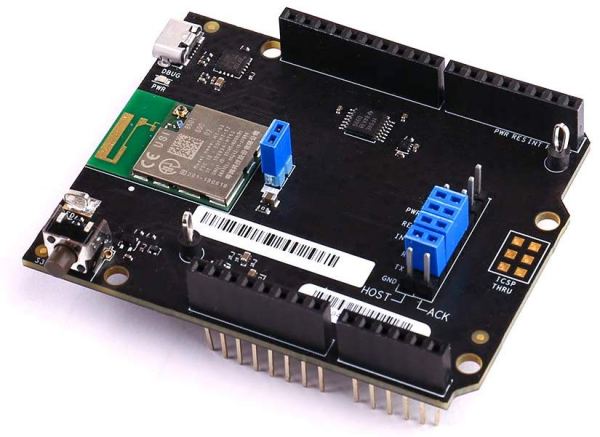
People who were subscribed to updates on the Alexa Connect Kit (ACK) would recently have received an email informing that this kit is now available for sale. Last time we covered the ACK was back in September of 2018, the ‘release’ moniker meant ‘preview’ and there wasn’t any hardware one could actually purchase.

Over a year a later it seems that we can now finally get our grubby mitts on this kit that should enable us to make any of our projects Alexa-enabled. What this basically seems to mean is that one can spend close to 200 US dollars on an Arduino Zero and an Arduino shield-mounted WM-BN-MT-52 module from USI (though not listed on their site, but similar to the WM-BN-BM-22?) that integrates a 192 MHz Cortex-M MCU and a WiFi/Bluetooth module, as summarized on the Amazon Developer page for the ACK.

Continue reading “New Part Day: Alexa Connect Kit Now Available For Sale”

Building A 6.5 Digit Voltmeter From Scratch

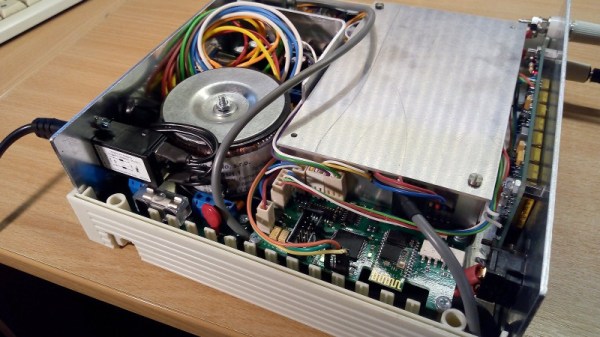
After initially working to create a modernized replica of a Czechoslovakian 4-digit Metra M1T242 voltmeter, [Jaromir Sukuba] figured that while he was at it, he might as well create a voltmeter that would be slightly more capable. This led to the design and construction of a brand-new, 6.5 digit voltmeter design, which [Jaromir] has documented over at EEVBlog.

Employing an MSP430FR5994 MCU for the digital board, and an Altera/Intel EPM240T100 CPLD plus ADC on the input side, the design has been undergoing validation for a while now. The current revision uses an OPA140 op-amp in an integrating ADC setup in a multi-slope run-up configuration, but [Jaromir] has plans to replace this input board with another op-amp in a more efficient topology in the future.

Continue reading “Building A 6.5 Digit Voltmeter From Scratch”