VRML And The Dream Of Bringing 3D To The World Wide Web

You don’t have to be a Snow Crash or Tron fan to be familiar with the 3D craze that characterized the rise of the Internet and the World Wide Web in particular. From phrases like ‘surfing the information highway’ to sectioning websites as if to represent 3D real-life equivalents or sorting them by virtual streets like Geocities did, there has always been a strong push to make the Internet a more three-dimensional experience.

This is perhaps not so strange considering that we humans are ourselves 3D beings used to interacting in a 3D world. Surely we could make this fancy new ‘Internet’ technology do something more futuristic than connect us to text-based BBSes and serve HTML pages with heavily dithered images?

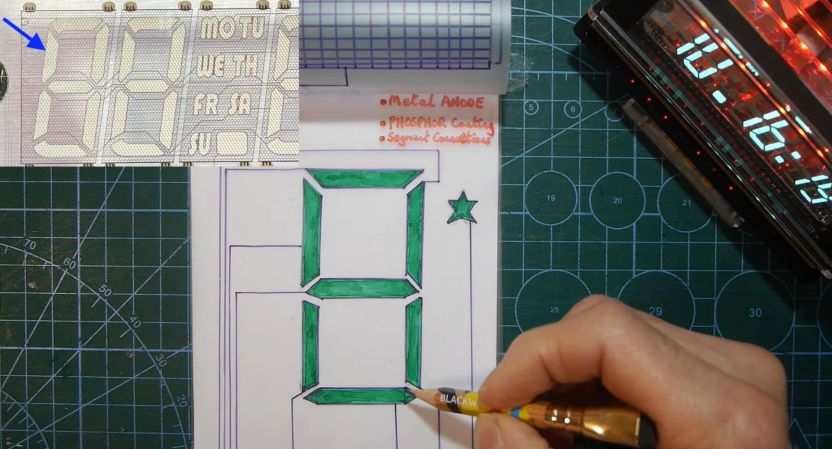
Enter VRML, the Virtual Reality Modelling Language, whose 3D worlds would surely herald the arrival of a new Internet era. Though neither VRML nor its successor X3D became a hit, they did leave their marks and are arguably the reason why we have technologies like WebGL today.

Continue reading “VRML And The Dream Of Bringing 3D To The World Wide Web”

A Portable 12 VDC Water Chiller For The Chemistry Lab

Having a chiller is often essential for the chemistry laboratory, but what if you’re somewhere without easy access to water, nevermind a mains outlet to plug your usual chiller into? In that case you can build a portable one that will happily run off the 12 VDC provided by a mobile source like the accessory outlet in a car while reusing the water from its reservoir, as demonstrated by [Markus Bindhammer] in a recent video.

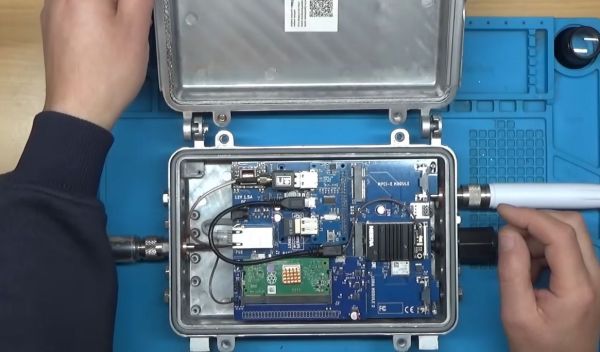
The build uses a compressor-based freezer as the base, which is significantly more capable than the typical Peltier-cooled refrigerators that cannot cool as fast or efficiently. The changes he made involve running in- and outlet tubing into the freezer’s compartment, with a submerged 12 VDC water pump providing the water to the outlet. This pump is controlled by a variable speed controller board that’s put in a box on the outside with the power lead also sneaking into the freezer. With these modifications in place the freezer’s functionality isn’t significantly impacted, so it can be used as normal.

After filling the compartment with water, the lid is closed and the freezer engaged. The pump controller is then switched on, with the water flow adjusted to fit the distillation job at hand. Although in this case a fairly small freezer was modified, nobody is saying that you cannot also do it with a much larger freezer, and fill it with ice cream and other treats to help it and lab critters cool down faster.

Continue reading “A Portable 12 VDC Water Chiller For The Chemistry Lab”

How To Design 3D-Printed Parts With Tolerance In Mind

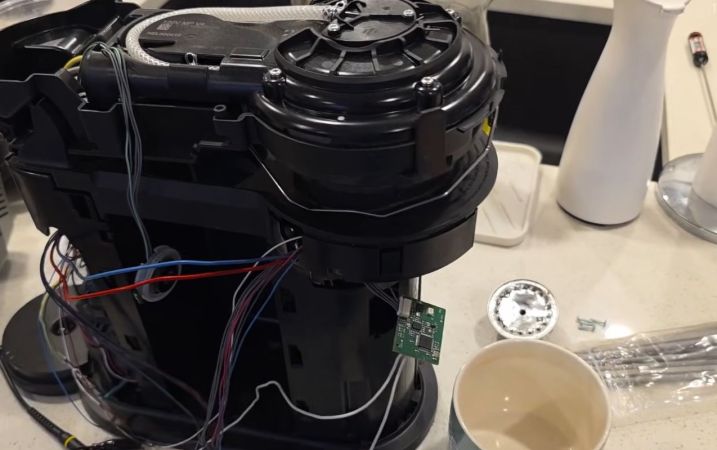
One of the continuing struggles with FDM printing is making sure that parts that should fit together actually do. While adding significant tolerance between parts is an option, often you want to have a friction fit or at least a gap that you cannot drive a truck through. In a video by [Slant 3D] a number of tips and tricks to improve parts design with tolerance in mind are provided.

Starting with the fairly obvious, such as avoiding sharp corners, rounding off edges and using chamfered edges  and filets for e.g. lids to make getting started easy, the video then moves into more advanced topics. Material shrinkage is a concern, which is where using thin walls instead of solid blocks of material helps, as does using an appropriate infill type. Another interesting idea is to use a compliant mechanism in the lid to get a friction fit without getting all print parameters just right.

On the opposing side to the lid – or equivalent part – you’d follow many of the same tips, with the addition of e.g. slots that allow for the part to flex somewhat. All of this helps to deal with any variability between prints, with the suggested grip fins at the end of the video being probably the most extreme.

Continue reading “How To Design 3D-Printed Parts With Tolerance In Mind”

A Gentle Introduction To Fortran

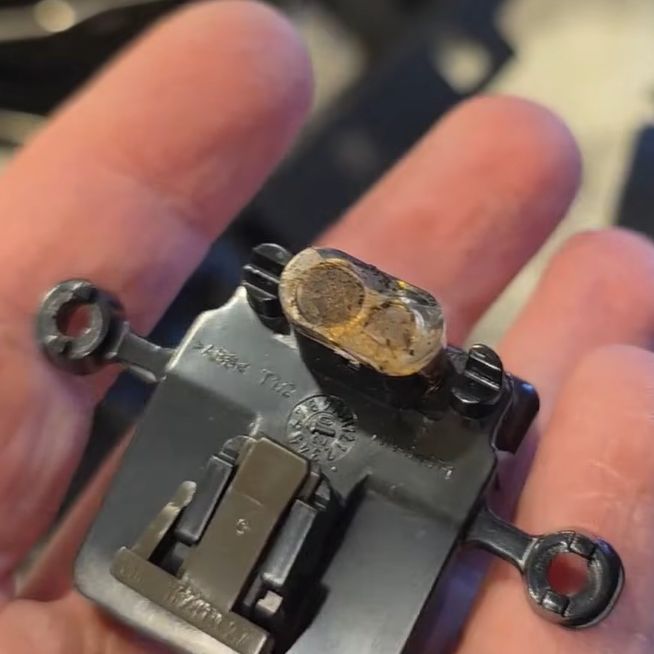
Originally known as FORTRAN, but written in lower case since the 1990s with Fortran 90, this language was developed initially by John Backus as a way to make writing programs for the IBM 704 mainframe easier. The 704 was a 1954 mainframe with the honor of being the first mass-produced computer that supported hardware-based floating point calculations. This functionality opened it up to a whole new dimension of scientific computing, with use by Bell Labs, US national laboratories, NACA (later NASA), and many universities.

Much of this work involved turning equations for fluid dynamics and similar into programs that could be run on mainframes like the 704. This translating of formulas used to be done tediously in assembly languages before Backus’ Formula Translator (FORTRAN) was introduced to remove most of this tedium. With it, engineers and physicists could focus on doing their work and generating results rather than deal with the minutiae of assembly code. Decades later, this is still what Fortran is used for today, as a domain-specific language (DSL) for scientific computing and related fields.

In this introduction to Fortran 90 and its later updates we will be looking at what exactly it is that makes Fortran still such a good choice today, as well as how to get started with it.

Continue reading “A Gentle Introduction To Fortran”

The Scourge Of Fake Retro Unijunction Transistors

We all know that it’s easy to get caught out by fake electronic components these days, with everything from microcontrollers to specialized ASICs being fair game. More recently, retro components that were considered obsolete decades ago are now becoming increasingly popular, with the unijunction transistor (UJT) a surprising example of this. The [En Clave de Retro] YouTube channel released a video (Spanish, with English dub) documenting fake UJTs bought off AliExpress.

These AliExpress UJTs were discovered after comments to an earlier video on real UJTs said that these obsolete transistors are still being manufactured and can be bought everywhere, meaning mostly on AliExpress and Amazon. Of course, this had to be investigated, as why would anyone still manufacture UJTs today, and did some Chinese semiconductor factory really spin up a new production line for them?

Perhaps unsurprisingly, some tests later and after a quick decapping of the metal can, the inside revealed a bipolar transistor (BJT) die (see top image on the left). Specifically, a PNP BJT transistor die, packaged up inside a vintage-style metal can with fake markings claiming it is a 2N2646 UJT.

The video suggests that scams like these might be because people want to get vintage parts for cheap, and that’s created a new market for people who would rather get scammed than deal with the sticker shock of paying for genuine new-old-stock or salvaged components. For example, while programmable unijunction transistors (PUTs) like the 2N6028 are still being manufactured, they cost a few dollars a pop in low quantities. UJTs used to be common in timer circuits, but now we have the 555.

Continue reading “The Scourge Of Fake Retro Unijunction Transistors”

TDA7000 die shot, with labels. Credit: Ken Shirriff

Reverse-Engineering The TDA7000 FM Radio Receiver IC

A wristwatch featuring the TDA7000 FM radio receiver IC. (Credit: Philips Technical Review)

During the 1980s a lot of consumer devices suddenly got a lot smaller as large-scale integration using semiconductor technology took off. This included radios, with Philips’ TDA7000 FM radio receiver IC being the first to cram most of what you’d need for an FM radio receiver into a single chip. Recently, [Ken Shirriff] had a poke at analyzing a die shot of the TDA7000, reverse-engineering its functional blocks. How did the Philips engineers manage to miniaturize an FM radio? [Ken] will show you.

Continue reading “Reverse-Engineering The TDA7000 FM Radio Receiver IC”

Why Cheap Digital Microscopes Are Pretty Terrible

The depth of field you get with a cheap Tomlov DM9 digital microscope. Pictured is the tip of a ballpoint. (Credit: Outdoors55, YouTube)

We have all seen those cheap digital microscopes, whether in USB format or with its own screen, all of them promising super-clear images of everything from butterfly wings to electronics at amazing magnification levels. In response to this, we have to paraphrase The Simpsons: in this Universe, we obey the laws of physics. This applies doubly so for image sensors and optics, which is where fundamental physics can only be dodged so far by heavy post-processing. In a recent video, the [Outdoors55] YouTube channel goes over these exact details, comparing a Tomlov DM9 digital microscope from Amazon to a quality macro lens on an APS-C format Sony Alpha a6400.

First of all, the magnification levels listed are effectively meaningless, as you are comparing a very tiny image sensor to something like an APS-C sensor, which itself is smaller than a full-frame sensor (i.e., 35 mm). As demonstrated in the video, the much larger sensor already gives you the ability to see many more details even before cranking the optical zoom levels up to something like 5 times, never mind the 1,500x claimed for the DM9.

On the optics side, the lack of significant depth of field is problematic. Although the workarounds suggested in the video work, such as focus stacking and diffusing the light projected onto the subject, it is essential to be aware of the limitations of these microscopes. That said, since we’re comparing a $150 digital microscope with a $1,500  Sony digital camera with macro lens, there’s some leeway here to say that the former will be ‘good enough’ for many tasks, but so might a simple jeweler’s loupe for even less.

There are some reasonable hobby-grade USB microscopes. There are also some hard-to-use toys.

Continue reading “Why Cheap Digital Microscopes Are Pretty Terrible”