Showing Off A High-performance Brushless Motor Camera Gimbal

gopro-brushless-motor-gimbal

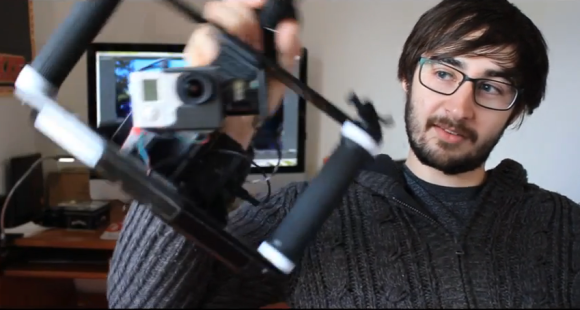
Here’s [Tom Parker] showing off a brushless motor gimbal stabilizer for his GoPro camera. We saw a similar project a couple of weeks back that featured a 3d printed quadcopter mount. This offering is meant to be held in your hands. It keeps the subject in frame even if the cameraman’s hands pitch and roll (we figured aeronautical terms were best here). This image shows him demonstrating a level camera as he quickly rolls the frame from one side to the other. It doesn’t compensate for yaw, which is something he may change in the next iteration. We already like the results he’s getting with it.

About 3:15 into the video demo below we get a very quick description of the build itself. He started it as a project at University. Fabrication included work on a 3D printer, laser cutter, and vacuum forming machine. The grips are bicycle handlebar components. To overcome the stabilization system the operator has access to a joystick. Without this you’d never be able to aim the camera up or down because of auto-leveling.

Continue reading “Showing Off A High-performance Brushless Motor Camera Gimbal”
DIP Switch Adjusted Voltage Regulator

dip-settable-variable-supply

It couldn’t be simpler but you have to admit that a small adjustable portable power supply like this one will be really handy.

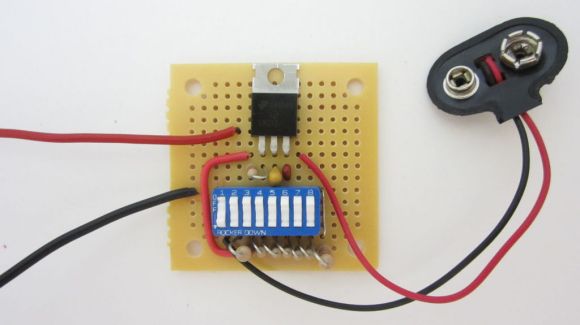
The main part of the PSU is an LM317 linear voltage regulator which we’re already familiar with. The output voltage is adjustable based on a voltage divider between two of the pins. The set of eight DIP switches allows you to tweak that voltage divider. Switch number one connects the 9-volt battery connector to the regulator, serving as a power switch. Each of the other seven switches adjusts the output voltage by 1.5 volts. The output of the regulator connects to your target device using alligator clips which are not in frame above.

[Jason] says he takes this with him when thrift store hunting for cheap electronics. It can mimic most combinations of Alkaline cells letting you power up electronic toys to ensure they work. But we would find it equally useful for getting that early prototype away from the bench supply for testing before finalizing a dedicated portable supply.

Continue reading “DIP Switch Adjusted Voltage Regulator”

Perfect Wall-mounted Tablet Integration

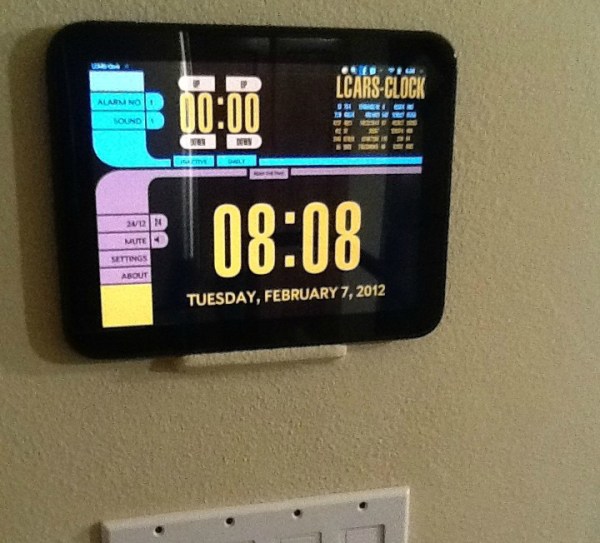
There’s a building downtown built about ten years ago that has tablet-sized LCD screens next to the entrance of each large meeting room. They’re never on and we always wonder why they didn’t just use one of those things that holds a sheet of printer paper to label what’s happening in the meeting space? Now this is a similar idea but with much better execution. Instead of just displaying data the in-wall tablet mount makes your room interactive.

[Tim’s] been working on it for a couple of years. He started out trying to house an iPod Touch behind a junction box cover plate. There are some pictures of that at the top of his build album. That didn’t quite take so keep scrolling to see the path to the finished product shown above. He cut a hole in the drywall and figured out how to mount a tablet dock that includes inductive charging. It holds the tablet in place with the small ledge and a few magnets, keeping its battery charged without a need for wires. Once tested he mudded, sanded, textured, and painted for a perfect finished product.

Hand Soldering BGA Wafer Chips

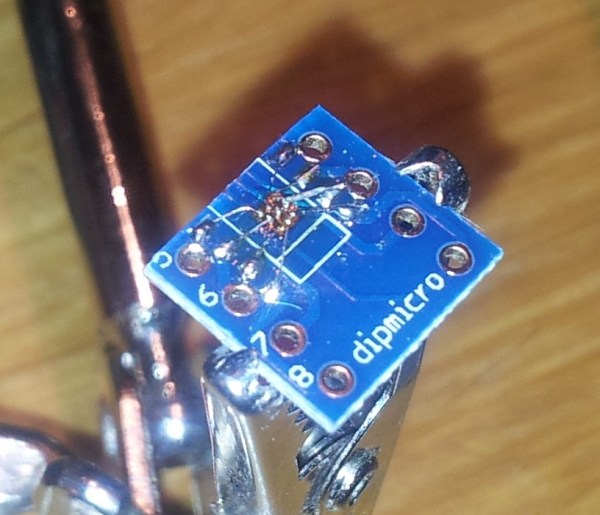
And here we’ve been complaining about Flat Pack No-Lead chips when this guy is prototyping with Ball Grid Array in a Wafer-Level Chip Scale Package (WLCSP). Haven’t heard that acronym before? Neither had we. It means you get the silicon wafer without a plastic housing in order to save space in your design. Want to use that on a breadboard. You’re crazy!

Eh, that’s just a knee jerk reaction. The wafer-level isn’t that unorthodox as far as manufacturing goes. It’s something like chip on board electronics which have that black blob of epoxy sealing them after the connections are made. This image shows those connections which use magnet wire on a DIP breakout board. [Jason] used epoxy to glue the wafer down before grabbing his iron. It took 90 minutes to solder the nine connections, but his second attempt cut that process down to just 20. After a round of testing he used more epoxy to completely encase the chip and wires.

It works for parts with low pin-counts. But add one row/column and you’re talking about making sixteen perfect connections instead of just nine.

Deep Woods Cabin; One Man, His Tools, And A Camera On A Tripod

We remember watching Alone in the Woods years ago on Public Television. It’s a story of a self-sufficient man named [Dick Proenneke] who loved the outdoors and decided to live alone in the Alaskan wilderness. It’s a remarkable story made more so by the film footage he made to document his experience. That teaser doesn’t do it justice, so check out the web page summaries as well and consider picking up a copy of the films for yourself.

The films include hiking, hunting, observing nature, and building this sweet pad which even [Steve] would be proud of. The first summer he left his native Iowa and scouted for cabin locations near Twin Lakes, Alaska. After finding a suitable location he felled enough trees to build the entire 11′ by 14′ structure and headed back home for the winter.

The next summer he packed in the tools seen above, and got to work. His build includes a stone fire-place as well as a door, windows, and a moss-covered roof. He did return to the continental US one more time, but ended up going back to Alaska to spend another 30 years in the cabin.

Continue reading “Deep Woods Cabin; One Man, His Tools, And A Camera On A Tripod”

Super-precise Light Painting From A Delta Robot

delta-robot-light-painting

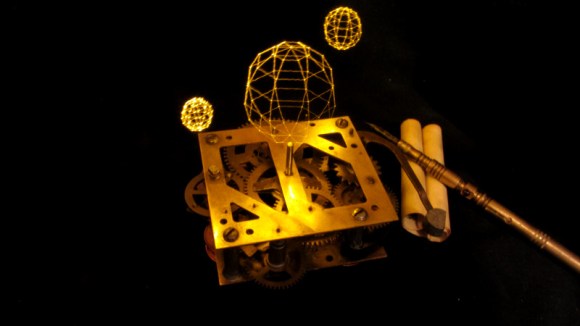
The points of those geometric shapes line up perfectly thanks to the delta robot arm controlling the light source. The source is a simple LED that can be switched on and off as it moves. A camera is set up in a dark room to keep the shutter open while the arm moves. We’re assuming that all of the light for the stationary objects in this image comes from the LED as well.

[Sick Sad] built the delta bot for just for this purpose. Check out the video below to see, and perhaps more importantly hear, the thing in motion. Seriously, the whine of the stepper motors is pretty awesome on this one.

The delta concept uses a central head on three arms angled down from above. If the LED is also pointed down it won’t light up the hardware and that’s why it doesn’t show up in the image. We’ve seen similar accuracy when using this style of machine for 3D printing. But if you don’t want to build a complicated machine you can try this out with a simple string plotter.

Continue reading “Super-precise Light Painting From A Delta Robot”

Family Pulls Together To Build Dad’s Casket

build-your-own-casket

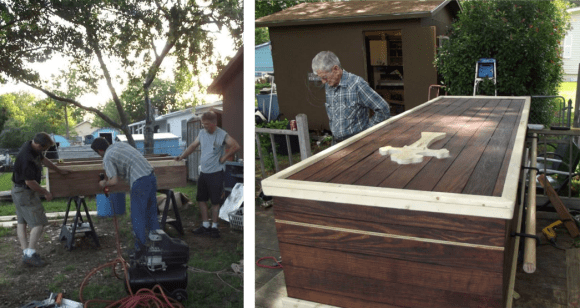
In these modern times we don’t often hear about families building their own caskets. But this project log documenting the deceased’s brother and sons fabricating a top of the line casket is really heartwarming. You may be thinking that they wouldn’t be able to include all the features you’d find on a commercially produced model. However, we remember seeing an episode of How It’s Made about caskets and there’s not much more than carpentry and simple upholstery involved.

The build starts with a plywood box lined with thin wooden ribs for added strength. The group then wrapped it with thin strips of dimensional lumber (maybe flooring?) which look great after a coat of stain. We’re not sure where the metal brackets for the two side rails came from. If you recognize them we’d love to hear about it in the comments.

The bottom line here is that for families used to working with their hands this is a great tribute and a way to commune with each other after the recent loss.

[via Reddit]