Swiss Army Keys

swiss-army-keys

This isn’t a hack that shows you how to start a car without the keys. It’s a way to ditch the bulky keyring for a set of fold-out keys. [Colonel Crunch] removed the blades from the pocket knife and replaced them with the two keys for his car (one is ignition and door locks, the other opens the trunk). He didn’t take pictures of the process, but he did link to this unrelated guide on how it’s done.

About one minute into the video after the break we see each step in the build process. First the plastic trim is removed from either side of the knife. The blades are basically riveted on; there’s a pin which holds them in and either side of it has been pressed to that it can no longer move through the holes in the frame. To get around this one side is ground off with a rotary tool, and the pin is then tapped out with a hammer. The removed blade/scissors/tool is used as a template to cut the body of the key down to size and shape.  The pin is then hammered back into place before putting the plastic trim back on.

Continue reading “Swiss Army Keys”

Pair Of Musical Hacks Use Sensor Arrays As Keyboards

sensor-driven-musical-keyboards

This pair of musical keyboard hacks both use light to detect inputs. The pair of tips came in on the same day, which sparks talk of consipiracy theory here at Hackaday. Something in the weather must influence what types of projects people take on because we frequently see trends like this one. Video of both projects is embedded after the jump.

On the left is a light-sensitive keyboard which [Kaziem] is showing off. In this image he’s rolling a marble around on the surface. As it passes over the Cadmium Sulfide sensors (which are arranged in the pattern of white and black keys from a piano keyboard) the instrument plays pitches based on the changing light levels. [Thanks Michael via Make]

To the right is [Lex’s] proximity sensor keyboard. It uses a half-dozen Infrared proximity sensor which pick up reflected light. He calls it a ‘quantised theremin’ and after seeing it in action we understand why. The overclocked Raspberry Pi playing the tones reacts differently based on distance from the keyboard itself, and hand alignment with the different sensors.

Continue reading “Pair Of Musical Hacks Use Sensor Arrays As Keyboards”

RF Switching Module Can Learn New Remotes

rf-remote-also-learns-by-itself

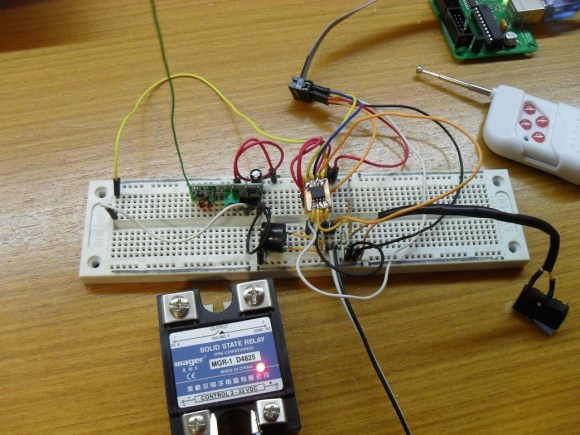
This breadboarded circuit is [Sergio’s] solution to controlling appliances wirelessly. Specifically he wanted a way to turn his pool pump on and off from inside the house. Since he had most of the parts on hand he decided to build a solution himself. What he ended up with is an RF base station that can learn to take commands from different remote devices.

The main components include the solid state relay at the bottom of the image. This lets the ATtiny13 switch mains voltage appliances. The microcontroller (on the copper clad square at the center of the breadboard) interfaces with the green radio frequency board to its left. On the right is a single leaf switch. This acts as the input. A quick click will toggle the relay, but a three-second press puts the device in learning mode. [Sergio] can then press a button on an RF remote and the device will store the received code in EEPROM. As you can see in the clip after the break, he even included a way to forget a remote code.

Continue reading “RF Switching Module Can Learn New Remotes”

Freezing Android To Crack The Encryption

frozen-phone-encryption-hacking

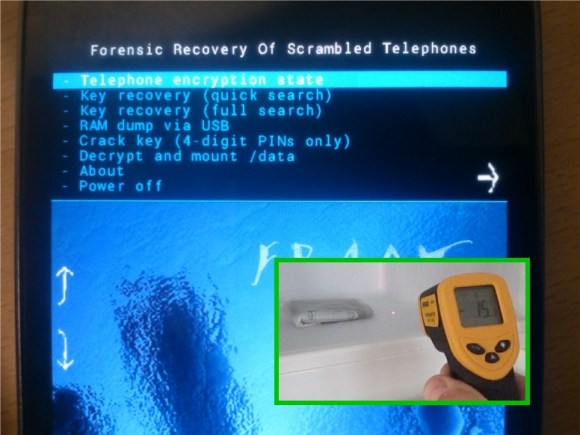
Build a better lock and someone will make a tool to open it without the key. Or in this case they’ve made a tool to discover the key using a trip to through the deep freeze. The Forensic Recovery of Scrambled Telephones — or FROST — uses cold temperatures and a custom recovery image to crack Android encryption keys.

Cold boot hacks go way back. They leverage use of low temperatures to slow down the RAM in a device. In this case, the target phone must already be powered on. Booting a phone that uses the encryption offered by Android 4.0 and newer requires the owner’s pass code to decrypt the user partition. But it then remains usable until the next power cycle. By freezing the phone, then very quickly disconnecting and reconnecting the battery, researchers were able to flash their own recovery image without having the encryption key cleared from RAM. As you can see above, that recovery package can snoop for the key in several different ways.

[Thanks Rob]

Solar Clock Uses Capacitors For Style And Function

solar-clock-uses-storage-capacitors-and-batteries

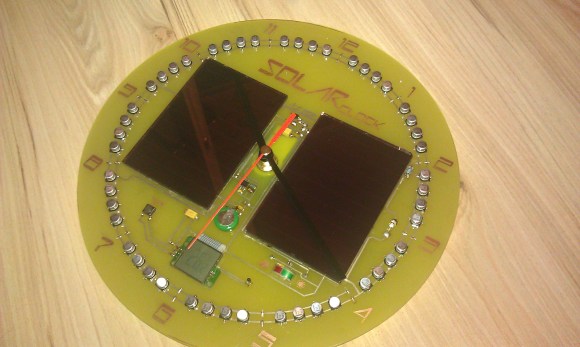
This solar clock was built using a lot of salvaged parts. We find it interesting that [Nereus] combined a ring of storage capacitors with a power cell (translated) to create a hybrid energy storage setup.

The machine translation makes it a bit rough to understand how this works, but the schematic helps quite a bit. The pair of solar cells, which were pulled from some cheap solar cellphone chargers, feed the bank of capacitors encircling the clock face. If placed in a room that gets plenty of sunlight the cells will top off the capacitors which then feed an ICL7663 regulator. We’d love to hear comments on this part choice, as it’s our experience that linear regulators are rather inefficient. But anyway, the regulated power feeds both the energy cell as well as the clock motor. When output from the regulator dips the battery picks up the slack. The project also includes a voltometer and thermometer which can be displayed on the tiny LCD screen just about the six o’clock tick mark.

Now if you want something completely battery-free you’ll have to check out [Jack Buffington’s] take on solar clock.

[Thanks Manekinen]

Hacked Auxiliary Port For A Car Stereo

hacked-auxiliary-port-car-stereo
We’re not sure if [Apachem25] is just lucky, or if installing Auxiliary ports on most car stereos is this easy. The dealership wanted $95 to put one in, but he managed to add a 3.5mm audio-in port to his car stereo for just a couple of bucks.

The connector on the back of his head unit is a 2×4 set of pins recessed in a protective plastic ring. It turns out that the audio connector cable for a PC CD-ROM drive has a 1×4 socket that is perfect for this. [Apachem25] simply clipped one of those cables in half and used both ends to interface with the Aux port. He found the pin-out for his particular model on the Internet. He needed a specific resistance value between two of the pins to get the deck to let him use the input. All that he needed was a quick bit of soldering. The left, right, and ground are brought around the side and soldered to an audio jack he added in the face plate of the unit.

If you’re still rockin’ the cassette deck our favorite automotive Bluetooth solution is still this one for a classic Beetle.

[via Reddit]

Diamond Ore Wall Lamp Brings Minecraft Into Your Home

diamond-ore-lamp

We were surprised to see all of the Christmas gifts that revolved around Minecraft. Seems like there’s a lot of stuff for sale, but we still like the DIY spirit that comes with making your own. [Thacrudd] recently finished this project. It’s a wall lamp that looks like Minecraft’s diamond ore.

The enclosure is a wood box that used to contain chocolates. After studying the pixel art texture for the game’s diamond ore blocks he marked out the pattern and headed over to the scroll to rough them out before finishing with files and a rasp. Next came paint, which was sourced as a sample from the home store. This left him with one shade of gray, but the variations were easy to add by mixing it with white or black.

A strip of white LEDs gives the lamp its inner glow. The openings have been covered with blue acrylic which keep the dust out while providing the appropriate hue.

[via Reddit]