Get Ready To Play Some Wicked Air Harp

Who needs a tactile interface when you can wave your hands in the air to make music? Air String makes that possible and surprisingly it does so without the use of a Kinect sensor.

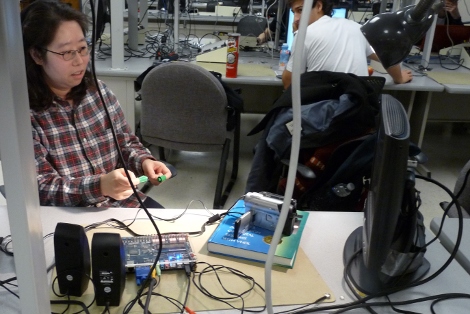
In the image above, you can see that two green marker caps are used as plectra to draw music out of the non-existent strings. Judiciously perched atop that Analysis and Design of Digital Systems with VHDL textbook is a camcorder recording an image of the player. This signal is processed by an FPGA (hence the textbook) in real-time, and shown on the monitor seen to the right. A set of guides are overlaid on the image, so the player knows where to pluck to get the notes she is expecting.

The program is designed to pick up on bright green colors as the inputs. It works like a charm as you can see in the video after the break. The team of Cornell students responsible for the project also mention a few possible improvements like adding a distance sensor (ultrasonic rangefinder?) so that depth can be used for the dynamics of the sound.

Continue reading “Get Ready To Play Some Wicked Air Harp”

Kindle Fire Cover From A Moleskine Journal

[Kevin Haw] is the proud owner of a brand new Kindle Fire. But to protect the investment he wanted a nice looking case and decided that DIY was the way to go. He ended up repurposing a Moleskine journal as a table cover.

You can do this one yourself in under an hour. Most of the pages in these journals are sewn in place and [Kevin] started by cutting the strings with a hobby knife. Once removed, he used a utility knife to separate the pages that were glued to the cover; this leaves you in the state seen above.

Obviously this unfinished look just won’t do. [Kevin] used some red duct tape duct tape to cover the unsightly spine. This adds strength, and does the job of cleaning up the area, but we might have also applied felt (or microfiber cloth) to the entire inside area for a bit more finished look. The final part is mounting the tablet which was accomplished with adhesive Velcro strips. These can be removed from the back of the Kindle Fire later on if you decided to use a different enclosure.

Simple PCB Vise

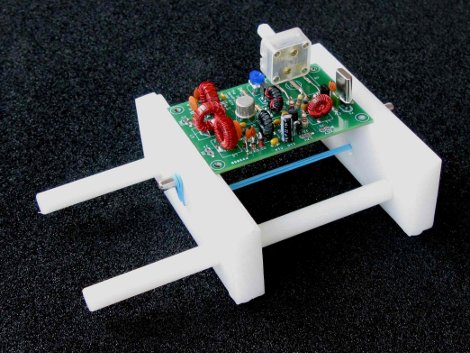
This one almost got relegated to a links post, but [Ken’s] simple PCB vise (PDF) is just so useful we had to give it a standalone feature. It works so well because he made every design feature count.

For instance, the groove the holds the PCB (almost impossible to see here but look at the diagrams in the PDF linked above) is cut with a dovetail bit, rather than just being a square rabbit. The clamping force is provided by that blue rubber band which simply hooks on a metal shelf peg on each side of the clamping plates. Those plates are machined out of polyethylene and slide nicely along the two nylon rods which keep them aligned. There’s really nothing to break or wear out here, except the rubber band with is easily replaceable. The rubber feet keep it from sliding across the bench as you work.

This is great for soldering, and would go right along with those diy smd parts clamps you made. It’s also a great way to hold onto your prototype boards when you’re working out the firmware.

Crunching The Numbers: Using Solar Cells Indoors

[Mathieu] was interested in using more solar cells for his everday electronics. He looked around but couldn’t find much information about using pholovoltaic for small indoor devices. We remember hearing some of the same things from [Dave Jones] in one of his EEVblog installments from a few years ago which looked at solar calculators; the only indoor solar gadget we can think of.

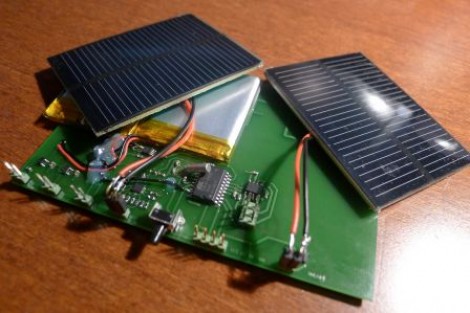
The quest for knowledge was on and [Mathieu] decided to build this indoor solar cell test platform. It’s a stable piece of hardware that allows him to run reliable tests in many different conditions. It’s designed to compare two identical cells. One is charging the Lithium cell, the other is driving a load directly. A second battery powers the platform separately from the solar circuits so that it can be used as a data logger. He collects, dumps, and graphs info from his test runs, then discusses his findings. We won’t spoil it, but the results are not great. Mostly you need sunlight to get real results as it’s just so much more powerful than artificial lighting.

Muff-Fones Sound Dirty; Well, Not Literally

Baby, it’s cold outside. But that doesn’t stop [Grissini] from listening to some tunes when not indoors. He added headphones to a pair of ear warmers. We guess you could call them ear muffs, which is where the name comes from. But these are the newer type that wrap around the back of your head.

[Grissini] picked up a set of headphones that similarly wrap around the back of your head. After pulling the speakers out of their plastic enclosures he needed a way to soften the sharp edges when they’ll be pressed against your ears. Sugru once again shows its versatility by providing a soft, self-bonding, and moldable surface. The last step is dead simple, as the ear warmers already have a fabric pocket by each ear perfect for accepting the speakers.

Now we need this to go one step further, by making them wireless. We figure hacking in a bluetooth headset board would make it work with your cellphone. Or you could roll your own minimal MP3 board and house it in the part that wraps around your neck.

Hackaday Links: December 11, 2011

Drilling square holes

We’re still a bit baffled by the physics of this, but apparently it’s possible to drill a square hole with a round bit. This video shows square holes being milled using a cutter which is offset from the center of the bit. [Thanks Jordan]

LED Motorcycle headlight driven by mains

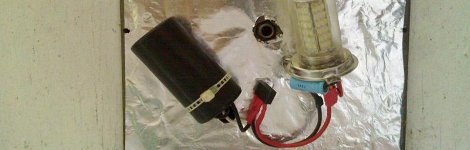
[William] found a way to use a big capacitor and bridge rectifier to run this H4 LED headlight bulb in a mains sconce lamp.

Electronic slide whistle

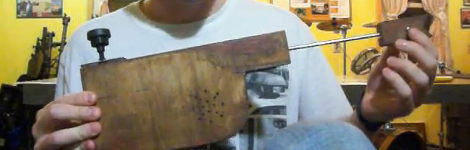
Here’s an electronic instrument that [Dorian] made. It uses a linear potentiometer and a button and works much like a slide whistle would.

Robot rocks out to Daft Punk

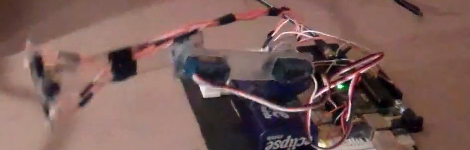
[Adrian] didn’t just make a robot arm out of CD cases and a mints tin. He built the arm, then made a music video featuring it.

More light-pipe sensor experiments

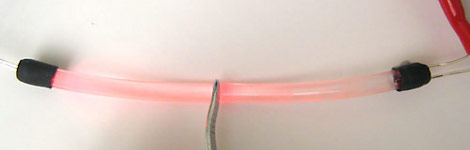
[Uwe] has been working on an input sensor using a flexible light tube. It is a similar idea to these optical flex sensors, but [Uwe] tried several variations like filling the tube with alcohol.

A Little Fire Breathing Pony To Call Your Own

[Lvl_joe] has been having a little fun with fire and an animatronic pony. The skeletal horse seen above is a child’s toy denuded of its original plush shell. That’s a good thing, because those synthetic fibers don’t play very nicely with flames. The toy originally retailed for around $300 bucks, but if you’re lucky, like [Joe], you can get one second-hand for $25 or less.

Since the horse is already motorized, it’s not too hard to patch into the drivers. Here an Arduino is used to take input from a Wii Nunchuck, letting you swing the fire sprayer to and fro. A grill igniter makes sure it’s not just spraying automotive starter fluid everywhere. You can hear the click of that tiny spark repeatedly firing in the demo video after the break. The starter fluid comes in an aerosol can. A custom trigger system holds the can in a PVC pipe, and actuates the valve with a Bowden cable.

Continue reading “A Little Fire Breathing Pony To Call Your Own”