Stepping Beyond The Ethernet Shield

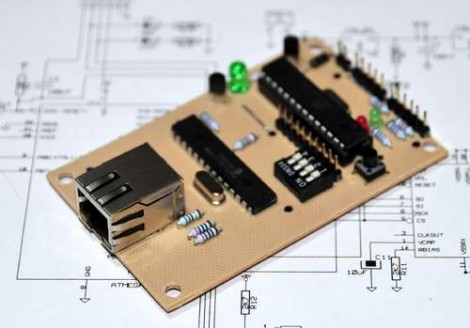
We’ve said it time and again, the Arduino is a prototyping platform. In that spirit, [Doug Jackson] shows you how to conserve the expensive Arduino board and Ethernet shield by building your own Arduino Ethernet module. You may remember the ENC28j60 as a NIC for your microcontrollers. [Doug’s] board makes use of that chip and adds an ATmega168 with a crystal, power regulator, breakout pins, and even a few DIP switches which can come in quite handy.

Touch Screen Using Range Sensors

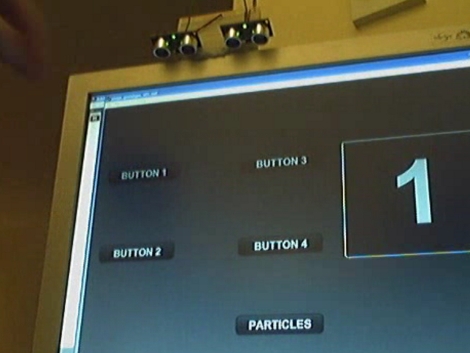
This touch screen relies on measurements from two range finders to track your finger as you press buttons. [James Alliban] put this together as his first Arduino project. We’re familiar with [James’] background because of his informative augmented reality business card. As the Arduino picks up data from the range finder it sends it to a Flash script that is running on the PC.

As we watched the video after the break a lot of questions came to mind. What kind of angle do these Ping sensors have? Will there be interference problems if they were placed perpendicular with each other? Would you get more accurate data if they were not both on the top of the screen? For now this is just a preliminary experiment, but we like the concept and may give it a try ourselves.

Continue reading “Touch Screen Using Range Sensors”

Heel Treads Make Shoes Go

Motorized treads as a replacement for the heel of your shoe? Okay, remember how The Jetsons had moving sidewalks everywhere so you wouldn’t have to walk at all? Well, there’s a much more efficient way to do it and Treadway Mobility seems to have figured it out. In the video after the break you can see several of their prototype units zipping the wearer around quite happily. We think the best part is that with the tread locked in place you can stand and walk like normal, assuming you don’t feel like you have a block of concrete attached to each foot. Maybe the real question is which is more geeky, this or the power lace shoes?

Continue reading “Heel Treads Make Shoes Go”

Whole House Current Monitoring

[youtube=http://www.youtube.com/watch?v=HlRBrTTLQFU]

[Debraj Deb] put together a current monitoring device that interfaces with the circuit box at his house. The system is controlled by a PIC 18F4520 and uses an LM358 Op-Amp to rectify the AC signal, as well as an MCP6S21 for range adjustments for detecting both high or low current loads. The data displayed on a character LCD includes average, RMS, and peak current. For now the data is saved to an EEPROM and can be dumped using a serial connection but [Debraj] plans to add a GSM modem so he can send energy use data to his cell phone.

[Thanks Ganesh]

Multi-layer Display Uses Water Instead Of Screen

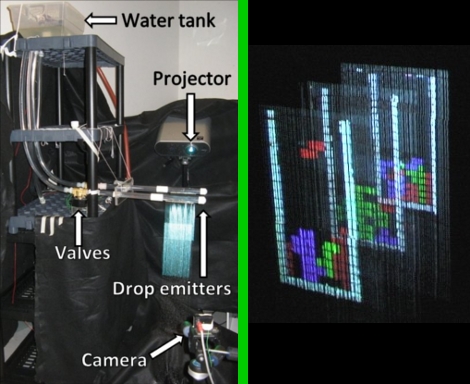
This multi-layer display uses droplets of water as a projection medium. This way, several different projected areas can be seen for a not-quite-3D layering effect. The trick is in syncing up all aspects of the apparatus. There are three manifolds, each with 50 stainless steel needles for water drop production. A solenoid valve actuates the drops, a camera images them mid-air, and a computer syncs the images of the dots with a projector. In the video after the break you can see the SIGGRAPH 2010 presentation that includes a description of the process as well as action shots including a 3-layer version of Tetris.

Continue reading “Multi-layer Display Uses Water Instead Of Screen”

Texting With Some Walkie-talkies

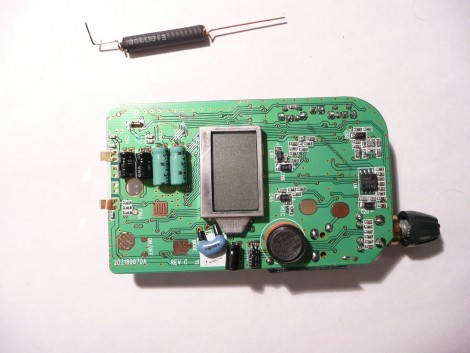
[Travers Buda] is giving new life to his abandoned childhood toys. He cracked open a set of Family Radio Services radios he had received for a birthday which work up to 2 kilometers apart. With just a bit of extra circuitry he was able to get them to act as wireless modems. The system functions but it looks like it would benefit from some more refinement, including error correction. In the end [Travers] manages to send and receive ASCII based messages at a whopping baud rate of 10.

Decatron Stand-in

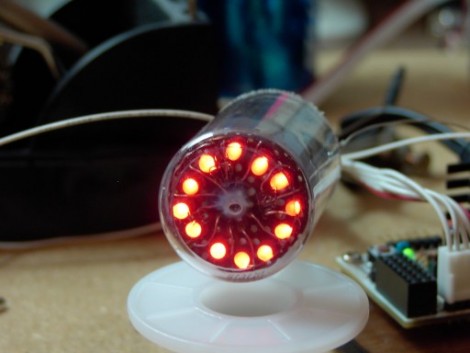
Think the swirling glow of a Decatron is cool but don’t want to deal with the voltage issues? [Osgeld] sidestepped the problem by developing a fake Decatron. Admiral Nelson (Captain Morgan’s cheaper cousin) provided the enclosure in the form of an airplane sized liquor bottle. The LEDs are common-something (not sure if it’s anode or cathode) so they end up being individually addressable through the mess of wires coming out the end. This will greatly simplify that kitchen timer we’ve been meaning to build. See the blinking lights go around and around after the break.

Continue reading “Decatron Stand-in”